A 'first verified record' of a 'new' lizard in British Columbia?: Teaching geography of the Pacific Northwest through news of a driftwood-pile denizen
(Originally posted elsewhere on 14 August 2020.)
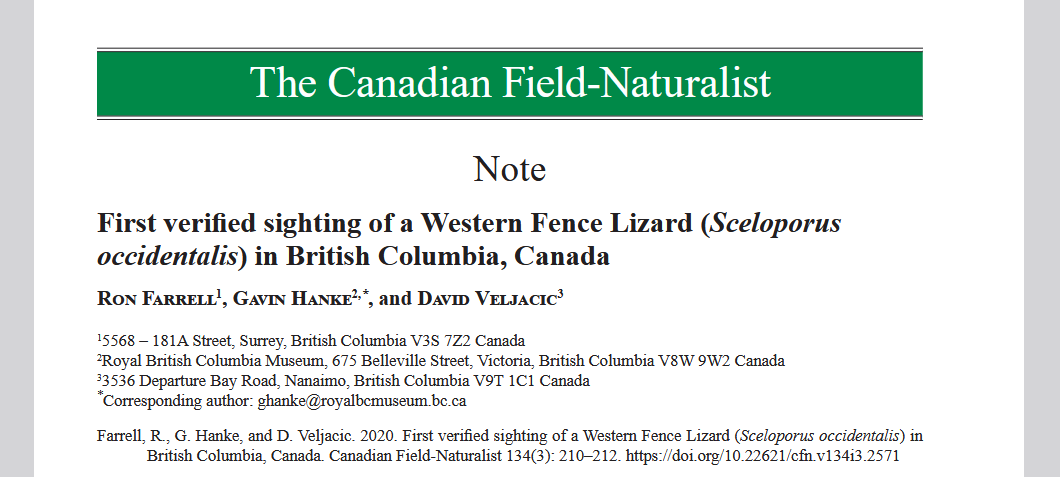
It happened, they found one: a “new” lizard species (well, subspecies) formally documented within the borders of British Columbia (and, by extension, the nation of Canada): the Northwestern fence lizard (Sceloporus occidentalis occidentalis).
Not a surprise to me, having been fixated on maps/reptiles (specifically on northern distribution range limits of reptiles/amphibians in the Pacific Northwest) and the uniqueness of little pockets of ecological islands (happens a lot in PNW because of mountainous topography, rain shadows, and marine climate—think about Palouse Prairie, Rocky Mountain Trench, the narrow islands of dryland/sagebrush in BC’s Okanogan Valley, inland temperate rainforest zone, the Sunshine Coast of easternmost shoreline of Vancouver Island, the way little pockets of oak savanna dot Fraser Valley or the island near Victoria) since I was little. This lizard is among a couple—the bullsnake, the Pacific gophersnake, the pygmy short-horned lizard—that have either been extirpated from within Canadian borders (having only historically lived in uttermost southerly reaches of the borders) or living within the US in very close proximity (close enough and near consistent enough habitat that they probably do occasionally occur).
But!
Wait.
The Northwestern fence lizard is a unique case.
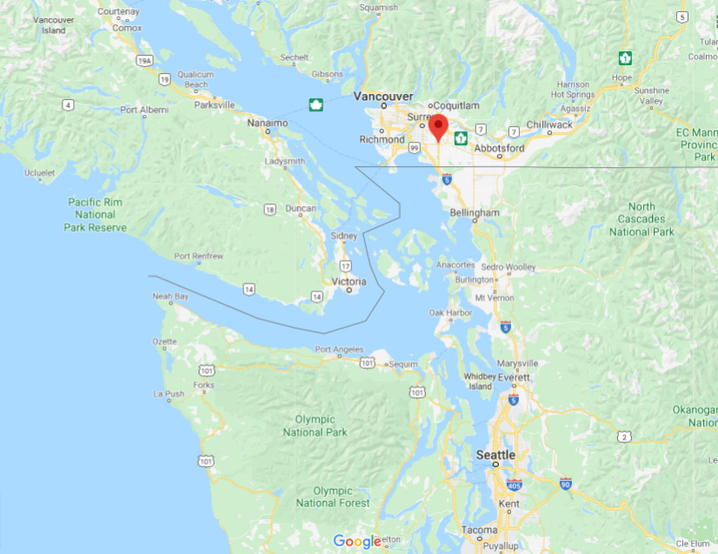
The lizard was recorded in early June 2020 in the Fraser Delta of the coastal PNW from Surrey, in the urbanized metro area of Vancouver, within the arbitrary political borders of so-called BC/Canada. (The closest known population of fence lizards is within US borders, only 30 kilometers away near Bellingham in Washington State).
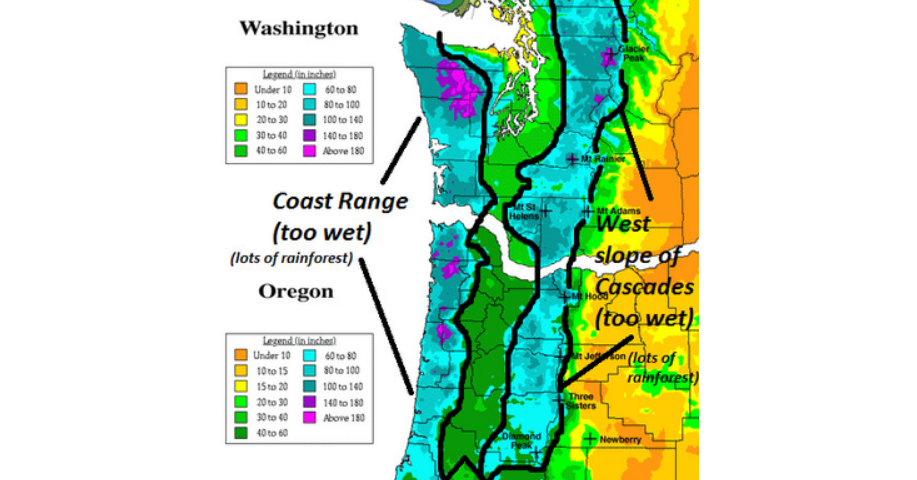
Photo documentation was included and the announcement was made by the Royal BC Museum’s Natural History blog. This might make some kind of sense, because the Northwestern fence lizard has one of the most interesting (to me, at least) geographic distribution range patterns for a reptile/amphibian in the PNW. A lot of the coastal PNW is shrouded in temperate rainforest (too wet and cool and shaded for most reptiles).
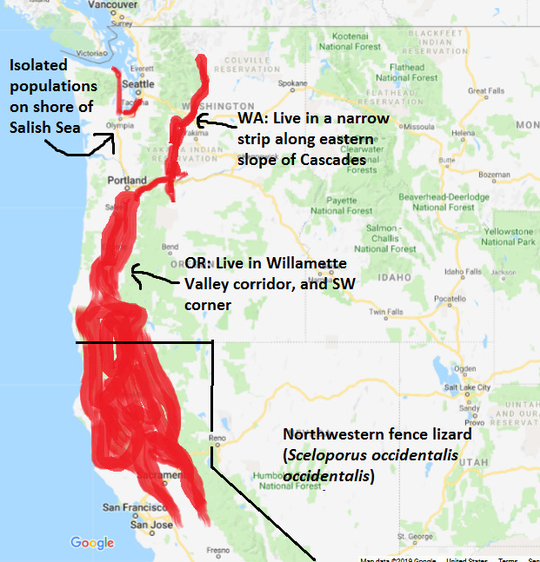
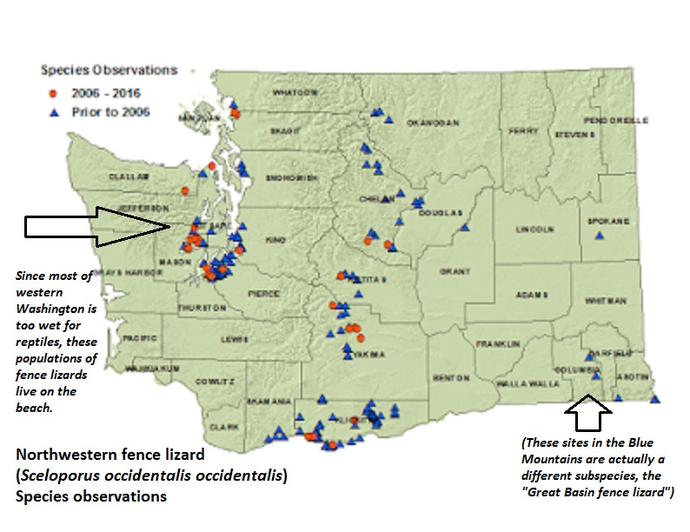
But the populations of Northwestern fence lizard in western Washington are isolated and unique. They live in driftwood habitat on the beaches of the Salish Sea.
The question is: Does this Northwestern fence lizard actually “naturally-occurring” in the Fraser Delta?
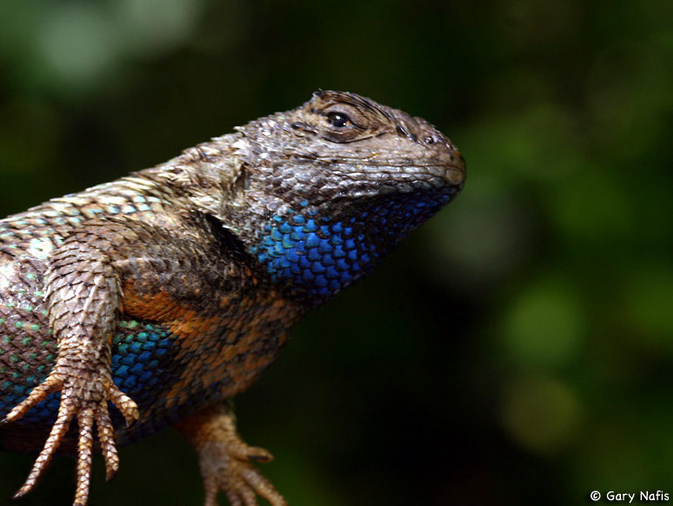
Here’s a Northwestern fence lizard from beach habitat from the Salish Sea within Washington State:
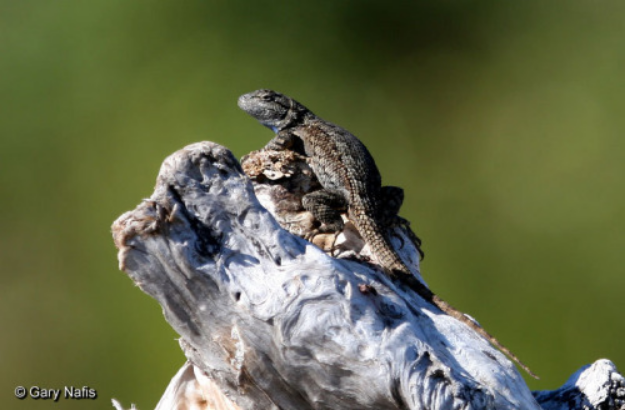
A Northwestern fence lizard from Kittias County, Washington:
Location of the “new” lizard:
Known native distribution of the Northwestern fence lizard (sorry for bad quality of the map, because—surprise, surprise—I made it using working-class GIS, ie. Microsoft Paint):
Two other native lizards are known to live within BC borders: Skilton’s skink and the Northwestern alligator lizard. (One other species of lizard might be extinct: The pygmy short-horned lizard, a species basically endemic to the inland Pacific Northwest, was historically reported from the Okanogan Valley.)
And coastal British Columbia is also home to an invasive/non-native introduced lizard: the European wall lizard of the Victoria area.
Canadian naturalists, I’m guessing, would not be entirely surprised that the fence lizard miiight be present within BC borders because of the proximity of two separate populations of the lizard nearby in Washington state: (1) The Puget Sound/Salish Sea, near Bellingham/Mt. Vernon, and (2) in the East Cascades slopes at the Methow Valley south of the Okanogan.
The Northwestern fence lizard a species of “Californian ecology,” from the oak and woodlands of northern California, Klamath Mountains valleys, and Willamette Valley. But it also has isolated populations existing on the beaches of the Salish Sea, where it lives in driftwood piles. The coastal Pacific Northwest is very wet, covered in rainforest: not very nice for reptiles that like “dry” environments. but the fence lizard has native “naturally-occurring” populations on these beaches, probably because the rain shadow of the mountains of Vancouver Island and the Olympic Peninsula provides a very narrow corridor of “mild” and relatively “drier” Garry oak habitat along the Salish Sea, where cities like Seattle and Vancouver can experience relatively warmer and milder climates despite being located so close to high-elevation mountains and humid temperate rainforest.
The Northwestern fence lizard’s distribution is relatively similar to the sharp-tailed snake (Contia tenuis), another rare example of a reptile from the coastal PNW.
Photo via California Herps; map by me, sorry:
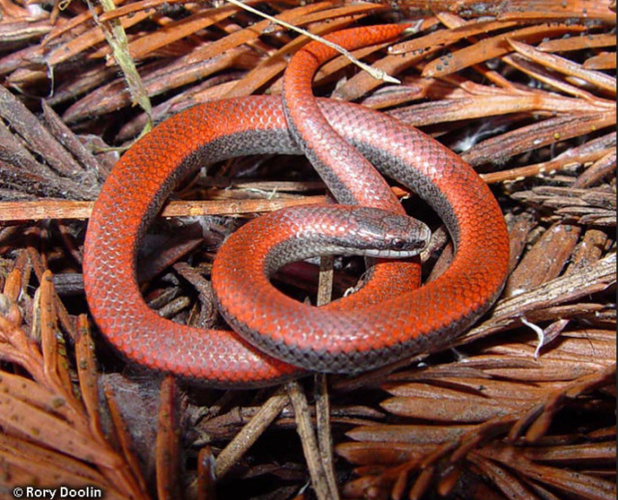
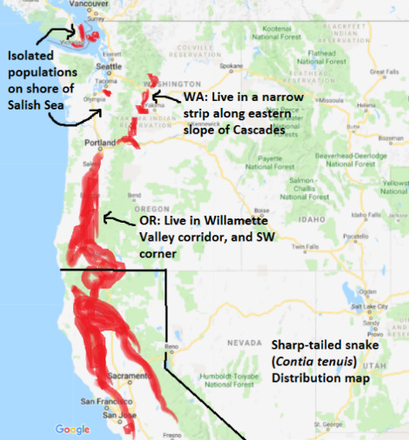
Very similar.
Compare the lizard’s map below to a climate zone map:
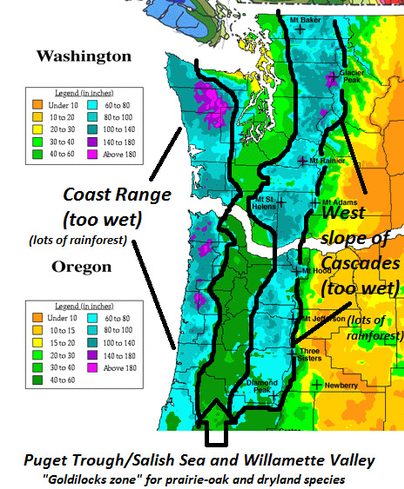
And then compare the climate zone map to a distribution map of Garry oak and oak savanna:
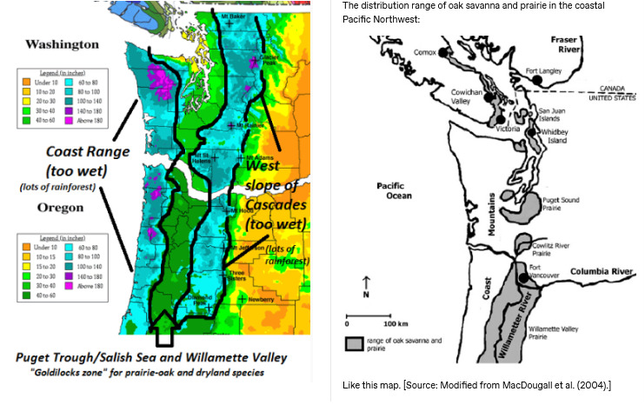
Anyway, the Northwestern fence lizard has populations near Port Angeles, Port Townsend, and Seattle; one of these populations exists near Bellingham, not far from Surrey and the BC border. also, there is a separate population of Northwestern fence lizards living in a narrow corridor of habitat on the other side of the Cascades, on the eastern slopes of the Cascades in the Methow Valley; this population is also close.
Again: but.
Even though there is contiguous habitat of coastal lowlands shared between the Bellingham and Surrey lizards, meaning that naturally-occurring fence lizards could be in the Vancouver metro area, gotta be hesitant about the Surrey lizard being “native.”
1 - So much of the Fraser Delta has been heavily altered and urbanized, so that almost none of the habitat is intact. other native coastal lowland species which were originally present in the Fraser Delta have gone extinct in the past century, including the Pacific gophersnake (which was historically detected near Bellingham and also on the Gulf Islands east of Victoria, but which no longer survives within Canada) another reptile species with a similar distribution pattern to the fence lizard.
2 - It’s very possible that this fence lizard was a transplant; a “pet” picked up in Washington State and then released.
3 - Also, even if this lizard from Surrey represents a “natural” dispersal from the population of lizards living near Bellingham in Washington State, have to point out that the population in Mt. Vernon was itself introduced by some meddling land manager in the late 1980s and early 1990s.
So hmmm?
Because I love the habitat: Here’s Northwestern fence lizard habitat on the shores of the Salish Sea (Maury Island, Washington):
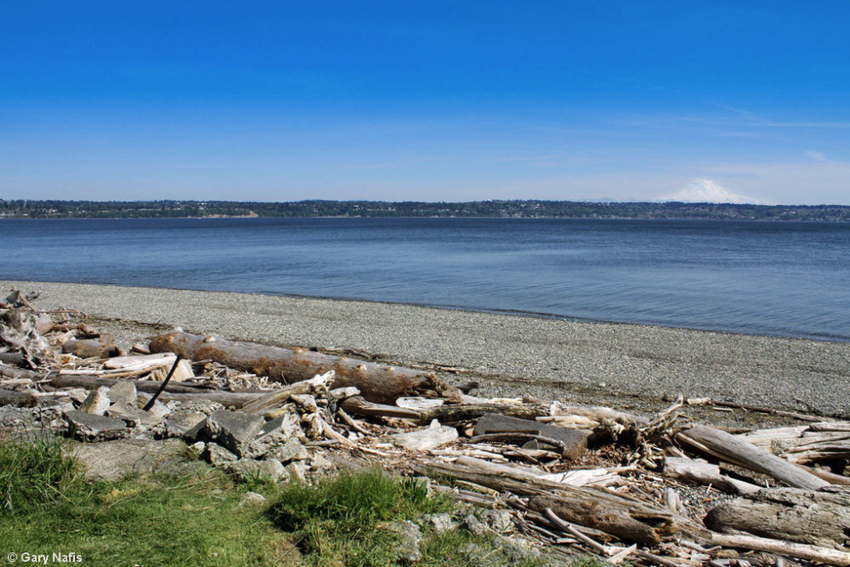
Maybe worth pointing out that these coastal lowland habitats on eastern Vancouver Island and the Fraser Delta are under real estate threat—of sorts—from another lizard: the non-native introduced European wall lizard.

Well, at least they’re not like bullfrogs, another non-native introduced species in the coastal Pacific Northwest. In that case, bullfrogs are a much greater threat: with a voracious appetite, they eat other frogs, like the endangered regionally-endemic species the Oregon red-legged frog, nearly extinct from its last remaining home in Canada (which also happens to be the Fraser Delta).