Acknowledging a holiday with slave revolts and the 1831 Christmas Rebellion

(Originally posted elsewhere on 23 December 2025.)
Just a Christmas-themed post that recalls the significance of calendar holidays to practices of escape among slaves in the Caribbean and antebellum US.
Screenshots to set the mood and make the case (I added URL source to each screenshot; following excerpts come from elsewhere):
Excerpt 1:
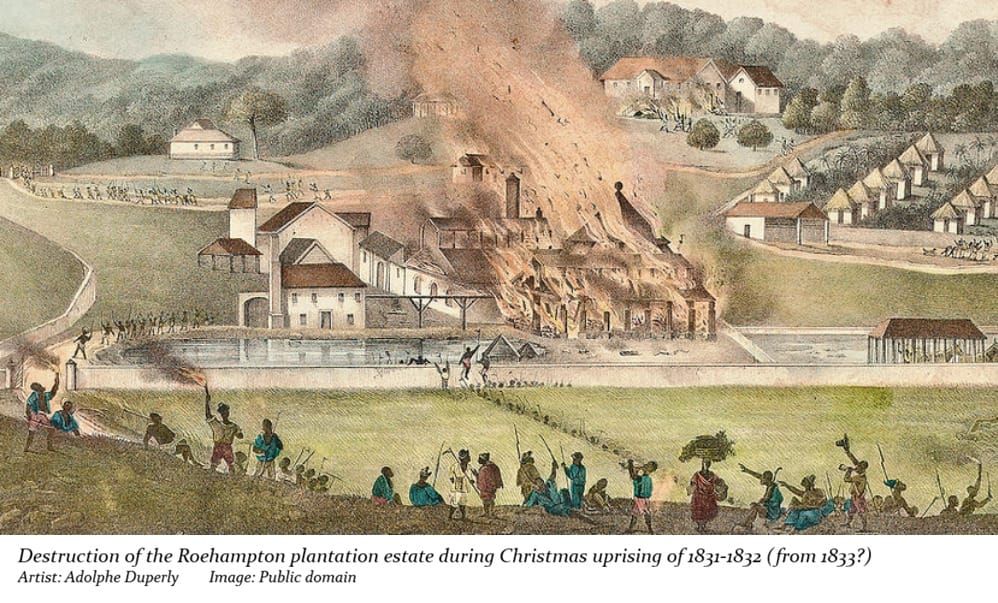
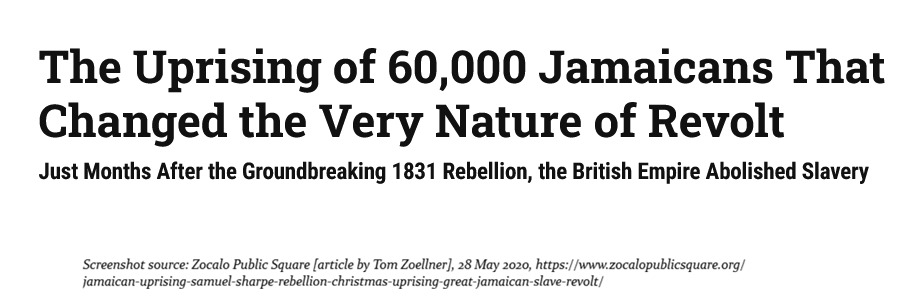
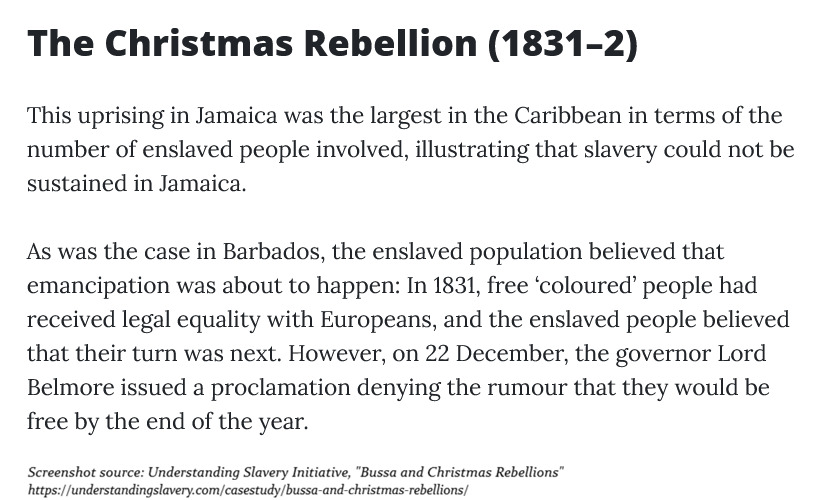
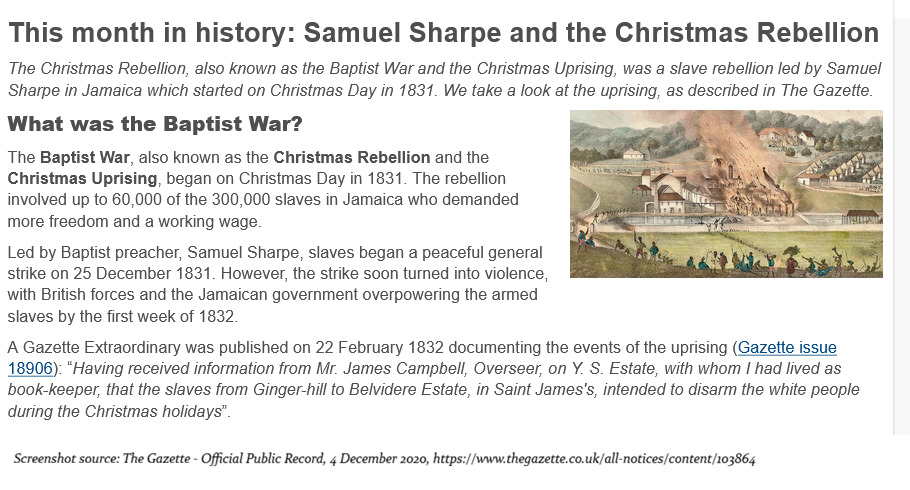
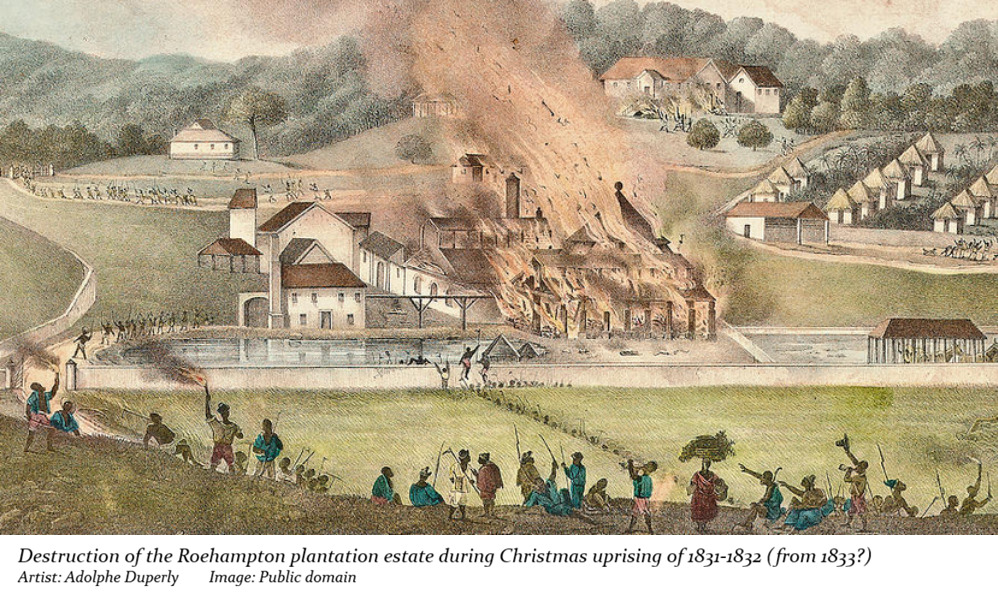
Yet, Douglass rightfully criticized the double-edged purpose of this seeming autonomy, arguing that the holidays were “among the most effective means in the hands of the slaveholder in keeping down the spirit of insurrection…These holidays serve as conductors, or safety-valves, to carry off the rebellious spirit of enslaved humanity…The holidays are part and parcel of the gross fraud, wrong, and inhumanity of slavery.” [...] Across the Americas, stories nevertheless abound of enslaved peoples utilizing this small window of, in the words of Northup, “a little restricted liberty” [...]. The famed fugitive enslaved couple and abolitionists Ellen and William Craft fled from Macon, Georgia to the north during the Christmas holiday in 1848. [...] The Christmas season also gave way to the largest slave rebellion in the history of the British Caribbean known as the Christmas Rebellion (or the Baptist War). During ten days in late December 1831 into January 1832, nearly 60,000 slaves (about 20% of the enslaved population of 300,000) led by the black Baptist preacher Samuel Sharpe went on strike and rebelled against plantation owners, demanding freedom and higher wages. According to Michael Craton’s Testing the Chains: Resisting Slavery in the British West Indies (1982), about 500 slaves were brutally killed by the end of the Christmas Rebellion, which Craton argues accelerated the process of emancipation in the British Caribbean. When the self-described liberto Santiago Martínez ran away from his master [...] [in Gran Colombia] on Christmas day in 1820, he was one of hundreds of bonded peoples of African descent who took matters into their hands during this special period [...]. In fact, one could even place Martínez’s marronage or the Crafts’ masterful escape on a longer historical timeline of Christmas and resistance to slavery beginning with the 1521 Hispaniola Revolt, which historian Martin Klein has called “probably the first revolt by African slaves in the Americas.” On Christmas Day in 1521, a group of 20 Wolof captives, who were claimed by Christopher Columbus’s sons, revolted against their overlords. According to Klein, “they waited until Christmas Day, when the Spaniards were celebrating and not paying careful attention.”
Text above by: Yesenia Barragan. “Christmas and Resistance to Slavery in the Americas.” Black Perspectives [published by African American Intellectual History Society]. 23 December 2016. URL: https:// www.aaihs. org/christmas-and-resistance-to-slavery-in-the-americas/ [Emphasis mine.]
—
And what of the scale of slavery on Barbados? What would warrant a rebellion?
Excerpt 2:
Throughout the eighteenth century the empire’s epicenter lay not in North America, Africa, or India but in a handful of small sugar-producing Caribbean islands. The two most important--tiny Barbados and its larger, distant neighbor Jamaica--were among the most profitable places on earth. On the eve of the American Revolution, the nominal wealth of an average white person was £42 in England and £60 in North America. In Jamaica, it was £2,200. [...] This gigantic influx of capital funded the building of countless Palladian country houses […]. Sugar became Britain’s single largest import, and the craze for it revolutionized national diets, spending habits, and social life [...]. Between 1700 and 1800, English consumption of sugar skyrocketed from about four pounds per person per year to almost twenty, roughly ten times as much as that of the French. [...]
In the decades following the Coromantee War, Jamaican slavery expanded and flourished as never before. In 1760 there had been about 150,000 slaves on the island; by 1808 there were over 350,000. To safeguard its white inhabitants, the colony became ever more heavily militarized. In the aftermath of rebellion, new laws severely curtailed the rights and movements not only of slaves but also of all other nonwhites: white solidarity was increasingly seen as crucial to security.
The British finally outlawed the transatlantic trade in 1807 (the same year the United States did). But the fantasy of an acquiescent […] class, governed by benevolent masters, never materialized, nor did the gradual withering away of slavery that abolitionists had hoped for. On the contrary, as Tom Zoellner argues [...], it was another Jamaican rebellion that finally precipitated the end of British slavery in the West Indies. Shortly after Christmas 1831, between 30,000 and 60,000 men and women rose up and ran away, refusing to work any longer as slaves. Hundreds of plantations were set on fire […].
The Slavery Abolition Act didn’t apply to India or Ceylon, and though it technically liberated over 800,000 British slaves in the Caribbean and Africa, all of them (excepting only small children) were forced to continue to labor as unpaid “apprentices” for a further six years, [...] subject to punishment for “indolence,” “insolence,” or “insubordination.” So many black West Indians were jailed for resisting these outrageous terms that full emancipation was eventually brought forward to August 1, 1838. [...]
In the meantime, for almost two hundred years, British taxpayers funded the largest slavery-related reparations ever paid out. Under the provisions of the 1833 act, the government borrowed and then disbursed the staggering sum of £20 million (equal to 40 percent of its annual budget—the equivalent of £300 billion in today’s value). Not until 2015 was that debt finally paid off. This unprecedented compensation for injustice went not to those whose lives had been spent in slavery, nor even to those descended from the millions who had died in captivity. It was all given to British slaveowners, as restitution for the loss of their human property.
Text above by: Fara Dabhoiwala. “Speech and Slavery in the West Indies.” The New York Review. 20 August 2020. URL: https:// www.nybooks. com/articles/2020/08/20/ speech-slavery-west-indies/ [Emphasis mine.]