A"grasshopper army," relief for the "(un)deserving poor," nationalist marketeering, and disaster in the Plains: implications of the Rocky Mountain locust swarm of 1874

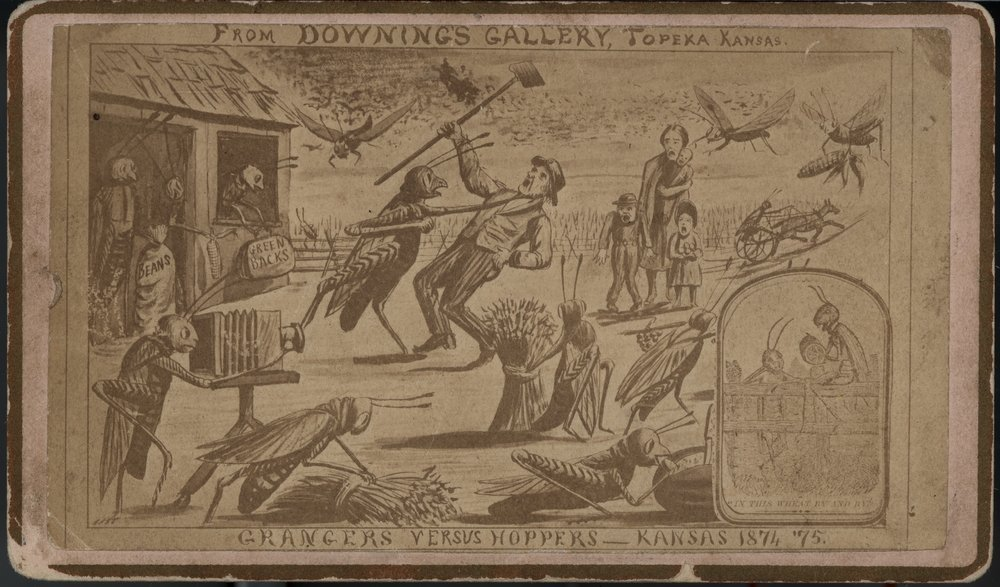
(Public domain image of an illustration from 1875 by cartoonist Henry Worrall, provided by the Kansas Historical Society to Wikimedia Commons.)
Just wanted to summarize takeaways from Alexandra Wagner’s work on implications of class; changing paradigms of poverty/disaster relief; nationalism in the marketing of frontier settlement; the curious timing of the Chicago fire of 1871; and the representation of insects/”pests.”
In brief:
- Context: Millions and millions of swarming insects obscuring the sun (Wagner cites estimates of 12.5 trillion locusts) in the Great Plains, in roughly ten days in July 1874. They apparently affected, to some degree, perhaps 198,000 square miles, though print media and most densely populated areas affected reflect most anxiety in transition zone between tallgrass/shortgrass prairie regions of Nebraska, Iowa, western Minnesota, etc. Wagner acknowledges the reports of grasshoppers (and their dead bodies) in such quantity/thickness to have allegedly stopped a Union Pacific train at Stevenson station (near Kearney, Nebraska). When turkeys and chickens consumed grasshopper bodies, “the digested insects tainted meat and eggs with reddish-brown oil.” Agricultural damage may have, in the stats cited by Wagner, affected 74 percent of the total value of US farm products in 1874. Hundreds (thousands?) were at risk of starving in the following winter.
- Serendipitous timing meant that relief aid funds weren’t readily available because this was in the immediate aftermath of the Panic of 1873 and the resulting Long Depression. (Illustrating rural/local vulnerability to crises of international capital, and also just… bad luck?)
- In 1877, Governor Penington of Dakota Territory declared May 4th a day of “humiliation, fasting, and prayer” to fight the bugs by ordering fields burned; he also ordered banks/schools/businesses to close to allow participation (because of an unexpected early-season grasshopper egg-laying hatch when a warm spring created local microhabitat for the bugs, suggesting wide/significant social consequences wrought from local/isolated quirks of ecology).
- April 26th was declared a similar day of “fasting and prayer” by Governor Pilsbury of Minnesota. (By the way, he was an heir of the agriculturalist pseudo-nobility—the Pilsbury family—from which we now get corporate Pilsbury dessert products.)
- In 1877, the Nebraska Legislature issued a regulation encouraging a “grasshopper army” to fight the “public enemy” (the locusts), mandating that all men ages 16-60 perform two days’ manual labor killing insects or else face $10 non-compliance fine.
- Most curious to me in Wagner’s telling is how we see a transition from Victorian disregard for poor people into more contemporary model of means-tested welfare more typical of the ascendant Progressive Era, in which a potentially early form of calculated means-testing was deployed to determine if people need assistance or are merely “lazy,” mobilizing framework of “the deserving poor” vs. “improvident, insolent, idle poor.” Aside from the Panic of 1873, there’s more to this serendipitous timing, since the great Chicago Fire of 1871 was, in Wagner’s telling, similar in character to the locust swarm of 1874. “Both disasters,” says Wagner, “although local or regional in nature, drew national interest and the sympathy of residents living in the East.” But the parallels don’t end with spatial and temporal proximity between fire-mauled Chicago and the locust-swarmed Plains. “Similar to western boosters who argued that too much aid might render farmers ‘soft,’” Wagner suggests, “many prosperous Chicagoans had feared unfettered charity and the ‘potential dark side’ of fire relief in 1871.” Wagner invokes historian Karen Sawislak, who described the Chicago Relief and Aid Society (populated by wealthy citizens) as “internally at war between a form of humanitarianism and conservative impulses, between a committment to aid the poor and a desire to preserve what they viewed as the proper social order of the city.” Thus, local (Nebraska, Iowa, Minnesota, etc.) advocates, in soliciting donations, sought to carefully project an image, hoping that the “nation viewed them as deserving poor, meaning that their condition had not resulted from their immorality … or individual failure.” In 1871, Chicago solicited aid from New England/Mid-Atlantic, and local charity organizations instituted means-testing, making people take oaths—that they were destitute and had sold all of their possessions—before access to relief. So in Nebraska in the winter of 1874-1875, to get aid for locust damage, a similar oath/testimony was required. A Nebraska man, in a letter published in the Worcester Daily Spy, explained: “If a man wants help he must go to one of the officers of the relief society and make a sworn statement that he has got nothing that he can sell to get anything with.”
- Beyond representations and belief systems characterizing poverty/”the poor,” Wagner also highlights the endurance and sometimes self-defeating consequences of subscription to notions of frontier masculinity/ruggedness: “When soliciting donations from other states, western delegates tried to maintain the public perception of western farmers as brave, patriotic, and resilient.” She includes a fair amount of excerpts from advocates, state officials, and others in print media to corroborate this. Though something akin to “pride” was apparently not the only influence on this, in her telling. Wagner suggests that promotion/marketing and local Plains institutions/landowners’ desire to maintain the region’s image as a fruitful site for potential investors and settlers also influenced their choice to initially downplay the disaster in both local and national papers. (Aha! Materialist motivations, of course!) Wagner then charts the transformation of local authorities’ rhetoric once they realized the persisting seriousness of the potential famine, proposing (again, with their press releases and solicitations) that they pivoted to presenting themselves as in-need yet still-rugged, with a nationalist bent. From one 1875 report from a federal official touring the region: “Thrift, enterprise, industry, and economy was exhibited in and around nearly every poor cabin I visited.”
Anyway, her study: Alexandra M. Wagner, “Grasshoppered: America’s Response to the 1874 Rocky Mountain Locust Invasion,” Nebraska History 89 (2008), pp. 154-167.
- By the way, I’d add: The locust species was entirely extinct less than thirty years later. 12 trillion to 0 in three decades.
- See Wyoming-based ecologist Jeffrey Lockwood’s research. Lockwood specializes in the natural history of the locust, and his work in recovering partially preserved locust bodies from alpine glaciers in the Wind River range and Yellowstone region influenced him to propose that part of the reason for the locust’s rapid extinction was the specificity of the habitat in which it deposited eggs/reproduced—despite the vast swathes from Saskatchewan to Chihuahua over which adults dispersed. This incubating reproductive habitat, Lockwood and some others suggest, may have been relatively limited to foothills and riparian corridors of the Upper Missouri watershed within the political borders of what is now Montana/Wyoming. Thus, “small”-scale environmental change—wrought by settler industry?—at relatively or seemingly localized sites can have significant consequences for much wider regions/ecologies.
- Bonus: This is not addressed by Wagner, but Dakota/Nebraska/Minnesota governments’ raising of anti-insect “armies” of citizens brings to mind the persistence of similar public conscription and rhetoric of violence incited for a kind of national defense in California institutions’ language of fighting disease/”pests” during the 1910s. Tangential, but I’ve been doing a lot with that setting lately. This included the quarantining of inbound Chinese/Japanese laborers at Angel Island Immigration Station; the clearing of red-light districts in San Diego/San Francisco by framing sex workers as “reservoirs of infection” akin to malarial swamps; growing discourses of border monitoring in the context of the Mexican Revolution; and the anxiety about safeguarding San Joaquin/Sacramento Valley agricultural commodities against “alien” pests arriving via trans-Pacific flow of crop diseases and insects, as addressed by Jeannie Shinozuka. However! The grasshopper army rhetoric most reminds me, in that same decade, of the“War of Squirrels” in 1918, meant to protect agricultural produce from “pest” ground squirrels. The state agricultural board encouraged schools to have kids competitively kill squirrels, and state agencies published posters showing squirrels with little pointed German helmets and mustaches meant to resemble Kaiser Wilhelm, adjacent to text like “the law says KILL ‘EM!” (marketed to children!) and with text which also explicitly detailed/instructed kids in how to use/apply poison. All kinds of shit with California’s obsession with quarantine/pests.
- Maybe you’d enjoy looking-up some of the print media cartoons of locusts from the 1870s? There’s at least one dramatic illustration (composite photo; newspaper/postcard) of a locust halting a train, seemingly in reference to the report from Kearney, Nebraska.