Tasmania as 'sanitaroium of India' and the thylacine as 'tiger': Knowledge, global networks of administrators, and associating imperial peripheries with each other in British imaginaries
(Originally posted elsewhere in May 2026.)
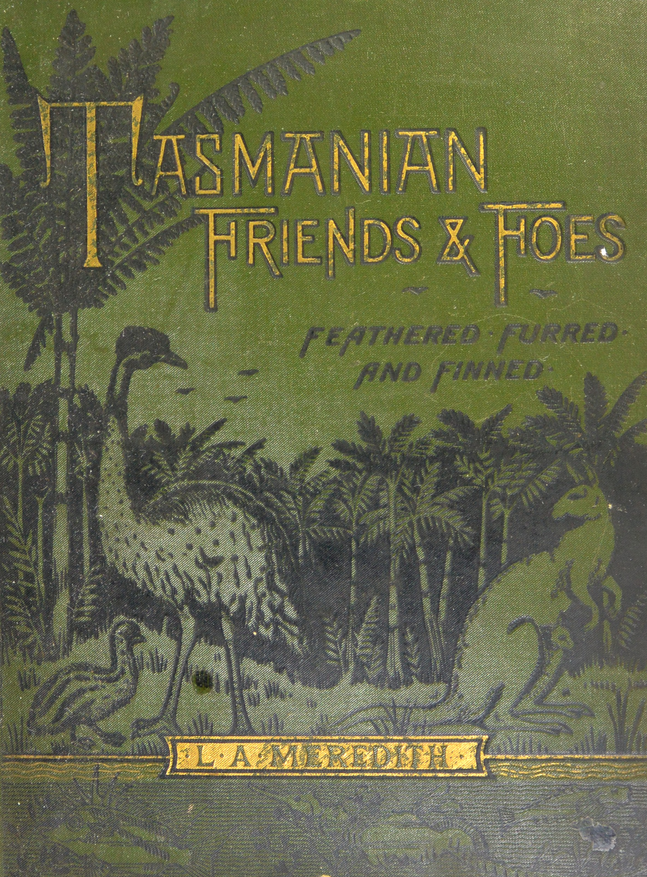
The image pictured above was circulating among my online circle this week. Illustrating a flightless endemic bird and a wallaby, it's the cover to: LA Meredith, Tasmanian friends and foes (1881).
This led me to consider the framing of thylacine as pest and dangerous predator among British administrators in the late nineteenth and early twentieth centuries. In turn, this brought to mind associations identified by Bikash Kumar Bhattacharya.
In a 2023 piece for The Otter, Bhattacharya locates anti-thylacine campaigns of that period in the connections between colonial authorities of India, on the one hand, and administrators of Aotearoa, on the other. Individual officials were often stationed in both places during their careers.
Check it out.
--
Excerpt:
A Dreamtime story from the Nuenonne First Nation of Bruny Island off the Southeast Coast of Tasmania (lutruwita) narrates how [...] a young pup [...] of the “Tasmanian tiger” (thylacine) [...] transformed [...] into corinna [...]. When lutruwita -- Tasmania, also known as Van Dieman’s Land -- was opened for British colonization in 1803, a medley of settlers -- from [...] fortune-seekers to species hunters -- made it to the island in the course of a few years. Travel guides and memoirs published at the time soon dubbed Tasmania the “sanatorium of India,” drawing many British colonists to the island who hoped to recuperate their health debilitated by prolonged stay in the tropics.
More significantly, it wasn’t only materials and bodies that circulated between the colonies [India and Tasmania]. But also ideas, impressions, and experiences gained in one colony made their way to the other. [...]
Settler farmers identified the thylacine as a “blood sucking vampire” [...]. [P]olitician John Lyne -- a representative of the Tasmanian rural lobby -- proclaimed, quite preposterously, that “30000 or 40000 sheep” were taken each year by the thylacine [...]. By 1830, the Van Diemen’s Land Company was already offering a reward for the killing of [...] the “hyena” i.e. the thylacine. Likewise, Mercury reported in 1882 in a piece headlined “Tiger Extermination” that landowners declared “a reward of £5 to be paid for each full-grown tiger [...] and £2 10s, for all cubs [...]." As a result, the animal [...] was extirpated by 1936. Comparison between the thylacine and the Indian tiger abounded in settler discourses [...]. This was in spite of the fact that the thylacine and the Indian tiger were two entirely different species, morphologically and ecologically. [...] Yet early settlers in Tasmania, many of whom had first landed on or had connections in British India carried the idea of the tiger as a ferocious predator [...]. [T]hese representations of the thylacine’s “nature” were based on faulty understanding of the animal perpetuated by myopic colonial science that privileged imperial economic interests above all. [...]
---
One of the major thylacine traders in Tasmania was James Harrison. Known as the “West Coast naturalist,” Harrison purchased and sold about twenty-five live animals and twenty dead specimens of thylacine. He was born in the Nowgong district of Assam in northeast India to a family of speculators en route from England. It is noteworthy that James Harrison spent his childhood in a region in India that was known for its [...] wildlife. Game hunting [...] was [...] [a] common pursuit among the Europeans in Assam [...]. Moreover, the period saw a spike in the visit of professional hunters and species collectors to the region as vast [habitat] was being stripped off to make way for tea plantations. [...]
---
William Thomas Dennison, who served as governors of Van Diemen’s Land (Tasmania) and Madras in India, described in Varieties of Vice Regal Life (1870) the tiger hunts he had organized in India.
Dennison’s book reinforced the idea that the tiger is a pest, an impediment to human progress, which echoed his policies towards the thylacine during his stint as the governor of Tasmania (1847-1854). [...]
---
Likewise, Sainthill Eardley Wilmot -- the grandson of Sir John Eardley Wilmot, the lieutenant-governor of Van Diemen’s Land from 1843 to 1846 -- served as a forestry officer in British India. Sainthill was born in Hobart in 1852 and spent his early life there. In My Home In Tasmania (1852), Louisa Ann Meredith mentions the presence of an “untamed” wild thylacine in Sainthill’s grandfather Sir John Eardley Wilmot’s private menagerie in Hobart. Later Sainthill Eardley Wilmot would take a particularly hostile attitude towards the tiger and other big cat species while working as the Inspector General of Forests in British India. [...] He also wrote an it-narrative about the Indian tiger, The Life of a Tiger (1911), that predicted the tiger’s impending extinction. On multiple occasions, he has alluded to the thylacine “wreaking havoc” on flocks of sheep in Tasmania. [...]
The material circulation of the living thylacine in India is little known apart from an exhibition of two live members of the species at Madras Zoo in 1886 [...]. The narrative circulation of the animal, however, has been relatively plentiful.
---
Text by: Bikash Kumar Bhattacharya. "Constellation Spirit, Vicious Vermin, and Icon of Environmental Guilt: Affective Entanglements of the Thylacine in Tasmania and India". The Otter, Network in Canadian History and Environment (NiCHE). Emotional Ecologies series (edited by Jessica M. DeWitt and Sarah E. York-Bertram). 20 July 2023. Published at: niche-canada. org/2023/07/20/ constellation-spirit- vicious-vermin- and-icon-of- environmental-guilt- affective-entanglements- of-the-thylacine- in-tasmania-and-india/ [Emphasis mine.]