Are 'smurf-berries' real?: On the 'second transatlantic crossing' of sarsaparilla and Early Modern botanical knowledge

(Originally posted elsewhere on 26 July 2023.)
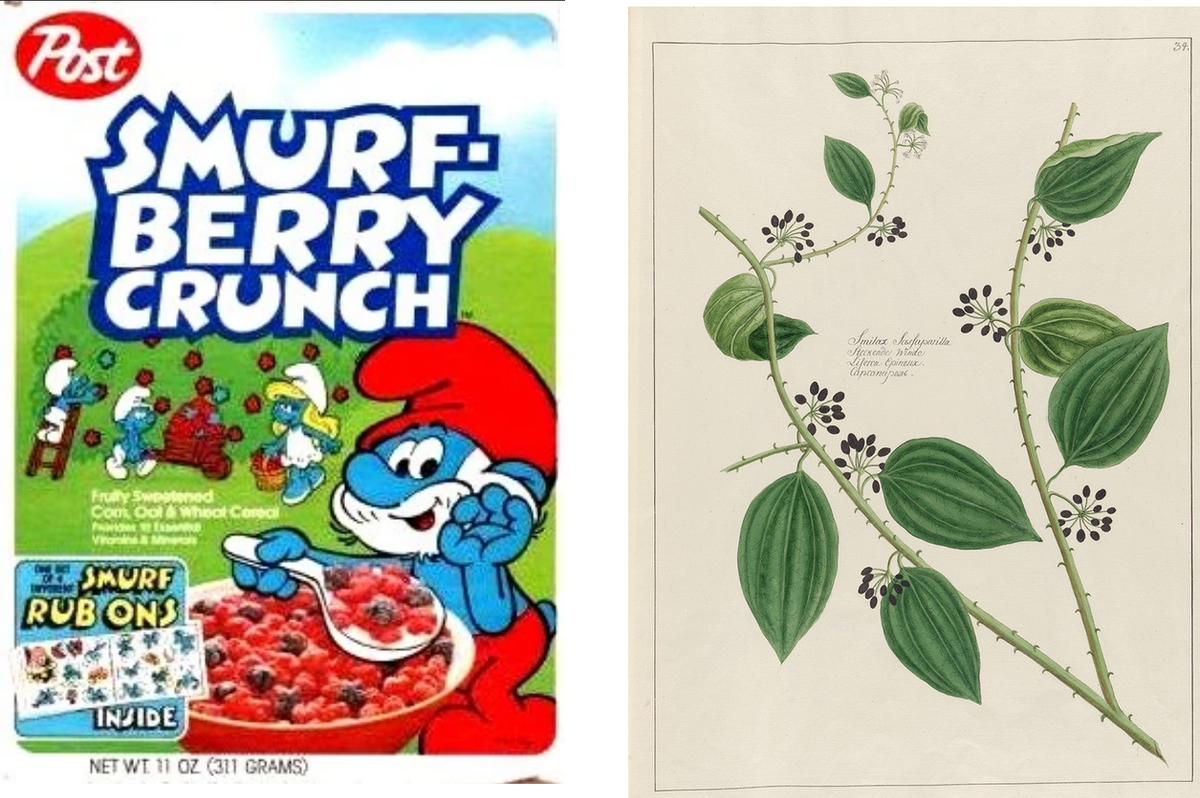
I was looking at photos of old 1980s consumer products available in US supermarkets. Upon seeing a Post product, "Smurf-Berry Crunch," which launched in 1983, I recalled a JSTOR Daily piece by Wouter Klein, where Klein invoked the smurf-berry/smurfberry (is there consensus on proper Smurf nomenclature conventions?).
Anyway, this was from the "Plant of the Month" series, and I was charmed by the way he framed the story of botanical knowledge and sarsaparilla (and popular US/European recognition or misrecognition of the plant) through the television program.
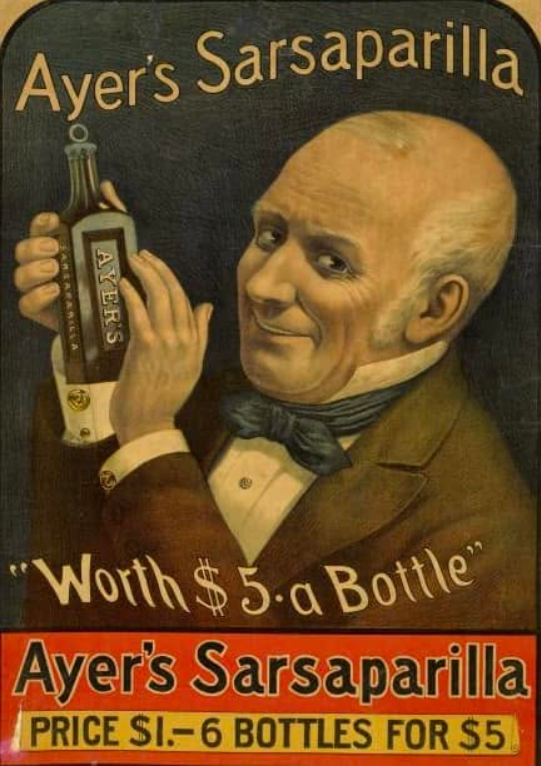
The lack of familiarity with sarsaparilla is interesting, since it is both a native New World plant and is also so widely used as a component in other consumer foods. Was it more recognizable to popular audiences during the heyday of print advertisement?
Anyway, Klein addresses it's history. Check it out.
--
Excerpt:
The introduction of the Smurfs in the United States signified, in fact, sarsaparilla’s second Atlantic crossing. The oldest references to sarsaparilla are from Old World antiquity, where Smilax aspera was used as an antidote for poisons. The Roman medical writer Dioscorides (first century CE) devoted a chapter to this plant […]. This description survived many centuries and became firmly embedded in the European medical tradition. […] When European naturalists explored the plants of the New World in the sixteenth century, they tended to relate new species to better-known plants whenever they could. […] Nicolás Monardes (1493–1588) described different kinds of American sarsaparilla in his work Historia medicinal de las cosas que se traen de nuestras Indias Occidentales (1565). His descriptions carried a commercial touch. For instance, he tried to convince his readers that the whitish sarsaparilla from Honduras was better than the black variety from Mexico. Similarly, he aimed to embed the new American kinds of sarsaparilla in the traditional framework of European medicine. […]
The old name sarsaparilla began to be associated not only with new Smilax species from different geographical regions, but also with new diseases. American sarsaparilla was not used as an antidote in cases of poisoning by venomous animals, but to cure syphilis. Syphilis had swept Europe […], and the market for syphilis remedies was booming. Yet a range of botanical substances had to compete with preparations that contained mercury. The most famous botanical antisyphilitics were of exotic origin: guaiacum wood, China root, sarsaparilla root, and sassafras wood. All these plant parts became staple drugs in European pharmacies […].
—
Sarsaparilla […] was also valued as a flavoring ingredient in medicinal tonic drinks, often along with sassafras. As such, sarsaparilla was to enjoy another wave of popularity in a later age. […] As a medical commodity, sarsaparilla enjoyed great commercial success early on. Between 1568 and 1619 alone, 670 tons of sarsaparilla were imported in Seville, Spain, equivalent to some 7.5 million doses. […]
In the eighteenth and nineteenth centuries, the borders between medicinal and other uses of sarsaparilla blurred. Proprietary remedies with sarsaparilla abounded, with the Ayer and Hood companies from Lowell, Massachusetts, turning the production of sarsaparilla into big business. In advertisements, it was usually promoted as a tonic, to purify the blood, and to create appetite. Because it was of American origin, it was supposedly especially suitable for American patients.
By this time, then, sarsaparilla had lost many of the Old World medical and cultural connotations […]. The divide became so pronounced that European fans of the Smurfs in the twentieth century were no longer expected to recognize the name of a plant that had been a mainstay of pharmaceutical practice there for centuries, while the name sarsaparilla lived on as a soft drink in the United States.
—
Image, caption, and text by: Wouter Klein. “Plant of the Month: Sarsaparilla.” JSTOR Daily. 16 June 2021. [”Plant of the Month” is a partnership between Dumbarton Oaks and JSTOR Labs.