Ghosts and girls from gekigo to Monthly Halloween: The advent of horror shoujo manga popularity among women, from 'alternative' 1960s to the 1990s boom (in printing) and bust (in markets) in Japan

On 30 October 2023, as the neighborhood’s popularly-beloved statue Hachiko was being fenced-off and shrouded from view to dissuade gathering, Shibuya Ward Head Ken Hasebe announced at a press conference—to great attention and some disappointment—that "Shibuya wa Halloween wo oyasumi shimasu” (“Shibuya is closed for Halloween”). Shibuya, the bustling Tokyo ward and internationally-famous hub of youth culture and nightlife, had hosted increasingly enthusiastic crowds of costumed revelers during the 2010s, with an estimated 100,000 people celebrating Halloween festivities in 2018. On the first day of October 2023, the ward had outlawed public alcohol consumption at nighttime near Shibuya Station, the first such year-round public alcohol consumption ban in Tokyo. The official closure and crowd control measures may not have come as a surprise to observers; after the 2018 toppling of a small truck in Shibuya, authorities began cracking-down on Halloween partying in 2019 before firmly discouraging gathering in the aftermath of the deaths of 159 people at a Halloween gathering in the Korean metropolis Seoul in 2022. To what extent might a mainstreaming of horror media consumed by teenaged girls and young women to be credited? Before Halloween—something of a recent cultural observation—was popular enough in Japan to attract tens of thousands to Shibuya’s streets, other horror-themed cultural iconographies had been expressed in those covers of shoujo magazine Monthly Halloween.
Section 1: Yokai in the 1960s
The year 1964 marked several horror milestones in film, magazines, and individual manga stories alike. Influenced by the scholarly publications of academic folklorists of the 1940s and 1950s, mangaka Shigeru Mizuki’s GeGeGe no Kitaro (1960) heralded a (re)discovery of yokai folk stories and a popular (re)engagement with stories of a morbid, “creepy” nature. Mizuki’s work was carried by Weekly Shonen Magazine, hinting at how shonen publishers firmly held the reigns of much creative production at that time. Manga in the early 1960s was largely driven by the model enforced by those publishers who deliberately marketed shonen to younger boys, a reliable demographic whose consumption publishers hoped to maintain with basic templates of bildungsroman stories, adventure, and narrative structures with little deviation. Nonetheless, the 1960s would bring a disillusionment with these standards—and with (inter)national institutions. At about the same time that Mizuki’s GeGeGe no Kitaro was receiving attention, legendary mangaka Kazuo Umezu was publishing one of the first of his de facto horror stories, Ningyo shojo (Doll Girl, 1959-1961). In 1965, foreshadowing the rise of both horror manga and the agency of women as readers, Umezu published the first installation of his Hebi Shoju (Snake Girl) trilogy, later known as Hebi Onna (Snake Woman), or Reptilia in English markets. Umezu’s piece was printed not with shonen publishers, but in the shoujo magazine Shukan Shojo Friend. I find it worth noting that the titular “Snake Woman” is essentially a depiction of Nure-onna, a widely-recognized Edo-period yokai, whose human head is mounted upon a snake’s body.
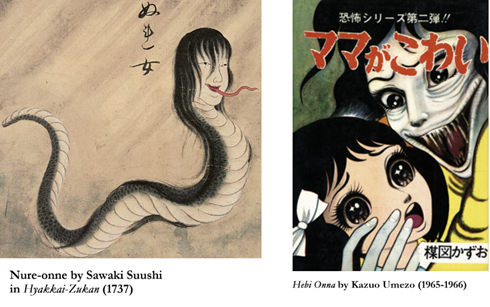
Thus, we might infer that Mizuki’s earlier promotion of yokai in GeGeGe no Kitaro was now blossoming beyond a single author or outlet. Yokai had been reanimated (pun intended) and were haunting the landscape of new mediums—not just manga. That same year, in 1965, director Masaki Kobayashi was awarded the Special Jury Prize at the Cannes Film Festival for her horror anthology film Kwaidan (1964), featuring several short narratives of ghost stories. Women were not just featured as the protagonists and antagonists in Umezu’s stories, but were also his primary readers. It seemed that one of “Kazuo’s greatest insights was to identify, in the female target audience, the main consumers of the horror genre”;[1] from “that moment on, there began a veritable boom in shojo hora … stories that, thanks to a strange combination of ‘whiteness of the protagonists’ and ‘sense of the macabre/horrific’ … captured the attention of thousands of female readers.”[2]
Section 2: New forms of shoujo, new tales of suspense
If the depiction of ghostly forms and creepy atmospheres was gaining momentum, were narratives themselves also becoming more “mature”? Both shonen formats and dominant cultural forms were implicitly critiqued in the nascent gekiga work of Yoshihiro Tatsumi beginning in 1957. Sharing Tatsumi’s frustration with traditional shonen narrative and thematic material, mangaka Shirato Sanpei founded Garo magazine in 1964 as an outlet for similarly “mature” gekiga stories. The widespread university protests of 1968-1969 (mirroring similar disillusionment and popular movements in Paris, San Francisco, and elsewhere) were followed by the second wave of Anpo protests in 1970. In this context, it was in Garo that Hideshi Hino would soon publish his Doro Ningyo (1968), featuring the visceral imagery of body horror. In 1973, Jiro Tsunoda would gain acclaim for his Ushiro no Hyakutaro (Hyakutaro the Guardian Spirit, 1973-1976). Nonetheless, narratives of horror were not beholden to easily-digestible moral dichotomies as in many adventure shonen produced for child audiences. Indeed, “[o]ne of the first women story-manga artists, Watanabe Masaka … pioneered a shojo mystery and thriller subgenre in horror shojo manga culture, most notably with Glass Castle (Garasu no shiro, 1969-70).”[1] Scholar Masafume Monden proposes that the “significance of such shojo fiction is that it does not merely narrate a simple good versus evil story … but embraces much greater moral ambiguity, even in the medium of manga magazines that targets the youngest (girl) readership.”[2] This willingness of horror shoujo to explore moral complexity is striking to me. In the same year that Watanabe published Glass Castle, fellow mangaka Ryoko Yamagishi also made her debut. Before publishing her Shiroi Hey no Futari (1971), a work sometimes described as the first “true” yuri manga, Yamagishi—one of the 24-nen-gumi artists—had made her professional debut with Hidari to Migi (Left and Right, 1969). Scholar of comparative literature Hiromi Tsuchiya-Dollase notes that “[t]he artistic and narrative qualities of [Yamagishi’s] works are praised, and they raised the level of the horror shojo manga genre.”[3]
While Umezu may have published his Snake Woman in a shoujo magazine, his popular Hyoryu Kyoshitsu (The Drifting Classroom, 1972-1974) was later published in a shonen magazine. This work is well-known not only for its film adaptation but also for its depiction of serious, high-stakes life-and-death scenarios among school-age children separated from adults and compelled to engage in violence; thus, the school becomes the site of horror. Perhaps in contrast to Umezu’s story is Miuchi Suzue’s Shiroi kageboshi (White Silhouette, 1975) published shortly afterward. Suzue’s story “is considered a horror classic.”[4] This story also utilizes the physical environment and social world of the primary school to stage horror. However, there are two twists or innovations in Suzue’s story that interest me and which might distinguish the shoujo horror tendency from the shonen horror tendency. Rather than relying on body horror or shock, in Suzue’s story, the protagonist Suzuko “fights the ghost, not through violence but through mental endurance and a strong will to live”; moreover, suggesting a more morally nuance perspective, “despite all the trouble caused by the ghosts, at the end of the story Suzuko goes to the grave of [the ghost] and prays to console her soul.” As Tsuchiya-Dollase puts it: “In shojo manga, discovering the stories of the ghosts and showing compassion for them [can be] more important than defeating them.” [5]
Section 3: Economic—and horror—boom(s) of the 1980s
In the rapidly and dramatically shifting postwar home consumer market, the Asahi Shimbun newspaper company, originally founded in 1879, was diversifying its mediums of release with sonosheet recordings and magazine publications. The company’s publishing wing, Asahi Sonorama, detected a taste for horror beyond shonen audiences, and launched one of the most monumental of the genre’s magazines: Monthly Halloween, a print magazine curated for an audience of teenage girls. Auspiciously and cheekily timed for its debut release on Friday the 13th in December 1985, Monthly Halloween would make major waves. In its June 1986 issue, mangaka So-Ko AGI published a widely-read adaptation of the popular US film A Nightmare on Elm Street, which added twists to the narrative more reminiscent of the distinctly Japanese fairy tale-esque elements. In subsequent issues, the magazine published adaptations of other US horror films, notably Re-Animator and Return of the Living Dead.
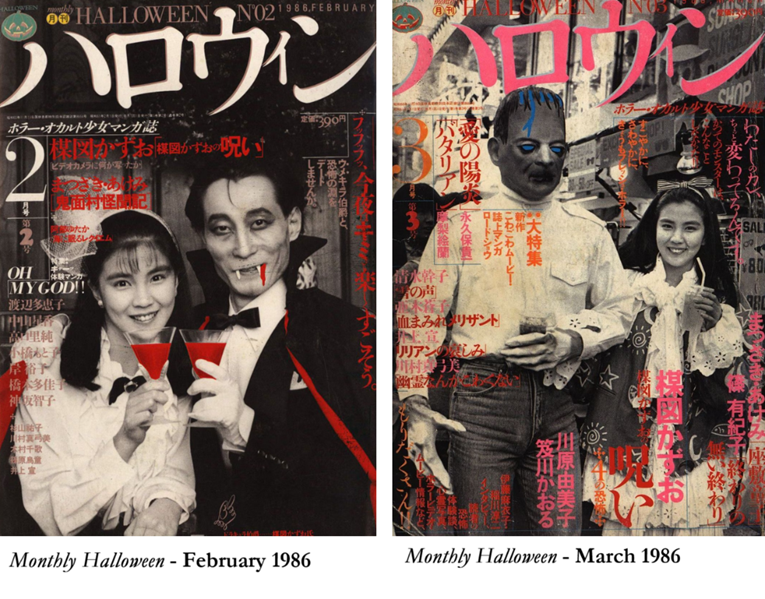
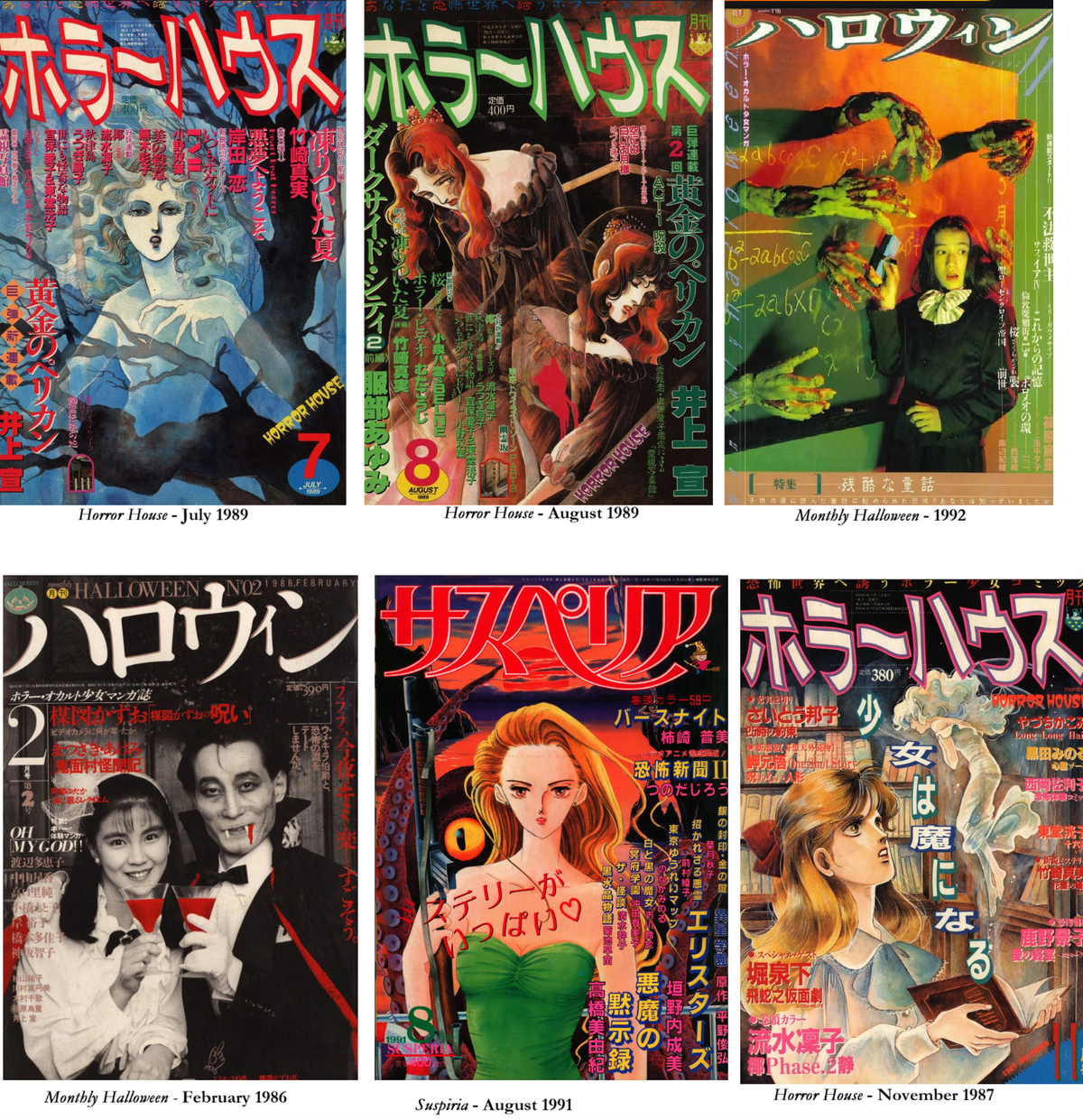
Covers of Monthly Halloween sometimes featured elaborately staged photos of Japanese performers donning the pastiched costumes of Universal Studios-style representations of Dracula, Frankenstein’s creature, and other US horror iconographies. In this, we can see that exchange across cultures (via US cultural icons) and mediums (from film to manga) influenced the marketing of these stories, a kind of hybridity of form long important in both manga and anime.
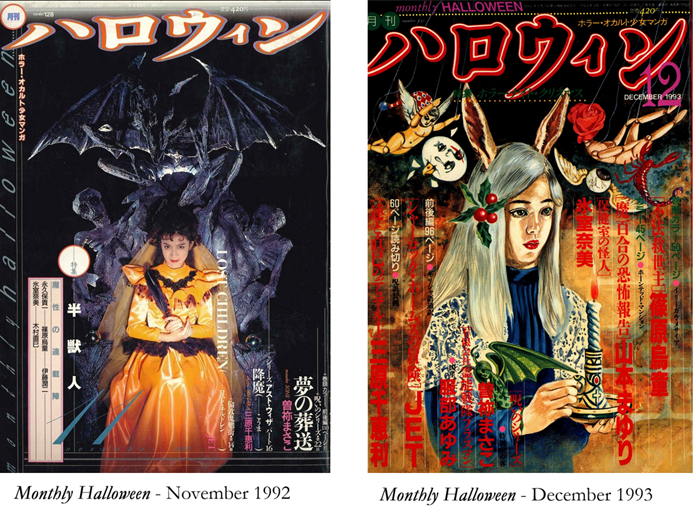
However, despite inclusions of references to US films, horror shoujo magazines took on their own and very original life. Covers would often feature beautiful illustrations, purpose-made and commissioned for each issue, with evocative, dynamic, vibrant illustrations often featuring girls or older women gasping at ghosts, recoiling from monsters, or, sometimes, brandishing swords or pistols in defiance against horrific creatures. Typeface on the covers played into the melodrama, with exaggerated, playful fonts.
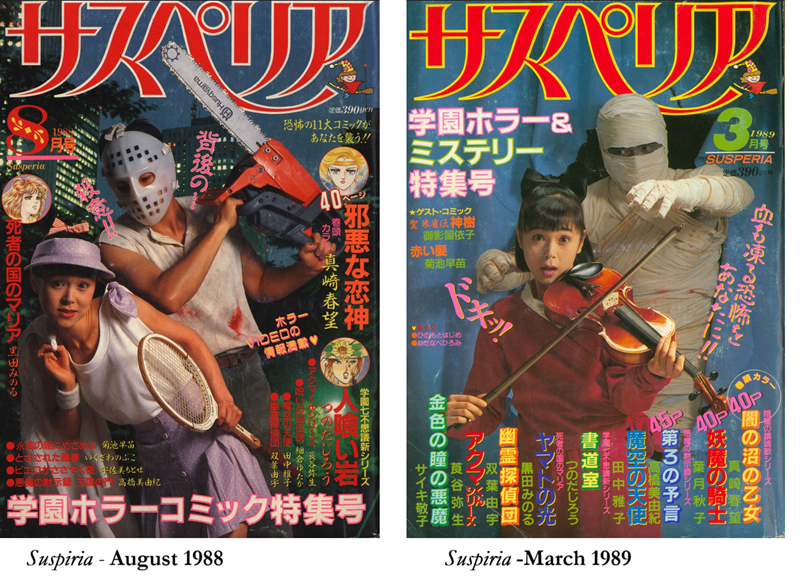
Monthly Halloween is credited with starting a boom in similar magazines. The first issue of Suspiria was released in February 1987. Early issues, like early Monthly Halloween, featured photography and references to popular US horror film iconography. Later issues increasingly elevated illustrations and depictions of original stories.
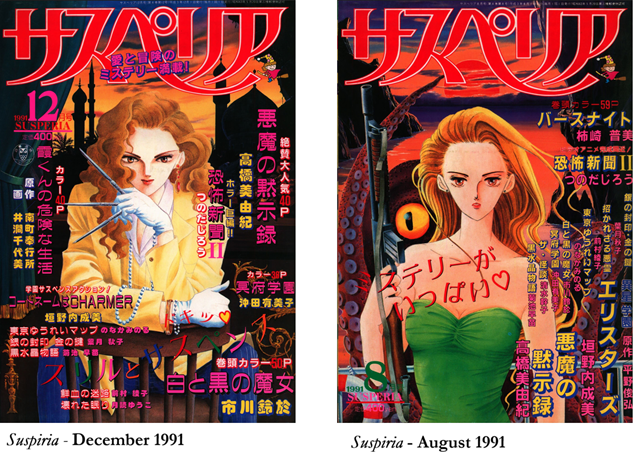
Monthly Halloween, of course, also featured illustrations and photography of original narratives.
If I could offer a candid aside, though, I want to say that my favorite illustrations for horror shoujo covers are those from Horror House, published from 1987 to 1991 by Tairikushobo.
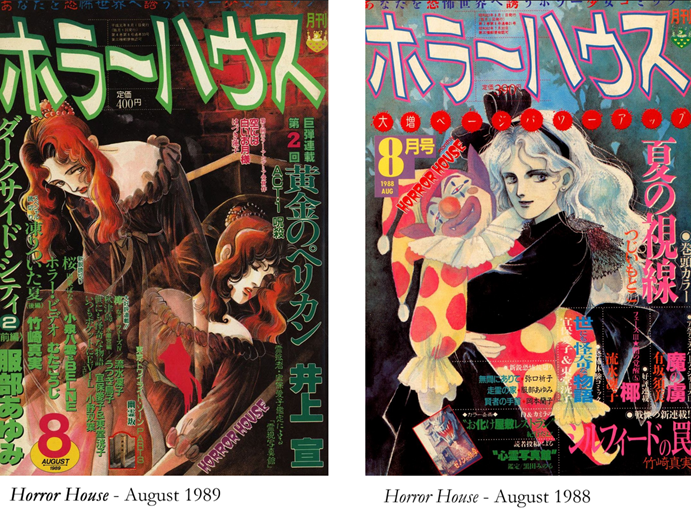
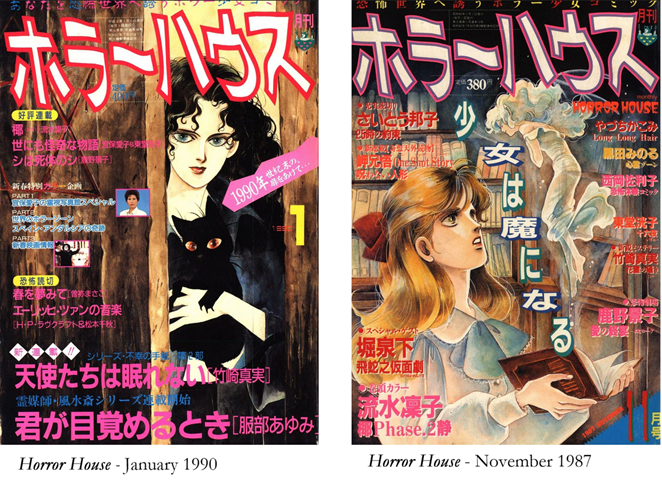
Other publications included Horror M and Specter. Meanwhile, in September 1988, the magazine Shoju Friend began running a special issue series known as Suspense & Horror, which soon became its own monthly release. Suspense & Horror was later picked up and printed by Kiss magazine. It is amusing and thought-provoking to look at the covers of Shojo Friend and Suspense & Horror side-by-side.
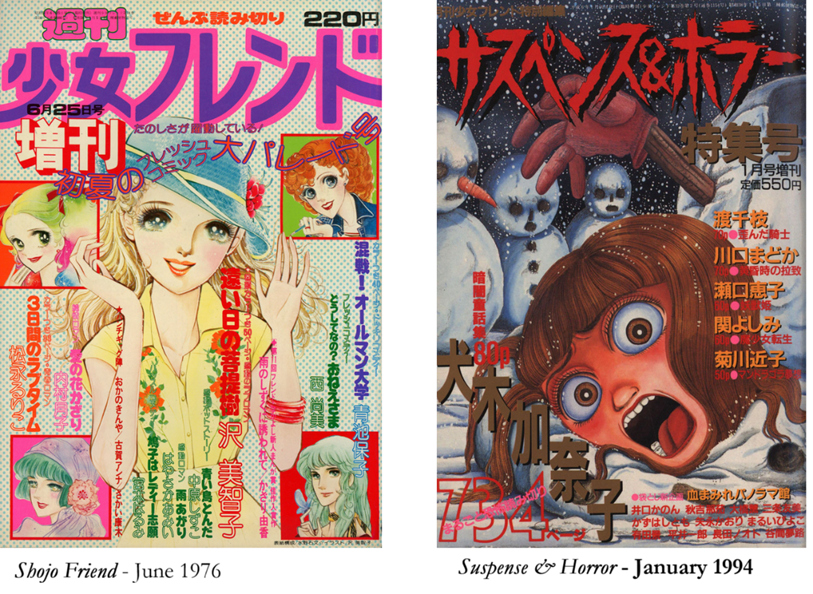
These covers, when compared, present a neat summation of the transition of shoujo publishers into “horror for girls.”
The lineage of pseudo-horror mangaka progenitors would eventually culminate around the same time that these publications were blossoming. Umezu, the foundational author of Snake Woman (Reptilia) and Drifting Classroom in the earlier Garo magazine, had established the Kazuo Umezu Prize to encourage early-career manga authors. For his first formally published story, the now widely-beloved Tomie (1987), internationally-renowned horror mangaka Junji Ito was awarded Umezu’s prize. And where else did Ito publish Tomie than Monthly Halloween, of course. Between 1987 and 1990, Ito’s output exponentially increased. This moment represented a maturation of horror manga—in more ways than one. At this time, not only was horror manga consolidating a genre identity, but the very thematic and narrative content of its stories was maturing, as well. Rather than depending on the shock of body horror, the true horror of stories like Ito’s was moreso psychological. Are the images of Ito’s stories unsettling, disturbing, and sometimes shocking? Sure. But the lingering effect on the reader often has more to do with eeriness, uncanniness, and psychological and metaphysical implications. Indeed, after publishing eleven chapters in Monthly Halloween, subsequent installments in Ito’s Tomie were moved to and published with the magazine’s sister publication Nemuki (an abbreviation for Nemurenu Yoru no Kimyo Na Hanashi—Strange Stories for Sleepless Nights), which was launched in 1990 and was geared toward more mature stories. Moreover, in 1991, Monthly Halloween also launched another sister magazine, Honkowa, which featured real-world folklore and ghost stories.
Discussion
Two of my favorite Ito stories were published in 1991: Used Record, about obsession with a cursed but alluring jazz record, and Beehive, about a disturbingly-deep connection to insects (both things that I can relate to). The financial speculation boom of the 1980s, which had propelled Japan to the status of global economic powerhouse and had facilitated the spatial and financial growth of Tokyo and Osaka, had stagnated in 1991 and resulted in an apparent “bubble” collapse by December 1991. If increasing social malaise might’ve driven more readers towards gekiga stories in the 1960s, to what extent might the conditions of the “lost decade” have compelled interest in horror manga in the 1990s? For me, as an outsider, it’s hard to tell.
I’m thinking now, specifically, about the short story form. Within Anglophone literary traditions, the so-called “weird fiction” genre—ambiguously encompassing or overlapping with much that is designated “horror literature”—is also quite attached to the short story form. University of Chicago historian Ada Palmer proposes that part of horror shoujo’s endurance and appeal might be related to how the short story form of weird fiction lends itself well to “girls” genre in manga.[1] Did the experimental space of gekiga help to provide a launching-pad for shoujo-magazine horror manga to engage in episodic stories or anthologies more akin to weird fiction rather than the singular, continuous narratives of many popular shonen stories? Moreover, do yokai stories also naturally lend themselves to the short story form? After all, the kinds of ghost stories, supernatural tales, and urban legends told in the real world around a dinner table late at night are the kinds of stories which are often anecdotal, peculiar, half-remembered, or relayed from others; endings of these stories are often unresolved and ambiguous. Masaki Kobayashi’s Kwaidan comes to mind once again. In the early- and mid-twentieth century, stand-alone stories of weird fiction were collected in edited print anthologies; Kobayashi’s film similarly presents several stand-alone stories within her anthology. Additionally, if shonen stories might be more prone to extended narratives, horror shoujo—like horror literature and weird fiction texts more broadly—might be more willing to engage in episodic storytelling.
One might interpret the tongue-in-cheek photography of iconic monsters from US films on the covers of late-1980s horror shoujo to mean that horror-as-genre was diluted with mass market appeal, particularly given the proliferation of different magazines. But perhaps that’s too simple or too unfair an interpretation. Rather than an example of how horror was becoming palatable for wider audiences, could the rising attractiveness of horror among manga readers have been an expression of something else? Like the original instantiation of Garo magazine, the gekiga model, and the work of Tatsumi, which often rejected the projected national mythologies of prosperity, could girls’ embrace of horror manga in the 1980s have reflected a similar rejection of the sunny optimism, glossy images of futurity, and narratives of pride and progress associated with the economic boom of the 1980s? Could the embrace of horror shoujo in the early 1990s have registered dawning awareness of the anxieties and malaise of the “lost decade”? I leave those questions to people much better acquainted with Japan and media histories than myself—but those questions are worth considering.
Publishing “real” contemporary folktales, the Honkowa magazine is still in publication today. In a way, the establishment of Honkowa was like a “coming full circle” sort of event. Real-world folkloric tales or folk stories, ghosts, and urban legends had drawn the attention of academic scholars in the 1940s and 1950s, whose research inspired Mizuki’s manga; Mizuki’s GeGeGe no Kitaro ignited popular interest in yokai, and many fictional stories of yokai abounded in manga during the 1960s; with the popularity of horror, particularly among girls in the 1980s and early 1990s, Monthly Halloween’s founding of sister publication Honkowa had returned attention to and reiterated the significance of those “real” ghosts and folk stories haunting the archipelago.
[1] Ada Palmer, “Japan’s Manga Contribution to Weird Horror Short Stories,” Reactor, February 18, 2014.
[1] Masafumi Monden, “Midnight Cinderella: Amoral Shojo (Girl) and Japanese Girl Culture,” The Journal of Popular Culture 55, no. 2 (2022): 454-475.
[2] Monden, 2022.
[3] Hiromi Tsuchiya-Dollase, “’Shojo’ Spirits in Horror Manga,” U.S.-Japan Women’s Journal 38 (2010): 59-80.
[4] Tsuchiya-Dollase, 2010.
[5] Tuschiya-Dollase, 2010.
[1] Paolo La Marca, “Horror Manga: Themes and Stylistics of Japanese Horror Comics,” Humanities 13, no. 1 (2024).
[2] La Marca, 2024.