Bananas, print advertisements, and leisure cruises in the laundered image of conquest in the early twentieth-century Greater Caribbean
(Originally posted elsewhere 6 November 2022.)
This is obvious rehashing for those already familiar with the term “Banana Republic,” the expansion of plantations in the early twentieth century, and the violent history of US dominion in the Greater Caribbean region. Though I’m partially compelled to rehash it today since I’d been looking through archives of leisure cruise advertisements.
I’m thinking of “the Great White Fleet.”
Just as uncomofrtable/problematic as it sounds. The story of the origin of the Caribbean cruise industry is, after all, in part, also the story of industrial-scale fruit plantations.
In 1914, the Great War began as the planet’s powerful empires-of-old were having issues: British, French, German, Austro-Hungarian, Ottoman, Russian, and Qing/Chinese powers were marred by internal revolt and global warfare. Also in 1914, the United States completed their Panama Canal and consolidated some measure of increased power in Latin America and the Caribbean (and the Pacific, by extension).
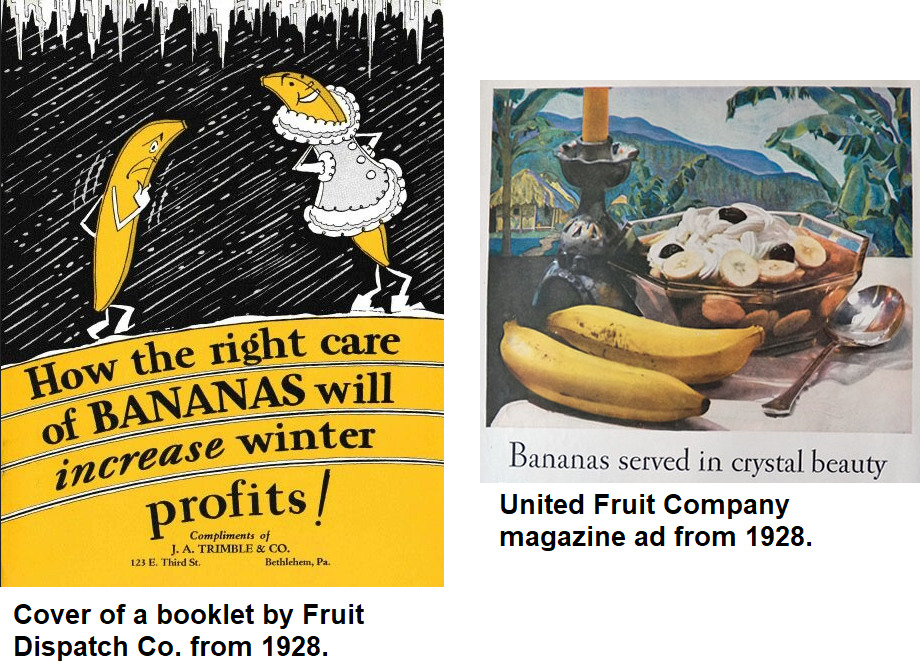
As of 2022, bananas generate 12 billion dollars per year, with 75% of bananas exported from Latin America and the Caribbean.
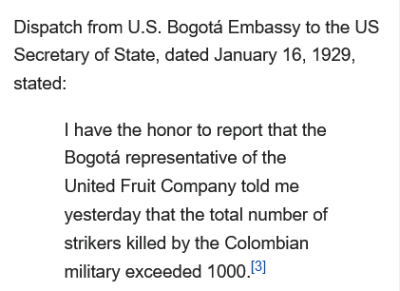
The planet’s single biggest banana-producing company is Chiquita. The Chiquita brand was previously known as United Fruit Company, which had essentially monopolized the banana industry in Latin America. United Fruit Company has a bit of an image problem, following its theft of Indigenous land across Central America in the early 20th century; its role in provoking the killing of tens of hundreds/thousands of plantation laborers during the Banana Massacre of 1928; and the company’s direct role in the CIA-backed toppling of the Guatemala government in the 1950s.
But what of the “romance” and “adventure” of the Caribbean?
So it’s 1915 or 1916.
Middle of the Great War. “Classic” empires are in disarray. But the US is consolidating global presence.
After the 1898 Spanish-US war, as Teddy Roosevelt’s cartoon cavalry conquered Cuba, the Spanish Main belongs to the US of A. The US Navy’s purview stretched (at least) from Puerto Rico to the Philippines, spanning the Caribbean and Pacific alike.
But the US Navy wasn’t the only fleet upholding that global power. The United Fruit Company had its own fleet.
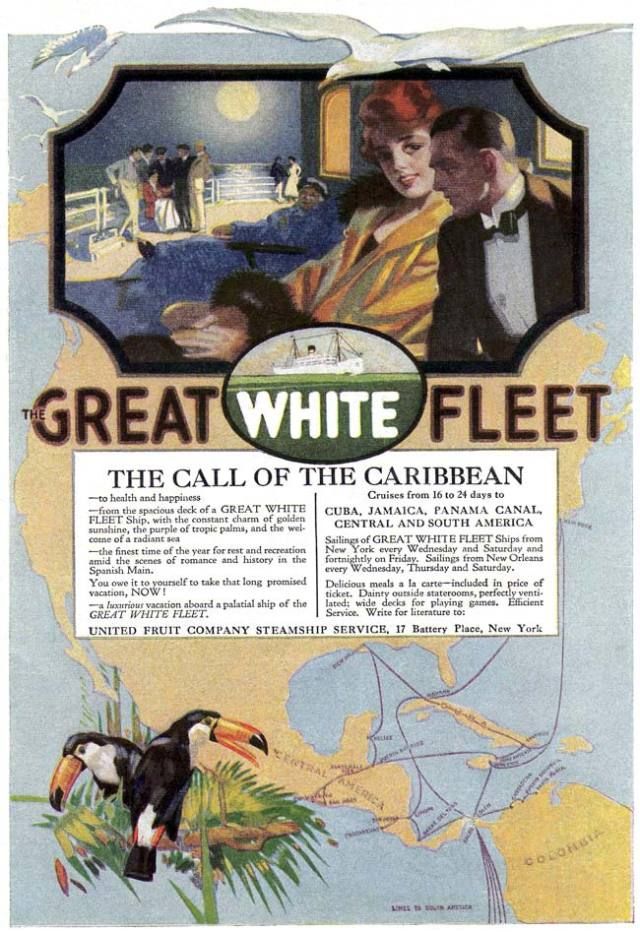
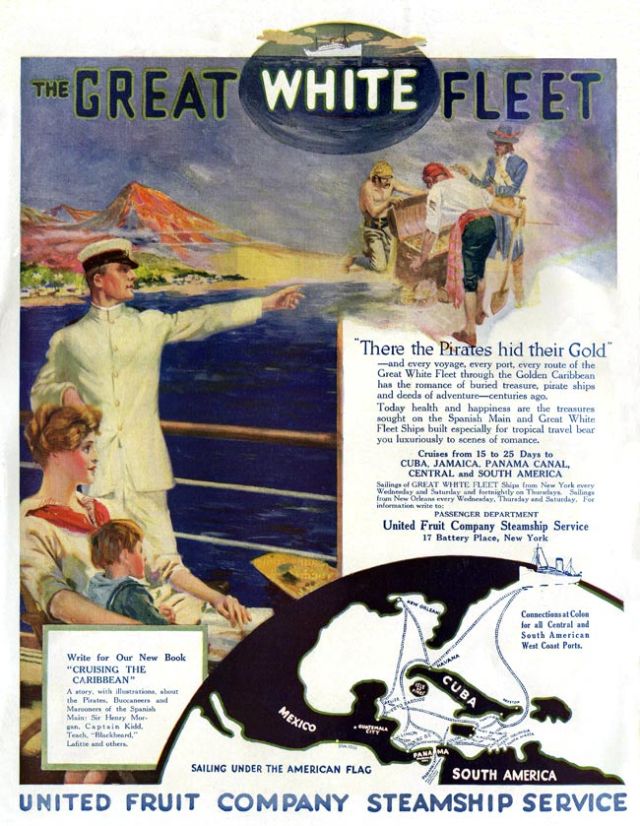
The text of one of these Great White Fleet ads, from 1916, adorned with imagery of a blue-and-gold macaw and an aerial map of the Caribbean, reads:
“[W]here winter never comes and where the soft trade winds bring renewed health. [W]ith all the comforts and all the luxuries of life you enjoy aboard the palatial ships of the GREAT WHITE FLEET. Delicious meals a la carte [...]. Dainty staterooms, perfectly ventilated [...]. [A]mid the scenes of romance and history in the Caribbean. And with it the opportunity to win for yourself a treasure of health and happiness, of greater benefit than the fabled fountain of youth, sought by Spanish adventurers in the tropic isles of the Spanish Main.”
Who’s leading the charge?
The United Fruit Company!
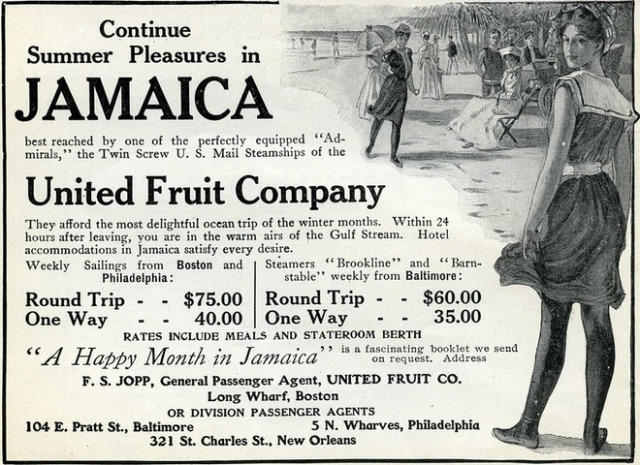
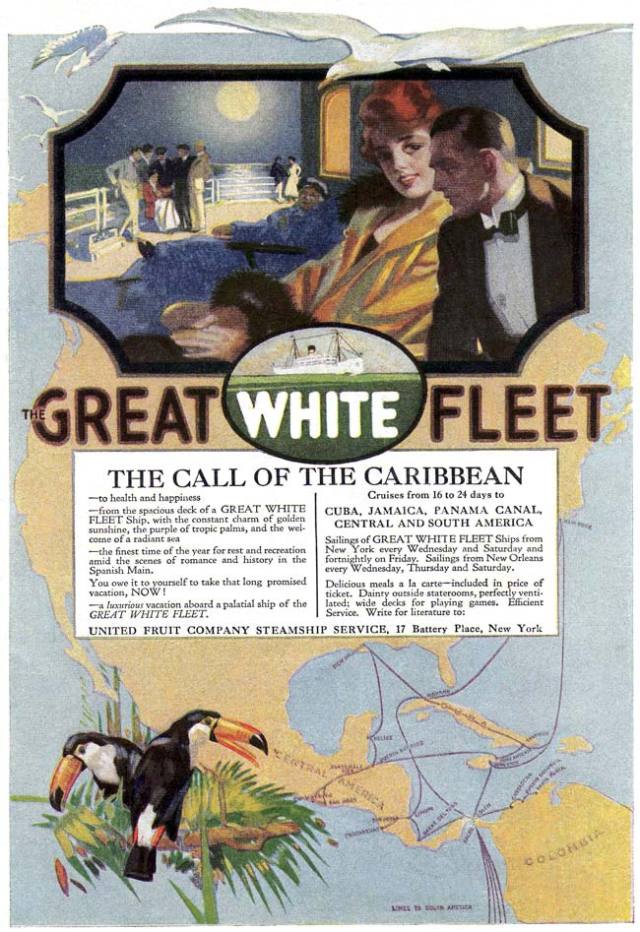
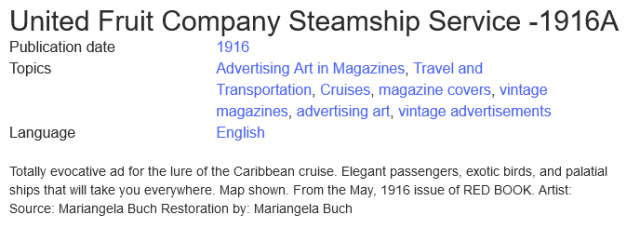
Advertisement above from the May 1916 issue of Red Book. See following for more details:
Another:
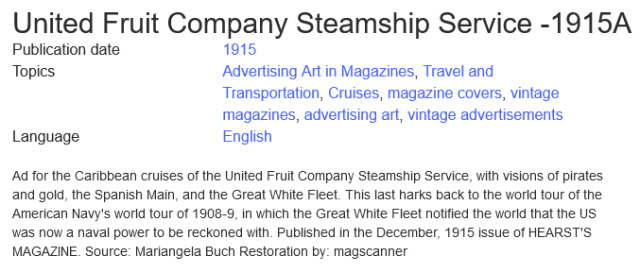
“There the Pirates hid their Gold -- and every voyage, every port, every route of the Great White Fleet through the Golden Caribbean has the romance of buried treasure, pirate ships an deeds of adventure [...].”
The Golden Caribbean. Exciting.
The same region where Columbus enslaved Indigenous peoples, where the US and France had together punished Haiti with unending economic warfare, and where the United Fruit Company would now set up shop.
The company’s plantations would expand across Central America, reinforcing social/racial hierarchies within labor sites and exercising power over local/federal governments of Central American nations.
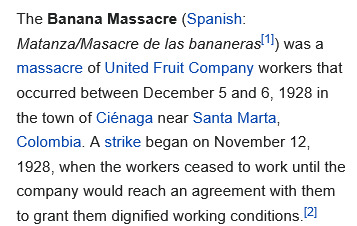
In 1928, over 30,000 laborers were on strike at banana plantations in Colombia. They demanded payment of actual wages, rather than the credits they were given which were mostly only redeemable at company-owned stores in company towns. The US government threatened to send the Marine Corps to intervene if the “subversive” workers would not return to UFC’s plantations. In December 1928, after martial law had been declared, General Cortes Vargas entered the town square of Cienaga (Magdalena) during Sunday gatherings, with machine guns, opening fire on the crowds, and killing perhaps 3,000 people.
In the late 1940s, the United Fruit Company intensified its ad campaigns led by propagandist Edward Bernays (nephew of Sigmund Freud???), who also practiced his skill at manipulative advertising when working to popularize the American Tobacco Company by showing women smoking “torches of freedom” and linking “women’s rights” to cigarette iconography.
Bernays, who explicitly wrote about his “counter-Communist” intention in the ads, was “drafted” in the war to topple ascendant left-of-center governments. After 1944 and after Arevalo’s labor reforms, Jacobo Arbenz Guzman took control of Guatemala in 1951, and took over 200,000 acres from United Fruit Company and returned them to poor families. Bernays launched propaganda attacks against Guatemala, helping to plant stories about Guatemala eventually carried in the Saturday Evening Post, New York Herald Tribune, and Reader’s Digest.
In January 1952, Bernays personally led a tour of Central America, accompanying publishers and editors of Newsweek, the Miami Herald, the San Francisco Chronicle, the Cincinnati Enquirer, Scripps-Howard, and Time magazine. When the CIA-trained military force led by Carlos Castillo Armas invaded Guatemala, with CIA aerial support, installing Castillo Armas as president, Bernays called them an “army of liberation.”
—
Today, in 2022, Chiquita maintains twenty thousand employees across 70 countries.
I think about this as I eat a banana at lunchtime. I think about this when I see the Edenic portrayal of a Caribbean shore, a landscape baked not so much by the tropical sun but instead scarred by centuries of genocide, slavery, and plantation labor, where government officials report with “honor” on the massacre of hundreds of people.
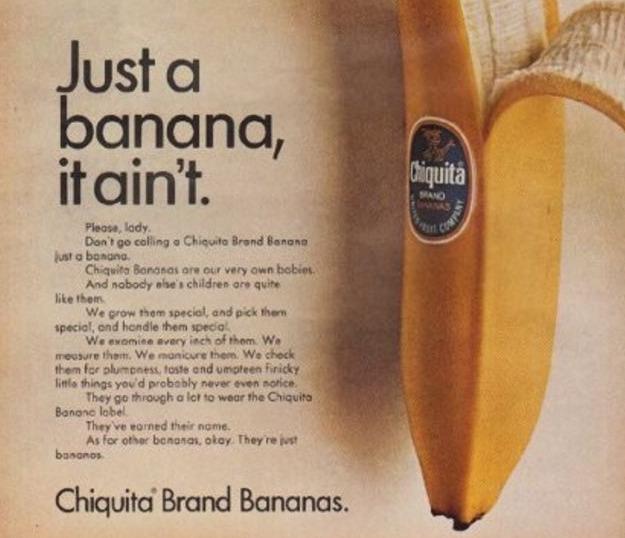
“Just a banana, it ain’t.”
Agreed.