'Believe in the border' and 'making modernity' through 'mundane performance of power' in French Algeria: Brock Cutler's 'ecologies of imperialism' and a review

(Originally post elsewhere on 13 September 2023.)
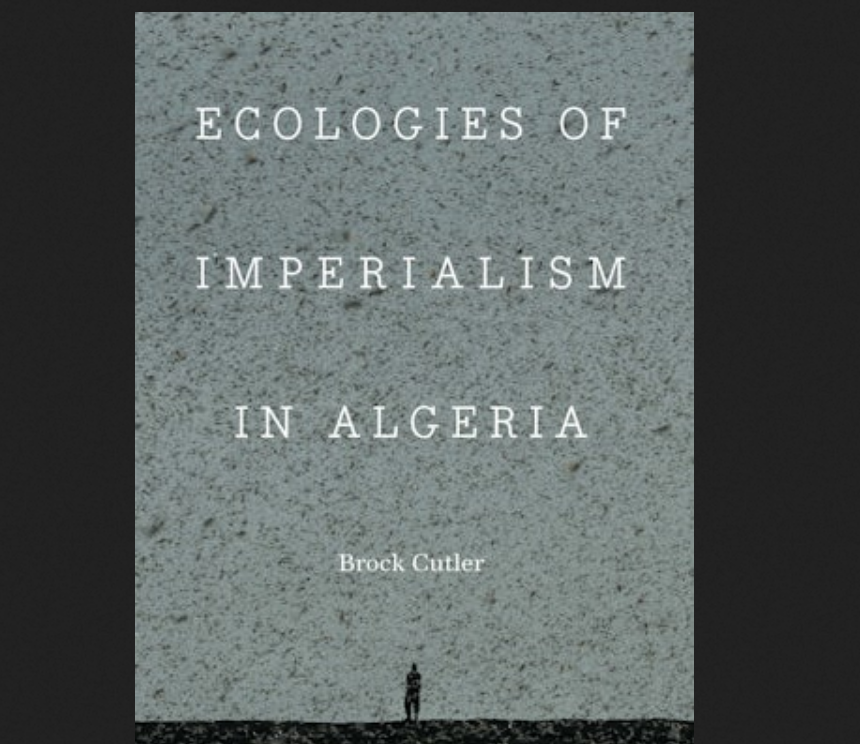
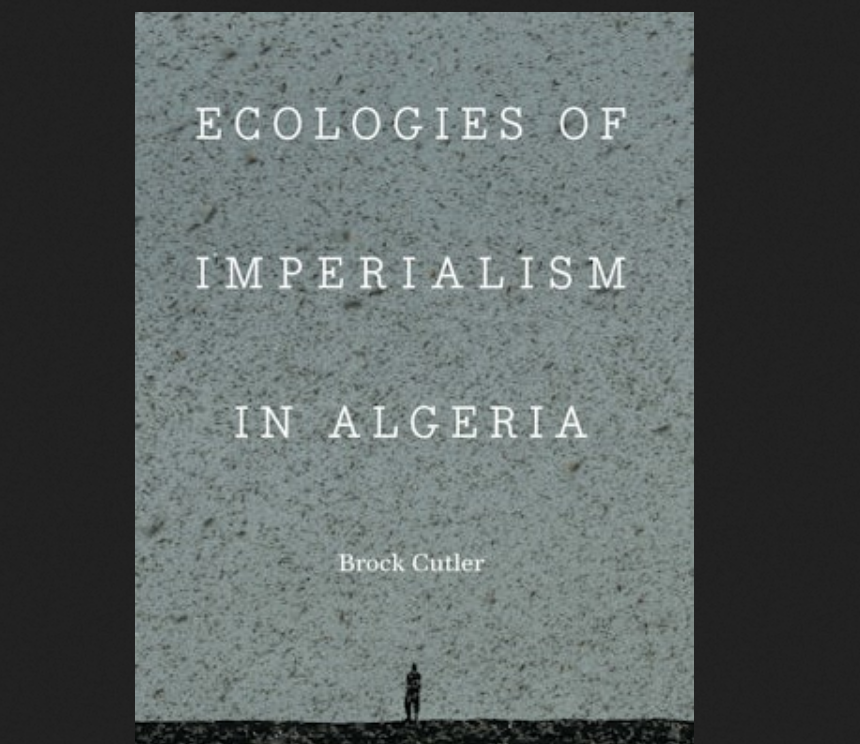
First, another scholars’ review (from H-Net/H-Environment) of Brock Cutler’s book, Ecologies of Imperialism in Algeria (University of Nebraska Press, 2023).
Then, an excerpt from one of Cutler’s articles, “Believe in the Border, or, How to Make Modernity in the Nineteenth-Century Maghrib.”
—
Excerpt 1:
Ecologies of Imperialism in Algeria, by Brock Cutler, begins with an account of food poisoning in nineteenth-century French Algeria. A deep rural crisis of drought and famine in the late 1860s had reduced the amount of fuelwood coming into the city of Algiers, leading one baker to use construction debris shipped to the colony from Paris to fire his bread oven in early 1869. The lead paint on that metropolitan rubble, product of Baron Haussmann’s transformation of the French capital, became a toxic element in the bread that sickened settlers in the colony. The author [...] treats this small episode as a microcosm of the divides, the unruly circulations, and the nonhuman actants and processes that characterized the early decades of colonial rule in Algeria, which the French invaded in 1830.
These divisions and circulations include those between metropole and colony, between modern and not modern, between person and environment, between human and nonhuman, and across the colonial frontier with Tunisia. [...]
---
The first [of three major narrative veins in Cutler’s study involves] [...] bread [...], the consumption of wheat grown on the Mediterranean plains of Algeria [...]. The toxic bread affair of 1869, however, was a reminder that the distance between metropole and colony was not so great. [...] The second vein examines the production of new ecosystem relations [...]. [T]he violence of decades of uneven conquest and the confiscation, appropriation, and enclosure of land and its reorientation toward regional and international [European] markets between 1830 and 1870 thoroughly destabilized rural Algerian life. This fragility turned lethal in the final years of the 1860s, when a series of environmental crises - locust plagues and drought - caused widespread famine and ultimately the deaths of up to eight hundred thousand Algerians. [...] The emptied land and cheap labor that were outcomes of the environmental crises enabled [France] to complete the capitalist transformation of rural Algeria [...]. Another outcome of the environmental crisis was an increase in the number of rural Algerians migrating to cities, where they were perceived as both a threat to public order and a reservoir of potential labor energy. [...]
[D]ivisionary logics, including the line between city and countryside and the modern gendered subject, were being performed, produced, and reproduced in the context of environmental crisis.
---
[Another] major element [in Cutler’s scholarship] [...] is an exploration of the complex politics of policing French Algeria’s eastern border with Tunisia, in the era before French colonial rule began in the latter polity in 1881. [...] [T]his border, officially demarcated in 1846, was only integrated into local ecosystem relations over the course of subsequent decades. Repeated performance of sovereignty through patrols and taxation of pastoral communities that lived and worked in the frontier commons instantiated the border, but the border region remained resistant to the forms of modern statecraft, such as standardization, bureaucratization, and written transactions, that French authorities preferred. [...] [Cutler] draws on intentionally “mundane” examples to show how they were critical to the steady reproduction of a modern imperial border (p. 47). [...] [A specific] episode of transborder [dispute] [...] in 1869 [...] became a referndum within the settler community on the virtues of military rule and a reminder for that [European] community of [supposed] indigenous incompatability with modernity. [...]
[T]he various divisions illuminated by the story - between modern and not, between inside and outside, and between European and Algerian - were performances staged at various times and places, not eternal features of the society or landscape. The repetition of “divisionary logics,” in the author’s telling, were at the heart of French colonial modernity (p. 149). [...]
---
[T]horough reading of the French colonial archive, from official sources as well as memoirs, newspapers, and periodicals [...], [t]he first two narrative threads, on bread and disaster, demonstrate the significance of moments of crisis [...] in actually changing the course of history [...] [and] longer-term [...] ecological transformations. The other thread, however, examines how the mundane performance of modern sovereign power and its divisionary logics, over time, made real or even naturalized the new imperial frontier between Algeria and Tunisia. Both [...] society-wide crises or the steady performance of the mundane logics of power [...].
---
All text above by: Jackson Perry. “Review of Cutler, Brock. Ecologies of Imperialism in Algeria“. H-Environment, H-Net Reviews. April 2024. Published online at: h-net. org/reviews/showrev .php?id=59842. [Emphasis mine.]
—
Excerpt 2:
There was a line in the sand - a border, or rather the idea of one. This idea described a frontier, delineated a boundary. In 1852 transgression of this idea and the sovereignty it represented angered Bey Ahmad of Tunis. [...] [T]he government of [French] Algeria accelerated plans to undertake a tour of the frontier [...], to define the spatial limits of French power. [...] [T]he bey wrote a letter to the French consul [...]. The two powers had to work together, each having representatives present [...]. The response came from Paris. The prince-president (Napoleon III), the minister of foreign affairs, and the minister of war all agreed with the bey [...]. The barrier was real, the border inviolable, the idea held. So the bey and the president understood each other. [...] [But] [a]n internal letter [among French officials] explained the thinking behind the military’s territorial violation: [...] it was necessary to “display clearly [the French military’s] position on the frontier and to act to take possession of the country that we have claimed.” This was important even if the act itself exposed the border’s unreality. [...]
In such a way, belief in the border exposes a kind of irrationality at the heart of modern state power: the very basis of modern sovereign claims - territoriality - was an abstraction that only distance from the influence of local events could make appear real. The idea of the frontier that the French president and the Tunisian bey shared was the modern belief in the reality of borders, of their existence as barriers. That these two shared this idea tells us something about the appearance of modernity in the Maghrib in the late nineteenth century. [...]
---
Anxiety about the situation along the frontier was manifested not only in French military sorties and “inspection tours”: we can also see it in the positioning in the colonial imaginary of migratory and transhumant populations as anti-modern. Seemingly unconcerned with national boundaries [...], these populations were cast as mere violent holdovers of the “traditional” practices of the Maghrib, soon to disappear before the progress of modern social organization and governmentality. [...] The [French] minister of war held that the government of Algeria should secure the border because unrest was “hampering the industrial development of the La Calle region and slowing the normalization of our authority among the tribes [...].” His reasoning did not necessarily reflect that of the cultivators who were accustomed to moving to lands on either side of the line drawn by Randon or moving their flocks within a generally elastic space. The dictates of imperial economics (i.e., mineral exploitation) were here locked into a territorially-bound sense [...].
The government of Algeria - which was at that point, legally in any case, the French government - [...] based claims to sovereignty on the ability to control violence [...]. This [French military] officer led soldiers across the northern Algerian-Tunisian border, stopping to talk with all the groups [...]. The minister of war wrote that, while this action was indeed problematic on the diplomatic scale, it was necessary and right on the local scale. “Our administrative interests cannot be left outstanding - our dignity itself is at stake in giving to the tribes evidence of our [power] [...]” and “this operation is necessary to tranquilize our tribes and organize the means of repression.” [...] In effect, the local scale necessitated a processional display of state power [and literal physical violence] to ensure its claims, while the international scale necessitated the abstraction of fixed and territorialized power. [...]
---
[I]n the winter of 1876 [...], [t]he territorialized nation-state was finally achieved. This rosy picture did not last. Even after the French occupation of Tunis [...] in 1881, belief in the border failed to spread to the scale of local life and governance. [...] Certainly the border, even a border that had largely been agreed upon and understood at the level of high politics for nearly three centuries, was a problematic and vexed ides. Only those removed from its immediate reality seemed to believe in it.
Despite the continued efforts of those apostles of modernity on the Algerian side of the border, the border was never as fixed as they thought it should be. Concerned reports about it continued [...] to fill the saddlebags of imperial postmen well after the establishment of the protectorate in Tunisia. The “realness” of the border was a matter of both material reality and socio-juridical imagination. The border between the Regency’s tribes and those of the dey in Constantine, for instance, had existed (more or less) since the 1500s. But these were obviously different conceptions of what made the border. [...] The border would be “real” for these French officials when groups on either side stopped transgressing the imaginary barrier the Regency and France had erected. Vexing to the French imperial imagination was the apparent breakdown of the concept of state power based on maintaining the monopoly of violence in a certain region: “We reserve to ourselves the right to penetrate into the territory of neighboring tribes that breach the interests of our tribes or territory and to punish them emphatically.” [...] Beyond informing people of their legibility to the state vis-à-vis taxes, the point of the multiple tours, meetings, raids, and trades [...] was thus to show off the power of the French war-making apparatus in order to claim for it sole legitimacy. [...] [T]he land claimed by the French becomes practical, modern territory only when the people living there accept the claims to sovereign authority of the French - not before. There is effectively no border until the people believe there is and act on that belief. [...]
That this type of thinking was not the special purview of the “recalcitrant” tribes themselves is reflected in a letter a French advisor to the Tunisian army wrote to the French minister of war in 1862: “Some have wanted to have a frontier delimination between the Regency [of Tunis] and Algeria; it is necessary, as Your Excellency has recognized, that the frontier remain vague. Let us not commit the present, let us reserve for ourselves the future, and let us not raise barriers between the rich valley of the Medjerdah, and the metallurgic deposits and the cork forests of the Tabarka mountains, [and Algeria].” From his vantage point on the ground, this officer saw a different relationship between the border and the territorial position of sovereignty than did the president or bey. The importance of the imperial project was better reflected in not securing a border. But this understanding did not make its way up the chain of command. There a “real” border was necessary.
---
Text above by: Brock Cutler. “Believe in the Border, or, How to Make Modernity in the Nineteenth-Century Maghrib”. Journal of the Economic and Social History of the Orient 60. 2017.
—-
That last quote which Cutler cites, from the French military adviser, is a bit funny to me. He’s so fixated on extracting forest profitability on behalf of the nation/empire that he accidentally became “anti-borders.”
As if to say: “You know what, the frontier is an essential sacred concept to our empire and therefore the border serves a very utilitarian function BUT if there is more resource wealth beyond that frontier then we actually should disregard the reality of border that we just spent so much time/effort building and revering.”
Borders are real until you decide that you want the money on the other side.
Also love the way he’s almost waxing poetic about the magnificent cork forests and metallurgic deposits. Like looking at a landscape with x-ray-vision goggles and seeing MODERNITY. “Your excellency, think about the beautiful metallurgic deposits!”