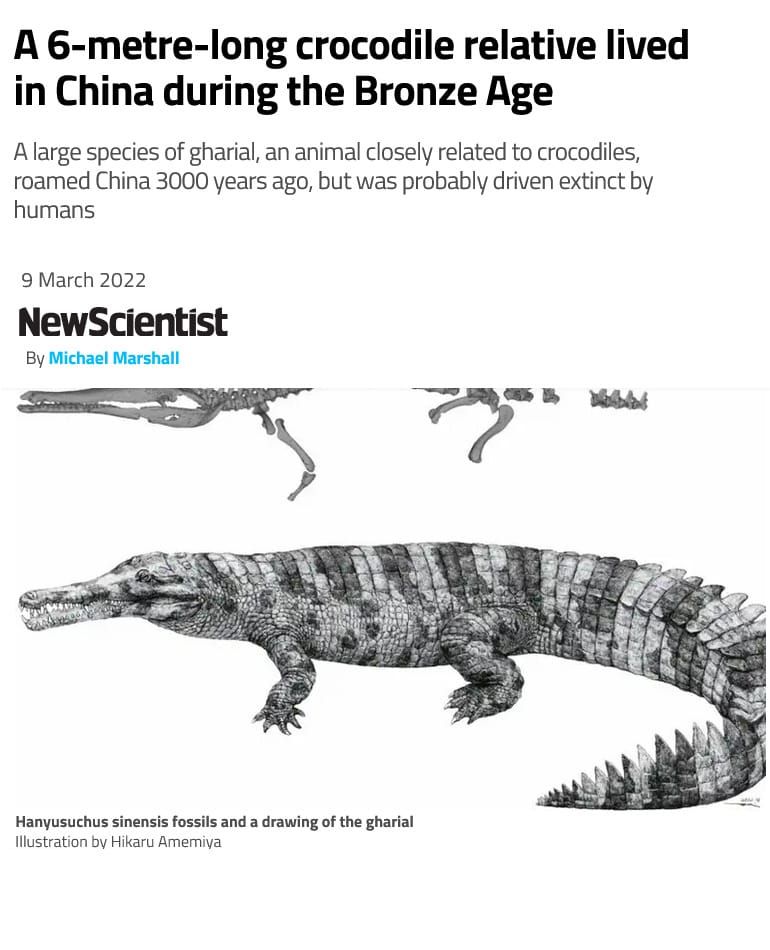
Big news for fans of bygone megafauna and ancient state-building: Previously undescribed six-meter-long gharial (!) from South China in the Bronze Age
(Originally posted elsewhere on 21 August 2022.)
(Originally posted elsewhere on 21 August 2022.)
Early 2022, researchers slowly and casually rolling out of bed, in their pyjamas, with a cup of tea:
“Oh yea, by the way, no big deal, we almost forgot to mention that a previously-undescribed species of bold bizarre strikingly-unique five- or six-meter-long giant crocodilian lived alongside sophisticated architecture and densely-populated human settlements in the Bronze Age near Guangzhou, Hong Kong, and the cultural epicenter of the Pearl River Delta, and may have lived for centuries throughout the advent of Chinese states all the way until 1630 AD, and Western pop-sci/naturalists never really widely realized this, have a nice day.”
Kinda like: “Y’know how so-called Pleistocene megafauna like woolly mammoths were possibly/probably still alive on Wrangell Island as recently as Egypt's Old Kingdom? Yea, also there was a giant crocodile.”
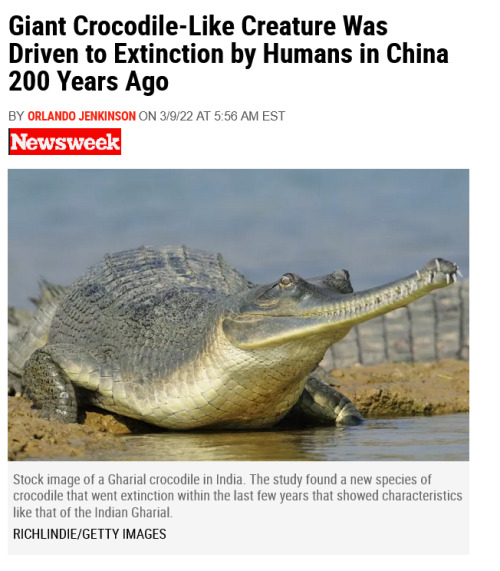
You're familiar with gharial, yea? Unique crocodilian, like a third lineage adjacent to alligators (which you could say subsume caimans) and crocodiles (including false gharial). Emblem of India/South Asia; go look 'em up.
Skeletal and bodily remains from the Hong Kong area have now been "reliably" dated, and the large “new” species has been officially described as of March 2022.
The creature is now known as Hanyusuchus sinensis.
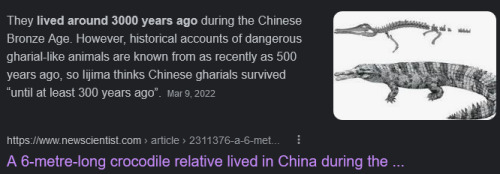
Ignore the sensationalist hyperbole of the following headline (they extrapolate a little too generously from the paper); just wanted an image of a contemporary/extant gharial to really animate it:
Previously, it was kinda assumed (speaking here anecdotally, as fan of reptiles and historical environments) that saltwater crocodiles may have lived farther north along the Chinese coastline, and that these saltwater crocodiles (also massive crocodilians themselves!) accounted for the mention of larger, more aggressive crocodiles in stories from the Pearl River Delta region (relative to historical mentions of the smaller, much more docile Chinese alligator).
But this new gharial raises questions: TWO big crocodilians in Bronze Age coastal southern China?
The researchers describe the remains of some gharials from the Shang and Zhou eras, which were apparently killed by humans with axes.
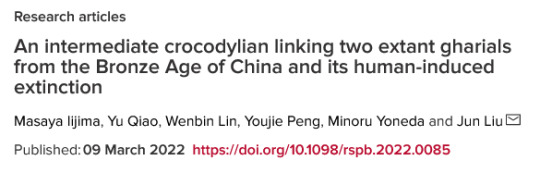
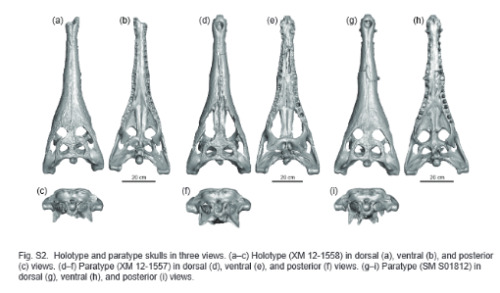
Here’s where remains of the gharial have been found, from the paper:
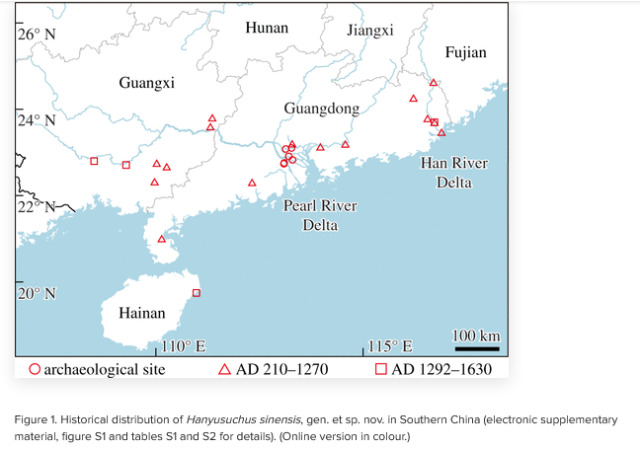
Today, this region is home to tens of millions of people and arguably the largest contiguous urban agglomeration on the planet (Guangzhou, Shenzhen, and Hong Kong).
The formal academic paper from 2022 which describes the new species of gharial has many high-resolution photos of skulls/skeletons of the gharial.
Worth a look?