Assiniboine project to reintroduce swift fox and Montana's obstruction: Explaining recent news (with maps) on environment and extirpation in the Northern Plains

(Originally posted elsewhere on 30 January 2021.)
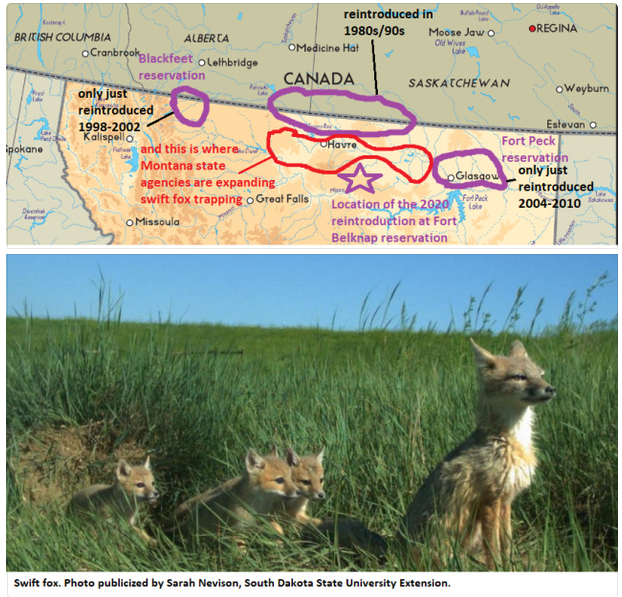
Wanna try to articulate how disturbing it is that Montana state agencies have just spit in the face of Native communities when undermining the reintroduction of the previously-extinct swift fox. Amazing that the Fort Peck reservation and Blackfeet reservation had just spent the past 20 years trying to reintroduce the native swift fox (which had been entirely extinct in the northern Great Plains for decades) in this region north of the Missouri River (at the extreme range limit of the species), and then in the summer of 2020, as the Fort Belknap reservation became the third Native community in the region to reintroduce the swift fox, Montana Fish Wildlife and Parks decided it would be a great time to expand the region where Montana allows sport trapping of the swift fox. (Estimates suggest that there are only about 150 to 200 swift foxes living within Montana borders; yet the state allows sport-hunting of the fox.) Despite knowing of Fort Belknap’s reintroduction plans, in 2020, Montana expanded swift fox trapping immediately adjacent to Fort Belknap, in the same summer, at the same time, that the reservation was trying to reintroduce the creature.
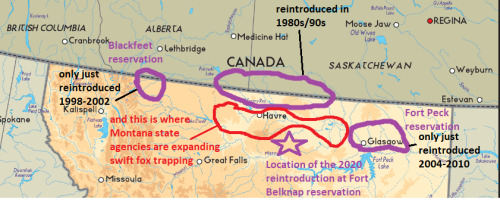
(Map by me, using the working-class GIS aka Microsoft Paint, sorry.)
In the early 20th century, the swift fox had been reduced to about 5% of their historical population size and had gone extinct over more than 60% of its historical distribution range, completely obliterated from the prairies and grasslands of the northern Great Plains (north of the Sand Hills and Platte River) where it used to live northward into present-day “Alberta” and “Saskatchewan.”
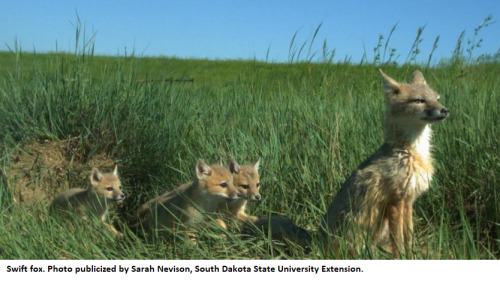
And when the Blackfeet reservation became the first community (within US borders) in this region to reintroduce the swift fox around 1998-2002, it took Montana state institutions less than 10 years before the state opened a trapping season for swift foxes.
In 2020, you had headlines like this:
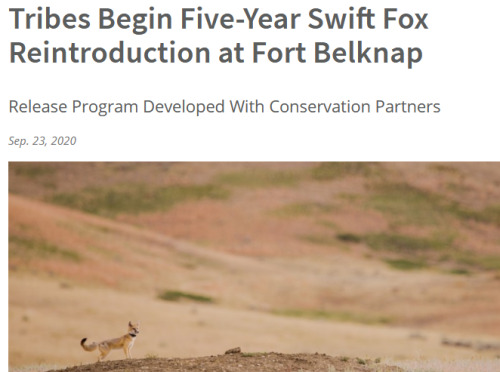
But those headlines--ostensibly good news about incremental progress--would be flanked by parallel headlines like this:
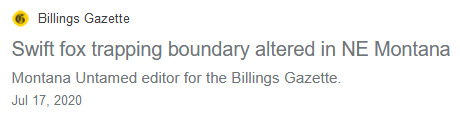
Frustrating.
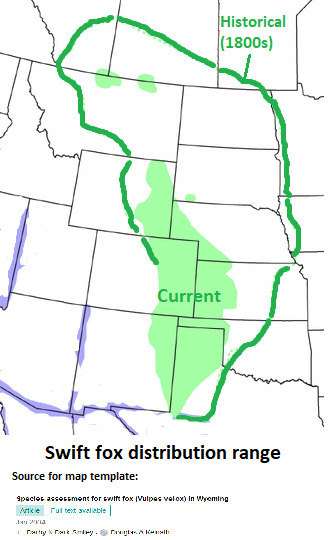
Anyway, I wanted to contextualize the scale of local extirpation.
Here's the historical distribution range for the swift fox (I added the outline and labels):
How important is reintroduction?
Here's some material from last year:
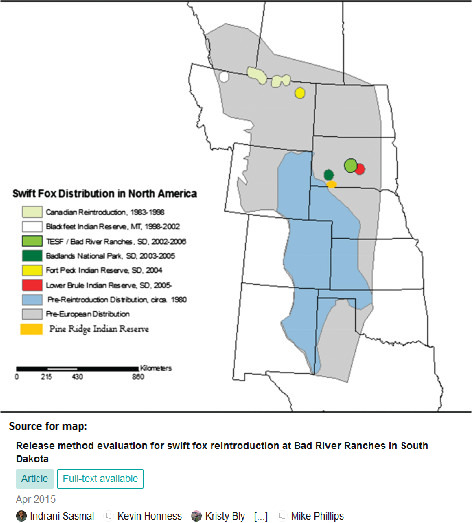
After an absence of more than 50 years, the swift fox has returned to the grasslands of the Fort Belknap Indian Reservation in Montana. From Sept. 12 to 20, the Assiniboine (Nakoda) and Gros Ventre (Aaniiih) Tribes of Fort Belknap released 27 swift foxes […], kickstarting a five-year swift fox reintroduction program. […] Swift fox numbers declined precipitously in the late 1800s, mainly due to poisoning intended for coyotes and wolves and the loss of grassland habitat. During this same time they were also eliminated from the northern portion of their range. […] [Re]introduced populations [north of the Missouri River] have yet to reconnect with populations in the southern portion of their historic range. […] The Fort Belknap swift fox reintroduction marks the eighth effort of its kind. Swift foxes were previously reintroduced in Saskatchewan and Alberta, Canada (1983-1997); Blackfeet Nation, Montana (1998-2002); Bad River Ranches, South Dakota (2002-2007); Badlands National Park, South Dakota (2003-2005); Fort Peck Reservation, Montana (2006-2010); and Pine Ridge Reservation, South Dakota (2009-2010).
Source: Smithsonian National Zoo Newsroom press release. “Tribes Begin Five-Year Swift Fox Reintroduction Program" (23 September 2020).
--
Here's a look at previous reintroduction sites:
And here’s a zoomed-in look with annoying additions from me (sorry):
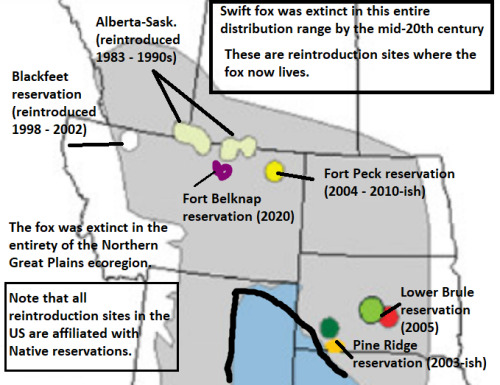
I’d note that all of the swift fox reintroduction sites within US borders are on are right next to Native reservations (Pine Ridge, Lower Brule, Fort Peck, and Fort Belknap).
As noted by the Smithsonian press release, and also by the reintroduction program’s leading non-Native coordinator in other published work from 2020, the swift foxes north of the Missouri River are not able to connect with the species’ healthier/stronger populations and main distribution range farther south in the Great Plains.
Here’s what that region (I'm originally from nearby) looks like:
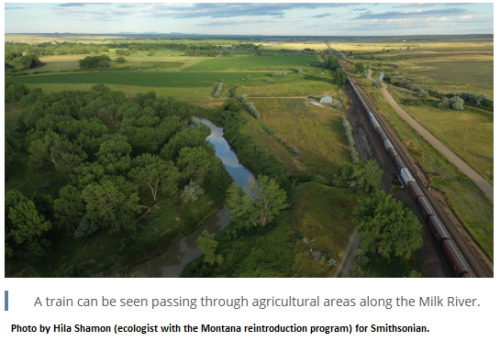
The region where the state of Montana chose to expand the trapping of swift foxes is known as “Region 6″ – near the Milk River in the “Hi-Line” region, where Fort Belknap and Fort Peck reservations are located.
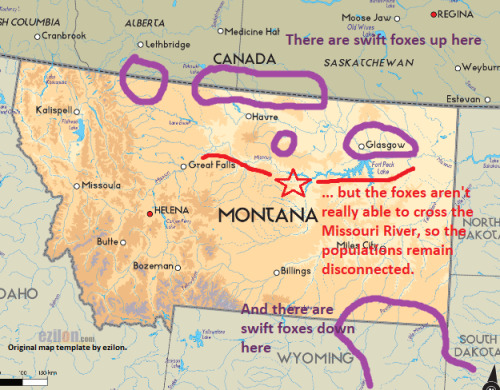
While it might’ve been easier for the state of Montana to justify an expansion of swift fox trapping in the southeastern corner of the state (where the swift fox populations at least have direct connectivity with \the larger, wider, and healthier fox populations farther south in the Great Plains), the state chose to expand trapping in the northern reintroduced population area.
Why is the decision to expand trapping north of the Missouri River, specifically, absurd?
I tried to describe it here:
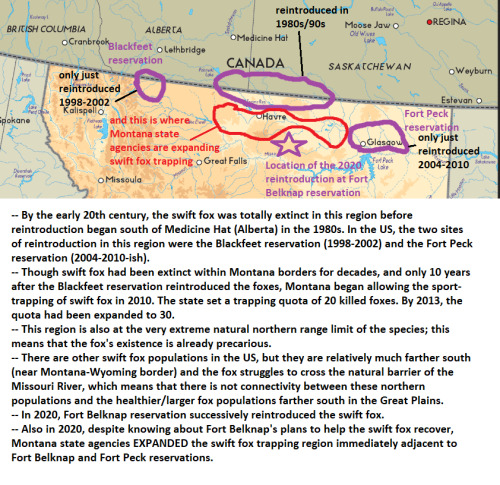
So the the swift fox was extinct in the majority of its distribution range, and was still completely absent from the vast area between Nebraska’s Sand Hills and Alberta, as recently as about the year 2000. And in this region, within the US, the fox now exists, really, only near a few isolated reservations. Should the state of Montana really be letting any sport-hunting occur? Especially right next to a Native community actively trying to help the swift fox re-establish itself?