Contextualizing a cartoon: 'Civilization,' the brutality of US/British campaigns in the Philippines/Boer wars, and anti-imperial critique in metropolitan cartoons, 1896-1906

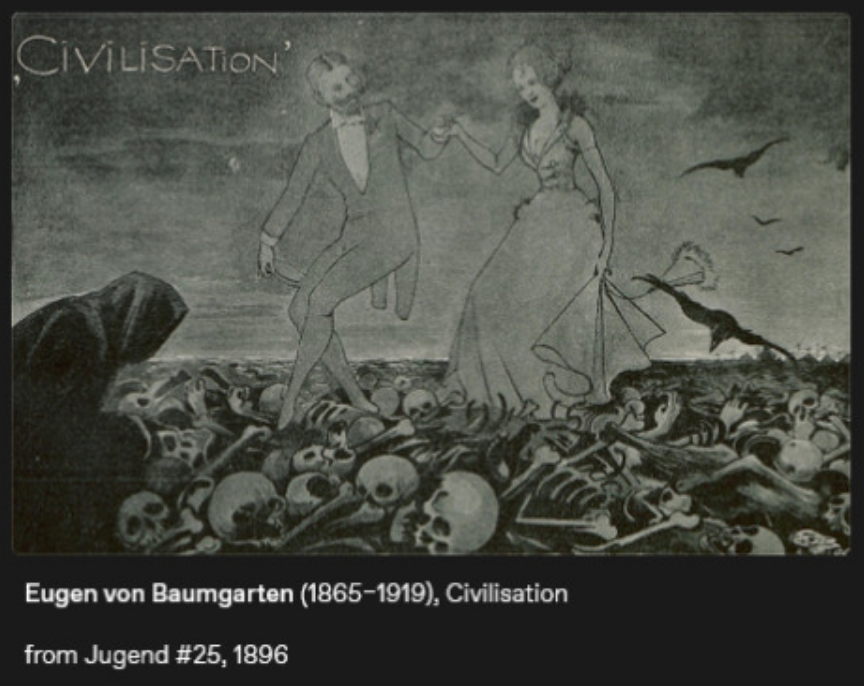
The cartoon pictured above was circulating among my acquaintances online. Originally from Eugen von Baumgarten in Jugend #25 (1896).
Some (contemporary) people expressed a measure of surprise that metropolitan cartoons--that is, white illustrators/publishers in domestic press of US, Britain, France, and Germany--were so conscious of such critique.
The image above, to me, is neat in that it anticipates (within a couple of years of its printing in 1896) an intensification of those types of cartoons.
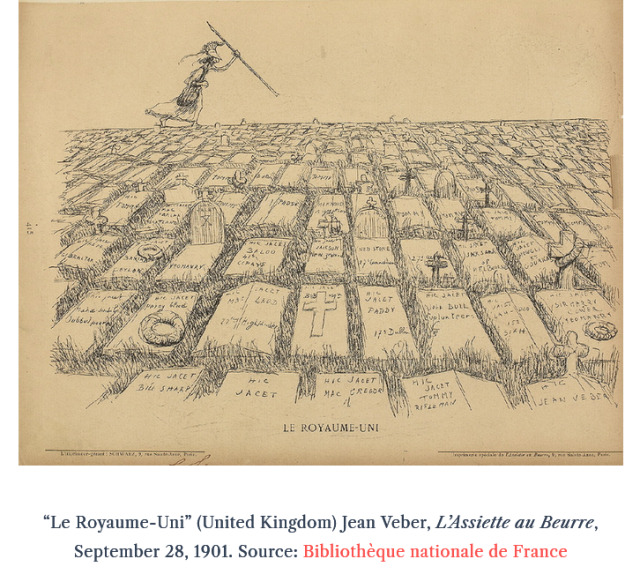
And the motif of a graveyard or field of bodies prostrate before avatars of empire would also recur.
For context:
- US military conducts Wounded Knee massacre (1890)
- US invasion/annexation of Philippines, Hawai'i, Guam, Cuba, Puerto Rico (1898)
- Britain's concentration camps of the Boer War (1899-1902)
- US brutality of the Philippines war (1899-1902)
- US/Britain/Germany/France invade during Boxer rebellion, occupy Beijing, and insist China pay 450 million taels (1900-1901)
- US brutality against the Moro rebellion (1902-1913)
- the German genocide of Herero and Nama peoples in Namibia (1904-1908)
Discourses of "civilization" in such a "globalizing" decade (1890s also kinda peak of Yellow Peril) in tandem with birth/ascent of science-y paradigms of technocratic "sanitation"/"hygiene," industrial agriculture expansion in the tropics, Progressive Era moralistic master-planning, and felt imperative to pacify internal/urban frontiers of rapidly-growing, "modernizing" cities.
Evidently, a lot of US cartoons in major magazines at turn-of-the-century were still-infamous-to-this-day, hyper-racist, eugenics-laden, etc. though some circulated at-least-somewhat-piecemeal criticisms.
I'd recently been reading on the contrast between racist/imperialist vs. critical representation (lots of cartoons to look at):
Ellen Sebring, "Civilization & Barbarism: Cartoon Commentary & 'The White Man's Burden' (1898-1902)," Asia-Pacific Journal: Japan Focus, Vol. 13, no. 1 (6 July 2015). URL: https://apjjf.org/2015/13/27/ellen-sebring/4339
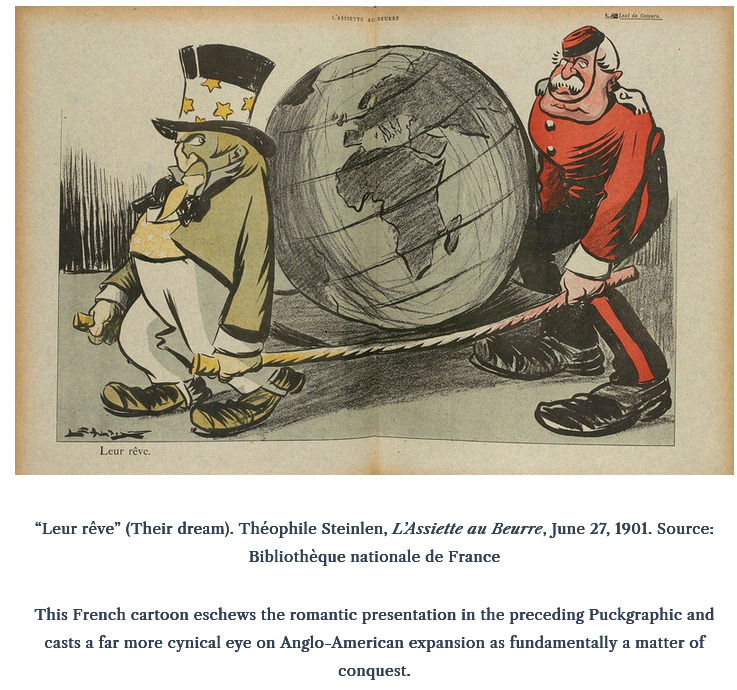
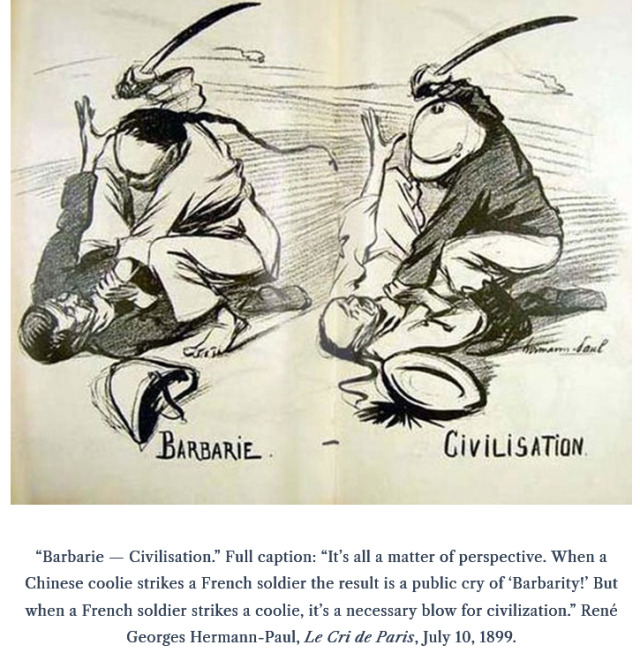
The graveyard motif reminded me of similar from Sebring's piece (captions are hers):
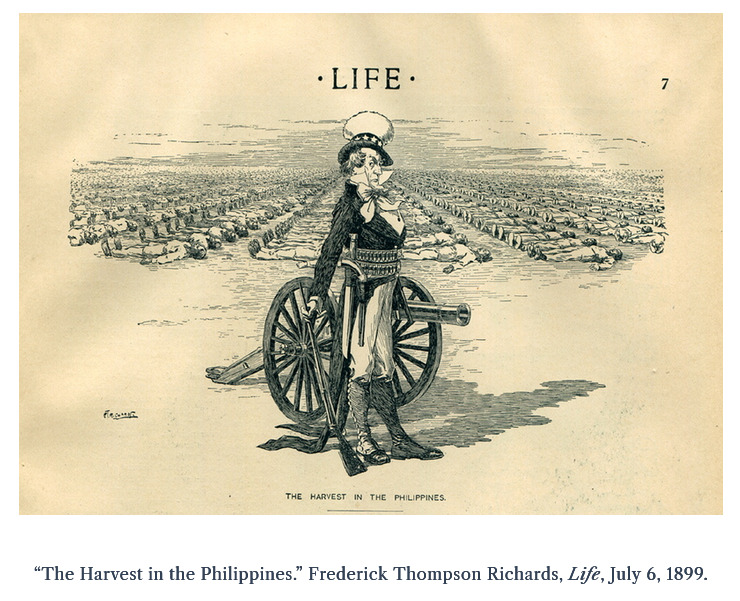
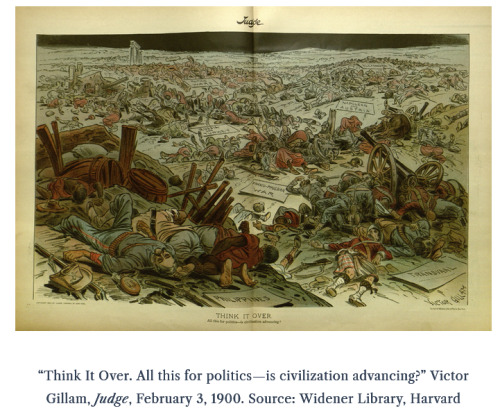
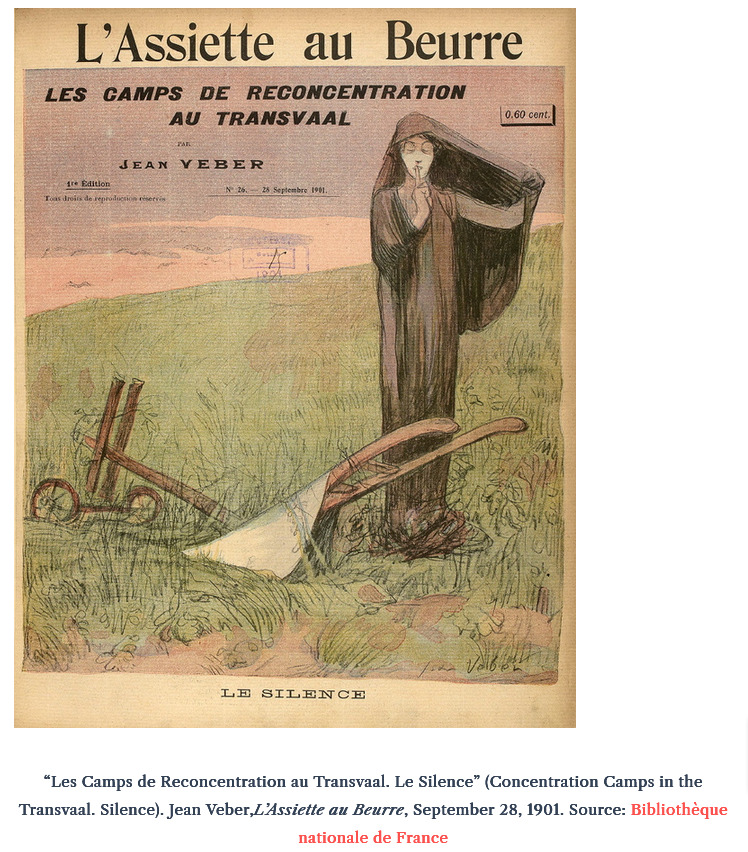
--
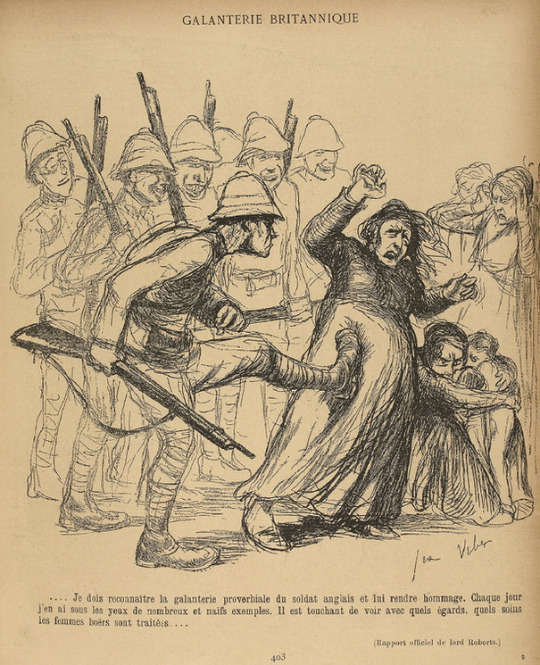
This one, in English, reads:
"British gallantry." From a French critique of British war-making in "Les Camps de Reconcentration au Transvaal," a sequence of illustrations by Jean Veber published in L'Assiette au Beurra, 28 September 1901.
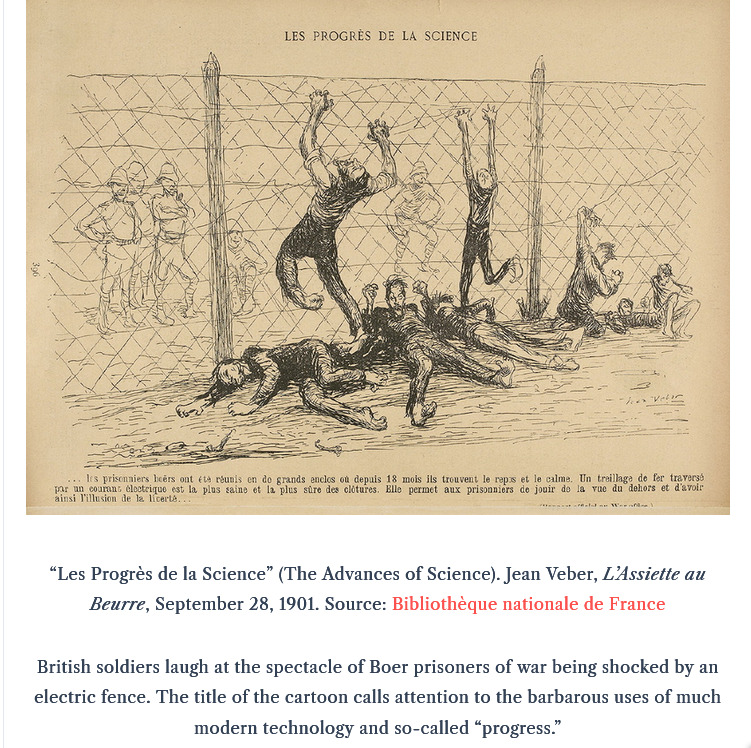
And Veber's caption for this, chillingly, reads:
"The Advances of Science."
Sebring interprets: "British soldiers laugh at the spectacle of Boer prisoners of war being shocked by an electric fence."
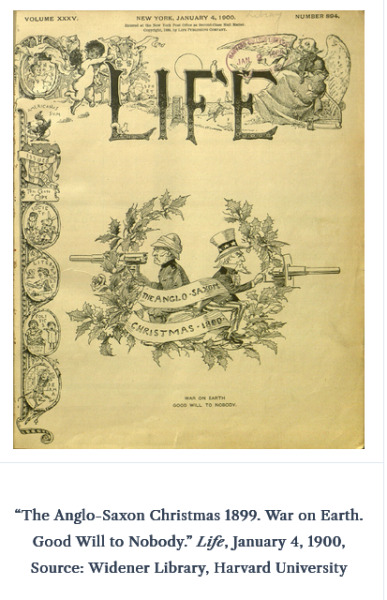
Really hammers home the message of one further up the page, in which the US and Britain acknowledge Christmas with the proclamation: "War on Earth, good will to nobody."