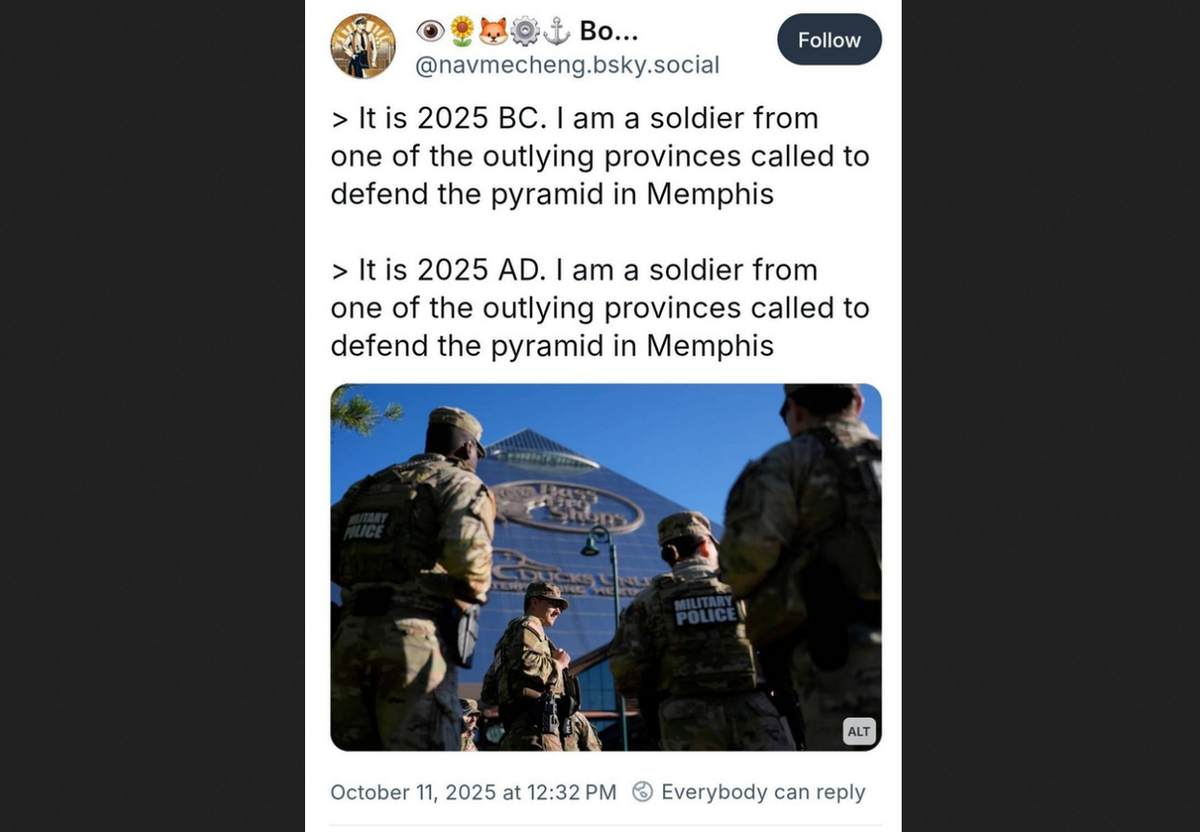
Contextualizing a joke about militarized 'Great Black (Bass Pro Shop) Pyramid': Labor coercion, Black dissent, supply-chain ghost acres, and armed guards defending a box-store parking lot

The Great Wheel of the evergreen tech-utopia masks the hinterland of the dispossessed.
Excerpt 1:
When Ferguson was burning, the National Guard set up base camp in the parking lot of Target. Men armed with automatic weapons guarded the Ross Dress for Less. Beyond the border of the parking lot [...], [t]he soldiers looked out into that darkness as if expecting something. [...] In the American imaginary, [...] [these] spaces are [...] [an] the Eden of the white race [...] the centerpiece of [...] [a] nationalist mythology [...]. Some of these [...] are the type of exurb where people commute to the city to work as police, real-estate contractors, or managers [...]. [Some] are Surplus Cities [....] defined by segregation and racilalization [...] in the form of direct violence--by police, [...] Immigration and Customs Enforcement [...]--and onerous rents extracted by anyone with a modicum of power. [...] None of these suburbs exist in a vacuum, however [...]. The office of the financier is cleaned by the underpaid janitor […]. Local hierarchies are inset into worldwide supply chains defined by labor arbitrage [....] in places like Bangladesh.
Text by: Phil A. Neel. “The New Geography of Suburbia: An Anatomy of America’s Hinterland.” New Labor Forum. 14 May 2018. [Emphasis mine.]
--
Excerpt 2:
They’ve built a “Great Wheel” on the Seattle waterfront […]. Silicon Valley myths of […] "immaterial" labor disguise a more gruesome dynamic [...]. Perched alongside a downtown business corridor […], Seattle's Great Wheel seems to peer out over […] [the] prophesied “cooperative commons,” an infotech metropolis abutting the beauty of an evergreen arcadia. But travel below Seattle’s cluster of infotech industries and the image appears much the same as that of a hundred years prior - a trade gateway, squeezing value from supply chains by selling transport and logistical support. [...] [L]ike UPS, founded in Seattle when the city was one link in a colonial supply chain [...]. In south Seattle, this logistics empire takes the form of faceless warehouses, food processing facilities, container trucks, rail yards, and industrial parks [...]. And, beyond them, the shadow stretches out to Washington’s rural hinterlands [...] and further still [...], where the Great Wheel meets its opposite: Memphis, the FedEx logistics city, watched over by a great black pyramid [the Bass Pro Shop pyramid]. […] Every Seattle is capable of creating a [...] “cooperative commonwealth” tended by apps and algorithms only insofar as there is a Memphis that can provide human workers to sort the packages, a Shanghai to build the containers that carry them, and a Shenzhen to solder together the circuits of the machines that govern it all.
Text by: Phil A. Neel. "The Great Wheel." Brooklyn Rail. April 2015. [Emphasis mine.]