Contextualizing a joke about the first-ever European illustration of a sloth: Abigail Weinberg on race, gender, and exoticism in Early Modern idealization of New World natural history knowledge

(Originally posted elsewhere on 18 September 2023.)
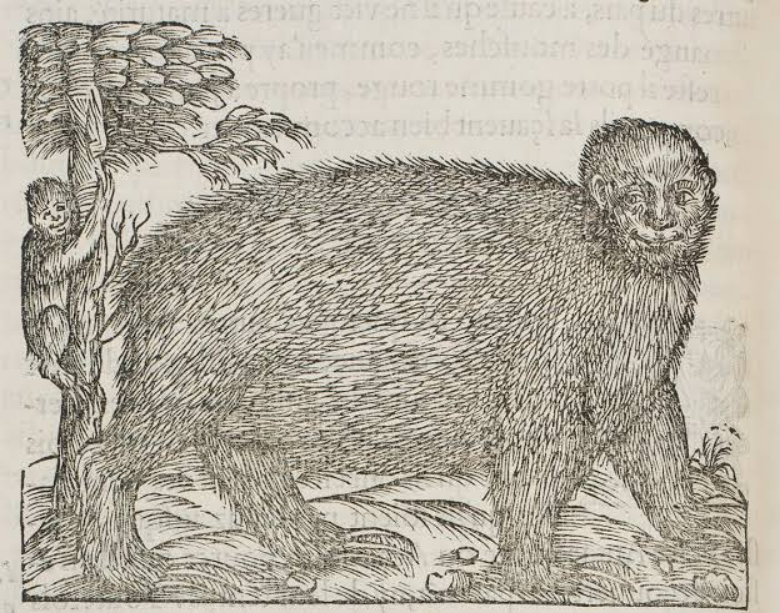
A couple of years ago, as you might recall, we had a fun time discussing European taxonomies and imaginaries of the tropics when I shared an image (Andre Thevet, "D'vne beste assez estrange, appelee Haut," 1558) of what might be the earliest European print illustration of a sloth.
Recently, though, I had the pleasure of encountering Abigail Weinberg's piece on that very sloth--and more. And, not kidding, it's published in the journal Sloth.
I love how much Weinberg does with this piece.
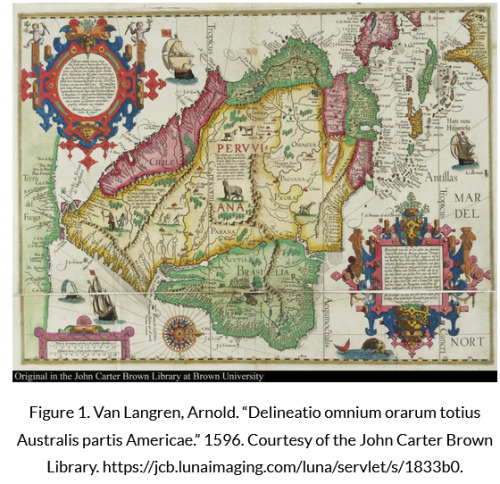
Check it out. She begins with a description of a certain map from 1596. To help see what she's getting at, I'll show it here (unaltered as shown in her original text). Take a close look at the very center of the map.
--
Excerpt:
[A] 1596 map of Peru by the Dutch mapmaker Arnold Van Langren. [...] Centrally located in Van Langren’s map [...] is a four-legged “beast” with a humanoid face.
The Latin text that describes it [...] roughly translates to: "This beast, which was called Haute by the Tupinambá people of Brazil, has never been seen eating or drinking: Because of this they believe them not to gather food, nor to nourish themselves through drink, nor from any other nourishment, but to live by a spilling of the air.” The description of a mythical New World beast that survives off the air dates back to the Spanish explorer and chronicler of the New World Gonzalo Fernández de Oviedo y Valdes, most commonly known as Oviedo. [...] The French monk André Thevet (1568, 81), who spent ten weeks exploring the French Antarctique region in Brazil, co-opted Oviedo’s language in his 1557 travelogue [...]
Thevet’s anthropomorphic illustration of the sloth with a human-like face was widely copied, and it is the one most similar to that in the center of Van Langren’s map. [...]
The location of the sloth in the center of Van Langren’s map underscores its mythic significance. While Thevet and Léry described the sloth as living in Brazil, Van Langren placed it in the center of Peru, between the letters “PERUVI” and “ANA,” such that the viewer is forced to confront the animal when reading the name of the land depicted. [...] [T]his map follows the medieval tradition by placing the primary object of wonder or interest in the center -- where mapmakers often place themselves [...].
---
Both Oviedo and Thevet, for instance, described the sloth as a monstrous amalgamation of the body parts of other animals. Oviedo compared the sloth’s round face to that of a lechuça, or little owl, and its nose to that of a monico, or monkey.
Although the beast comprises the parts of several natural animals -- a monkey, a bear, a carp, a human child -- the aggregate produces [...] a monster. [...] Thevet made a startling mention of the “fyne of a Carpe.” In climbing a tree using a body part that resembles the fin of a sea creature, the sloth blatantly violates the natural order, bringing characteristics of a sea creature onto land. [...]
---
[E]ven the sloth’s name is tied to the notion of sin [...]. Oviedo drew on this foundation through his implicit connection between the sloth’s grotesque animal characteristics and blackness.
To introduce the animal, he writes: (Swift–Parakeet they call on the mainland the clumsiest animal in the world, and it is so slow and deliberate in its movement, that to walk the space which would take 50 steps, it needs an entire day. The first Christians that came to dry land, when they got to Darien in the province of Cueva, when they saw this animal (remembering that in Spain they tend to call the black man John White, because the opposite is understood), they gave it a name very far from its self, for being slow, they call it swift, and in the province of Venezuela they call it the lazy.) [...]
By connecting the irony of the sloth’s name, meaning “swift,” with the Spanish joke of naming a black man White, Oviedo ties the animal conceptually to a race Europeans considered to be inferior because of its members’ differing physical characteristics [...]. Oviedo later adds, “Ni he visto hasta agora animal tan feo ni que parezca ser tan inútil que aqueste” (I have never until now seen an animal so ugly, nor that appears to be as useless as this one) (414). [...]
---
The sloth on Van Langren’s map not only inherited European notions of race and monstrosity; it was also descended from a tradition of portraying New World flora and fauna through heavily gendered tableaus. Several of the figures on Van Langren’s map -- the sloth, the opossum, the floppy-eared dogs above it, and the Brazilian cannibals below -- originated from sixteenth-century prints that encoded notions of gender, savagery, and animality by portraying America as a classically muscled nude woman surrounded by plants and animals native to the New World. [...] The sloth also elicited disparate reactions [...]. While Oviedo, as we have seen, was repulsed by the animal, Thevet (1568, 81) seemed to delight in it, informing the reader of his description of the sloth that “by this ye may sée the wonderfull works of nature, how that she can make things strange, great, incomprehensible, and wonderfull [...]."
The opposing possibilities embodied by the sloth -- that it is both docile and monstrous, “wonderfull” and repulsive -- mirror the binaries present in gendered depictions of the land. [...]
The sloth, for all its monstrous characteristics, possesses a uniquely feminine potential to be tamed. Thevet, for one, referred to the sloth using female pronouns, and explorers such as José de Anchieta (1534-1597) and Fernão Cardim (1548/1549 – 1625) said that its face resembled that of a woman [...].
---
Yet the personification of the sloth as a woman came at the expense of the Indigenous inhabitants, who were in turn dehumanized. Thevet (1568, 81) wrote that “this beast is very louing to man, when she is tame, coueting to be always on his shoulders, [...] the which doings the wylde men of the countrey cannot abyde for that they are wicked [...]." Léry [...] clarified this point in his History of a voyage to the land of Brazil, writing, “his claws are so sharp that our Tupinamba, who are always naked, do not take much pleasure in playing with him.” Thevet invoked sympathy for the animal by citing the Indigenous inhabitants’ moral deformity [...]. The supremacy of wild animals over Indigenous peoples took symbolic form in Sir Walter Raleigh’s 1599 illustration of the Haute [sloth] [...].
The sloth asserts itself as the largest and most visible icon on Van Langren’s map, and can perhaps be taken, in all its contradictions, as a representation of America as a whole. It is depicted as both enticing and repulsive, alluring yet inferior. Its human qualities seem to lessen those of the “savage” Indigenous inhabitants surrounding it, while its animal qualities push it into the realm of the monstrous. It, like America, per the colonialist vision, requires European control in order to be tamed. In its docility, it appears ripe for conquest, but its sharp claws hint at a certain wildness which provokes terror.
---
All text above by: Abigail Weinberg. "Centering the Sloth in an Early Modern Map of Peru". Sloth Vol. 6, No. 1. Winter 2020. [Bold emphasis and some paragraph breaks/contractions were added by me for accessibility.] Images and their captions are also shown as they are presented in Weinberg's article. The article is available online at: [animalsandsociety.org/research/sloth/sloth-volume-6-no-1-winter-2020/centering-the-sloth-in-an-early-modern-map-of-peru/]. Sloth is a publication of The Animals and Society Institute. ASI can be contacted by phone at (734) 677-9240 and at: 2512 Carpenter Road, Suite 202A, Ann Arbor, MI 48108-1188.