Contextualizing intense Australian mining on Aboriginal land of Pilbara (a timeline and critique of a corporate publicity stunt)

(Originally posted elsewhere on 16 November 2020.)
Hmm?
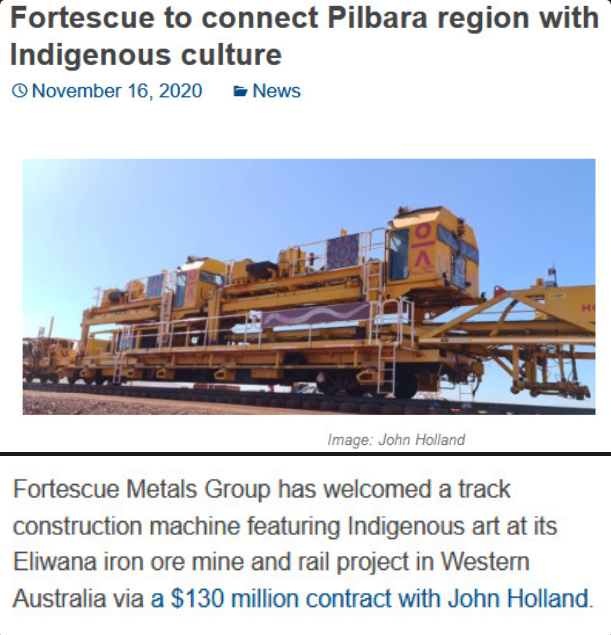
Interesting "acknowledgement" here from Fortescue, don't you think?
Why would such a mining company "welcome a track construction machine featuring Indigenous art at its Eliwana iron ore mine and rail project"?
What else has iron-mining corporation Fortescue Metals Group “welcomed” in the Pilbara region?
– The ancient Weelamurra site, in the traditional land of the Wintawari Guruma people, contains rock shelters, some with artwork appearing to depict Eastern Guruma creation stories, and some shelters dated to over 47,000 years old (35,000-ish years older than the end of the last Ice Age, some even older than the famed Juukan Gorge site). One of these Weelamurra rock shelters shows evidence of human habitation up to 60,000 years ago, among the very oldest in all of Australia, and among the oldest surviving documents of human activity on the planet. Fortescue has requested permission from the government of Western Australia to build mines at the site.
– In the Pilbara region, Fortescue legally “manages” over 5,900 Aboriginal heritage sites located on land leased to the corporation for mining. That “track construction machine” featuring Indigenous art at the Eliwana mine site? Since 2017, in order to service the Eliwana mine, Fortescue has repeatedly sought formal permission to build railway infrastructure over the Ngajanha Marnta sacred site, despite years of resistance from Wintawari Guruma people. Fortescue is the fourth-largest iron ore-producing company in the world, with billions in annual income extracted from the Pilbara region alone.
– In September 2020, as major mining company Rio Tinto was being heavily criticized in popular media for destroying Aboriginal sites in the Pilbara region, some of Fortescue’s shareholders formally asked Fortescue Metals Group to enact a “moratorium on desecration of Aboriginal sites” in the region. But Fortescue’s executives refused to consider this moratorium because “the physical copy of the documents it was printed on arrived too late to be considered at the annual general meeting … due to a c0vid-related courier delay” even though “electronic copies had already been filed.” Woops.
– In the Pilbara region, there are 13,300 formally-documented Aboriginal “ethnographic and cultural sites” on land leased to Rio Tinto, the second-largest iron ore producer on the planet. (This tally does not include the other imperiled Aboriginal sites across the corporate mining estates of other regions in Western Australia.)
– BHP – the planet’s largest mining company – controls over 8,000 formally-documented ancient cultural sites in the Pilbara.
– There are 536 formally-documented cultural heritage sites within the Paraburro iron ore mining hub. Some Yinhawangka people say that watering holes (which are very rare in the desert) are sacred; watering holes make up 7% of these cultural heritage sites. Yirra is a site in the mining hub which has evidence of human occupation 23,000 years old. The site is located 75 meters away from a major roadway which Rio Tinto uses to truck iron ore from the mining pit.
– In the state of Western Australia, rates of Aboriginal incarceration and imprisonment have doubled between 1990 and 2010.
– In the Pilbara, relatively close to the Guruma sites, Martidja Banyjima elders have resisted the destruction of their cultural heritage sites. In this area, in 2020, only 3 days after the destruction of the 45,000-year-old Juukan Gorge sites made international headlines and provoked outrage, Western Australia issued mining company BHP permission to destroy between 40 and 86 ancient Aboriginal sites, some dating to 15,000 years old.
– Infamously, in May 2020, Rio Tinto (also heavily focused on iron ore extraction, like Fortescue) destroyed the Juukan Gorge site, which contained ancient Aboriginal artwork over 45,000 years old. Rio Tinto was aware of the significance of the site (as early as 2016) prior to detonating the explosives, but protests from Puutu Kunti Kurrama and Pinikura people were ignored. Rio Tinto is currently engaged in a $15-billion expansion project of mines in the Pilbara region.
– As of October 2020, even as some of the corporation’s executives resigned in the wake of harsh public criticism and grillings from Parliamentary inquests, Rio Tinto still holds over 1,780 legal approvals to build mines at Aboriginal sacred sites in the Pilbara region alone.
– The Murujuga Peninsula, in the Pilbara region, is home to an estimated 2 million Aboriginal rock art engravings, some of them over 50,000 years old. (According to a local historian specializing in Aboriginal rock art: “This is the longest, deepest, [most] continuous narrative of human production, belief systems, and culture in the world. […] It is unique and there are 2 million.”) It has been said that this site was home to the oldest known surviving artistic depiction of a human face (before it was destroyed by a mining company to make rubble for roadfill). The Murujuga Peninsula is also home to the Yara Pilbara and Orica ammonium nitrates and explosives plants; a Rio Tinto industrial salt production site; the largest mercury treatment plant in Australia; the Yara Pilbara fertilizer plant; the Karratha gas plant; the Pluto liquefied natural gas processing plant; and Rio Tinto’s regional iron ore export terminal.
– In July 2020, the Deep History in Sea Country project announced discovery of one of the planet’s most significant ancient submarine sites: Aboriginal tools and constructions at least 7,000 to 8,500 years old, submerged beneath the sea off the coast of the Murujuga Peninsula (it was covered by water as global sea levels rose after the Pleistocene). Australian law automatically protects any underwater/offshore shipwreck sites which are at least 75 years old; Australian law does not protect underwater/offshore Aboriginal sites over 7,000 years old. This site is less than 5 kilometers away from where Australia’s largest gas producer (Woodside Petroleum) plans to build an $11-billion fossil fuel pipeline (the Scarborough project).