Contextualizing popular blowback to Canadian copper-mining in Panama, from 2011 to the protests of 2022

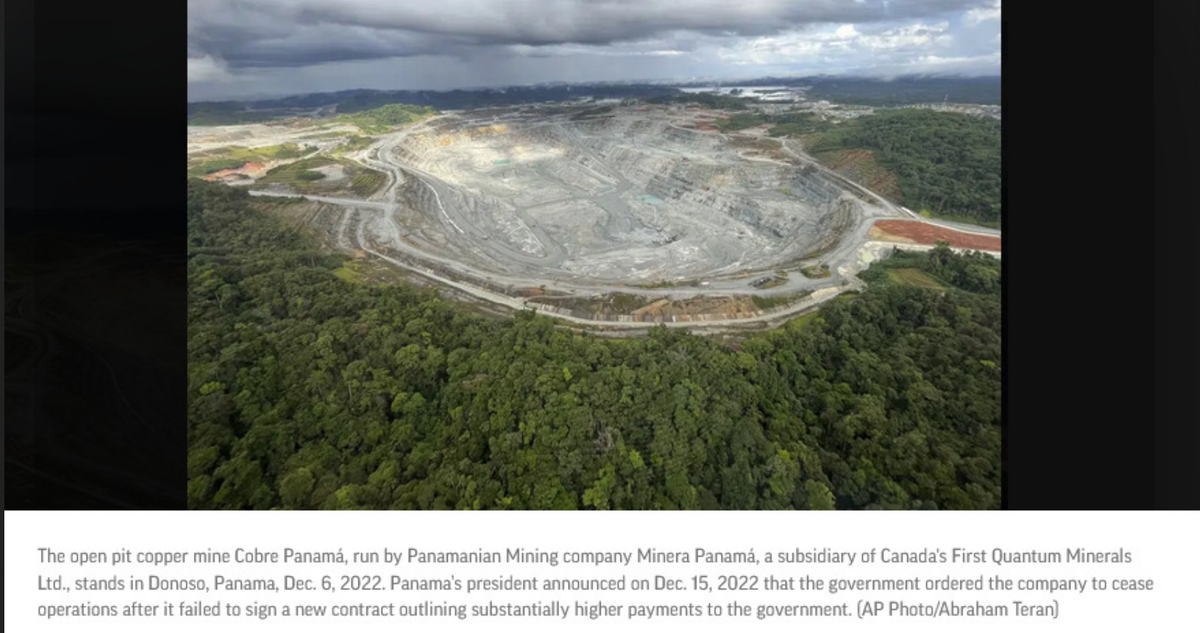
(Originally posted elsewhere on 24 March 2023.)
If you wanted to know more about the saga of defiance of Canada's open-pit copper-mining in Panama.
Here are some the headlines regarding Canada-Panama state disputes--disputes which might obscure the popular distaste animating much of Panama's public.
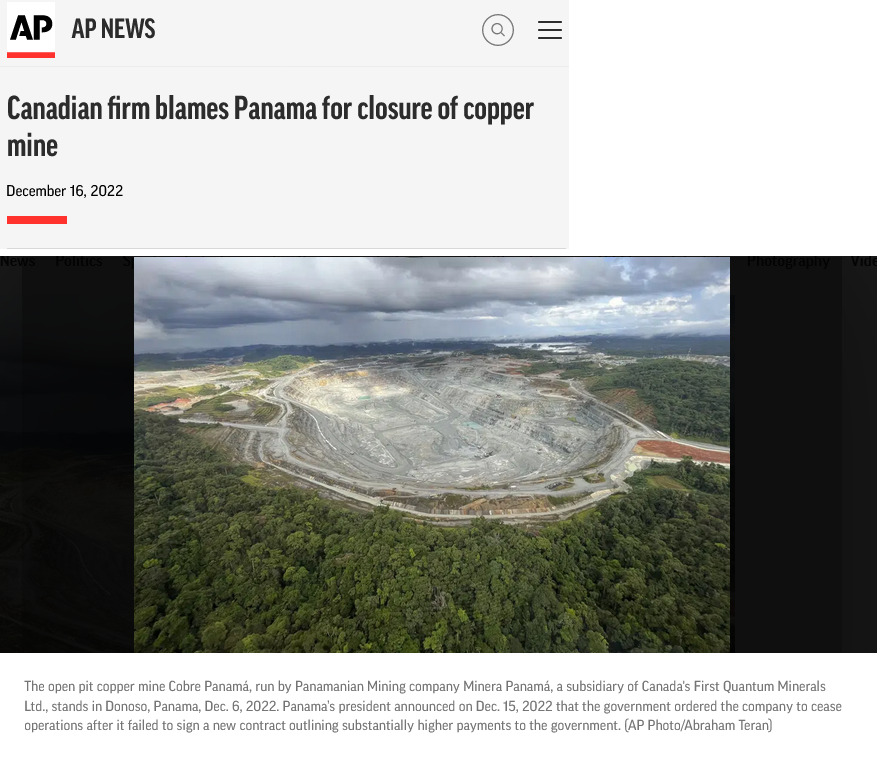
Screenshot and headline from: “Canadian firm blames Panama for closure of copper mine.” AP News. 16 December 2022.
--
Headline from: “Panama: Canadian mining company First Quantum denied to expand copper exploitation area for alleged failure with environmental commitments.” Business & Human Rights Resource Centre. 26 January 2023.
--
Headline by: The Associated Press. “Panama reaches 20-year deal with Canadian copper mine.” As republished at ABC News. 8 March 2023.
--
So what's going on in the background?
Let's look to Canadian Dimension's ongoing reporting:
Excerpt:
In Panama, a dispute has emerged of a type that is common to countries in Central and South America: a huge transnational company has invested in the country’s resource wealth, resulting in a conflict over suitable payments to the government that draws in officials from the company’s nation of origin in defence of corporate profits. In this case, the company in question is First Quantum Minerals, a mining giant with lucrative investments across the Global South – and the country of origin is Canada.
This summer [2022], Panamanians rose up in nationwide protests against the neoliberal status quo imposed on the country by the government of Laurentino Cortizo. Beginning on July 1, these protests brought together diverse groups including teachers, students, trade unionists, farmers, and Indigenous organizations […]. The causes of the summer 2022 protests go back decades and help illustrate the dynamics of the current conflict between First Quantum (and their backers in Ottawa) and the Panamanian state.
Throughout the 1990s, Canada aggressively pushed for states in Central and South America to adopt neoliberal reforms that would permit more foreign investment and fewer regulations for transnational companies. […]
Several protest movements emerged in Panama in the 2010s in opposition to the effects of free market reforms generally and the predominance of Canadian mining specifically. At the heart of these resistance movements is the Canadian-owned Cobre Panamá mine, which is the largest foreign investment in the country […].
—
Cobre Panamá was owned by the Toronto-headquartered Inmet Mining until 2013, at which point it was acquired by Vancouver-based First Quantum. In 2011, the Martinelli government attempted to limit the Indigenous Ngäbe-Buglé nation’s rights to autonomy and self-government in order to grant mining companies access to minerals on their land. Meanwhile, Martinelli repealed a law that prevented foreign governments from investing in the mining sector – a gift to Canada’s Inmet Mining, which at the time was seeking financing from the sovereign wealth funds of Singapore and South Korea.
These moves sparked protests that continued into 2012. Martinelli responded to demands for the annulment of mining and hydroelectric concessions on Indigenous territory with violence by dispatching riot police. The police killed one protestor, injured thirty-two, and detained forty. The protestors did not budge; instead, they blocked the entrances to Cobre Panamá and another mine owned by the Canada’s Petaquilla Minerals. Eventually Martinelli relented and vowed not to approve mining projects on or near Ngäbe-Buglé lands.’
—
During the 2011-2012 conflict, nobody in the Canadian government issued a single statement on the matter. When protestors took to the streets again in 2022, Ottawa released a statement that totally omitted the reasons behind the uprising.
Following the economic shock of the COVID-19 pandemic, the Cortizo government declared that Panama’s recovery would rely on incentivizing foreign investment in the mining sector. Social movements have by and large rejected this new arrangement due to the history of corrupt collaboration between state officials and foreign companies and the weakness of environmental protections.
—
For example, in April 2022 the Panama Worth More Without Mining Movement – which arose in opposition to the Canadian-owned Cobre Panamá mine – released a report that found over 200 “serious” breaches of environmental commitments by the project managers, including the breaking of reforestation promises, “the felling of 876 hectares… in an area of high biodiversity and international importance,” and “the discharge of waste from the tailings tank into natural bodies of water without official endorsement.”
Following the summer 2022 protests, the Cortizo government announced plans to reform the mining sector by instituting greater regulations on foreign companies. In the meantime, the Panamanian state and First Quantum were in the process of negotiating a renewed contract. Jason Simpson, CEO of Canada’s Orla Mining (which is hoping to begin extraction at its Cerro Quema gold project), said, “The biggest story in Panama is Cobre Panamá, so as the government works through their renewed contract law for First Quantum’s asset there, that’ll take priority… We’ll be patient for that to be resolved and then we hope to get working on construction in Panama.”
The negotiations for the renewal of the Cobre Panamá contract began in September 2021. The two parties agreed that First Quantum would provide Panama with between 12 and 16 percent of its gross profit, a new rate that would replace the previous two percent revenue royalty. […]
—
Much like Ottawa jumped to the defence of Centerra Gold following Kyrgyzstan’s nationalization of the Kumtor gold mine last year, the Trudeau government has taken a keen interest in Cobre Panamá and, according to the unnamed Reuters source, is actively backing the mining company’s position. Given Canada’s long history of support for neoliberal reforms and transnational investment in Central and South America, Ottawa’s support for First Quantum in these negotiations should come as no surprise.
—
Headline and text by: Owen Schalk. “Ottawa backs Canadian mining giant in dispute with Panama.” Canadian Dimension. 26 December 2022.