Empire-building in Greenland: Making new suburbias, US domestic lifestyles, and the importance of vision and photography in laundering the image of a colony
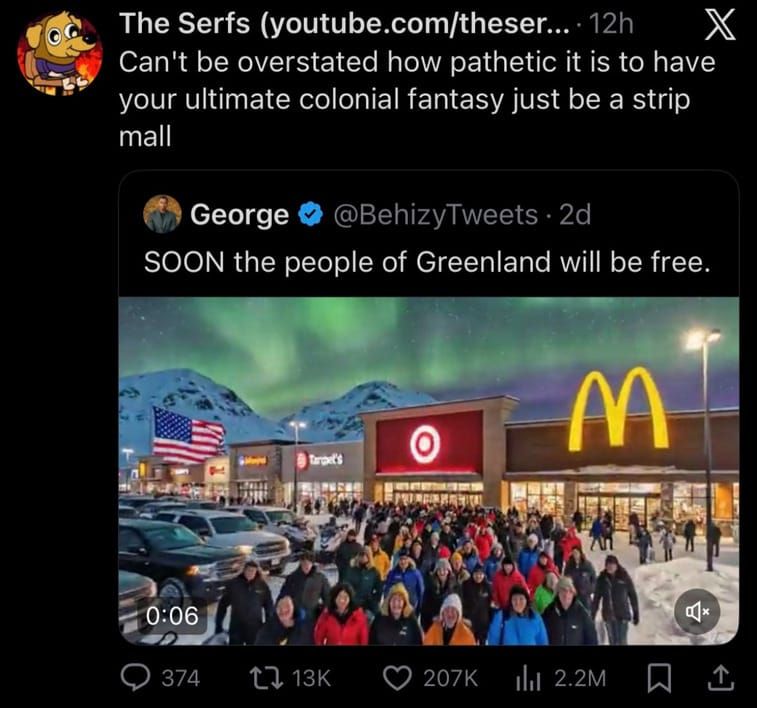
(Originally posted elsewhere on 26 May 2022. Addition/update added 19 January 2026.)
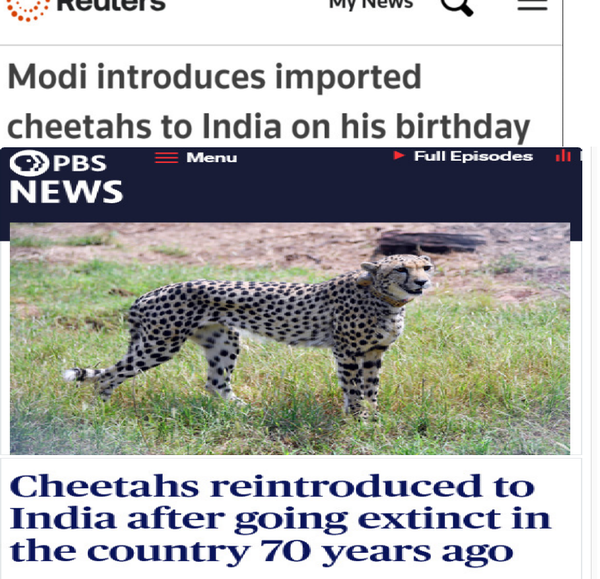
The addition/update, which I think helps contextualize the relevance of the excerpt/passage itself: This little joke/meme image was circulating online after the US president said/did some stuff.
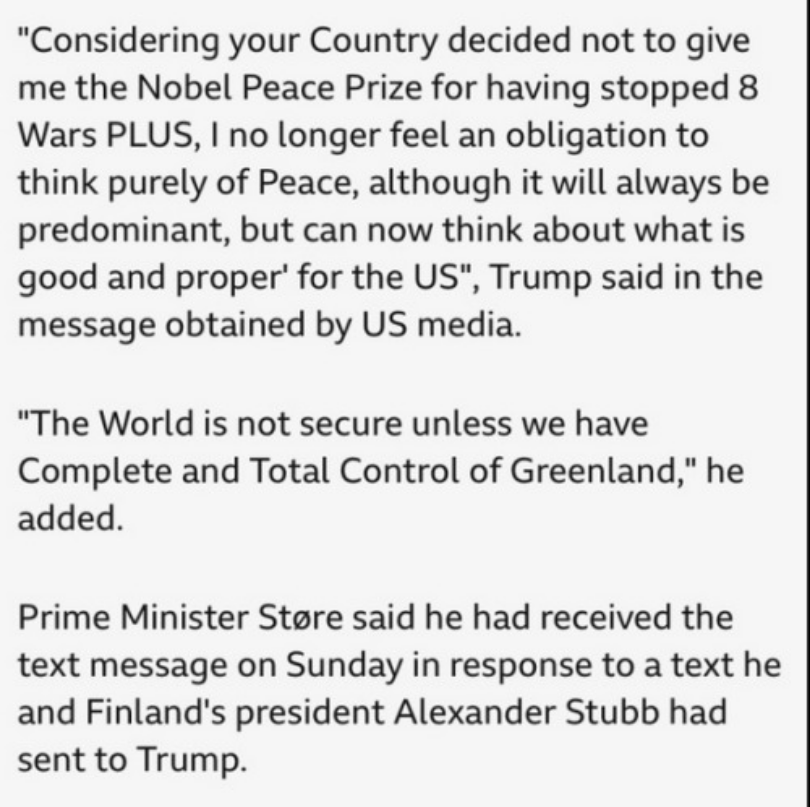
And the original text analyzed in May 2022:
Concerning empire-building in Greenland and islands of the Pacific; the making of “new suburbias”; the “exporting” of US domestic lifestyles; and the prominence of visual/aerial imagery and film photography in relaying this images/ideas of a possess-able imperial frontier.
Excerpt:
Within the Western popular imagination, places like the RMI [Marshall Islands] and Greenland are often used as mirrors or–perhaps more accurately–as bellwethers […]. They are rarely made meaningful on their own. Instead, reports published in major news outlets describe a “melting” Greenland and a “disappearing” Marshall Islands by translating their loss through symbolic forms deemed more legible to the average American. […] [N]uclear photography endeavored to “take the place out of the landscape” so as to replace public concerns around ethics instead with awe […], [undertaken simultaneously as] movement of peoples necessary to, first, produce terra nullius–a space emptied and made available […] –and second, to mark that space as distinctly American through the installation of miniature suburbias in the form of military bases and bunkers […]. Social, geographical, and material practices of division […] reflect what Aimee Bahng has referred to as “settler colonial… constructions of enclosure” […].
[A] “homemaking project” that once collapsed the “here” and “there” of US empire now envisions a difference that overlooks American complicity in apocalyptic […] futures […]. It is, in part, because of the presumed insignificance of the Marshall Islands and Greenland (and by extension their people) that these two places became pulled into the crosshairs of […] geopolitical [projects]. […]
—
As Marshallese activist Darlene Keju-Johnson recalled, “in 1946, a U.S. Navy officer came to Bikini Island and told Chief Juda, ‘We are testing these bombs for the good of mankind […]’… the naval officer did not tell the chief that the Bikinians would never see their home again” […]. Moved to first Rongdrik (Rongerik), then Ānewetak, then Kuwajleen (Kwajalein), and then Kōle (Kili), ri-Pikinni struggled to survive as the United States tested sixty-seven nuclear bombs on Pikinni (Bikini) and other nearby sites between 1946 and 1958. […] These ideologies were exported in the form of US military installations like the US Army Garrison Kwajalein Atoll and Greenland’s Camp Century, constructed in midcentury. […] Historian Lauren Hirschberg’s analysis of the suburbanization of Kuwajleen highlights how the heteronormative nuclear family structure became central to the remaking of the atoll as both a space of exception and “a colonial technology for marking the island as a familiar domestic national space” […].
Through a major partnership with Bell Telephone Laboratories, the US military promoted life on Kuwajleen as a space of supreme comfort and leisure through the publication of welcome guides that boasted salons, prime rib dinners, and department store shopping […]. Meanwhile, Marshallese day laborers who provided janitorial, housekeeping, and groundskeeping services commuted from Epjā (Ebeye), where they lived both segregated from and economically beholden to the base […].
—
One of the largest military bases ever constructed by the United States, Thule [in Greenland] served as a key strategic location […] and, simultaneously, distracted from undisclosed nuclear activity at nearby Camp Century, a “city under the ice” that housed an arsenal of six hundred nuclear missiles […]. [P]lans for Thule’s expansion in May 1953 included the forced removal of eighty-seven Inuktun and the demolition of their homes […].
Newsreels about Camp Century similarly highlighted features designed to replicate American suburban life “under the ice.” Created by the United States in 1960, Camp Century operated as a cover for Project Iceworm, which used a network of subterranean tunnels burrowed under the Greenland ice sheet […]. The camp, which operated only until 1966, comprised living quarters, research facilities, and a portable nuclear reactor for the stated purpose of better understanding military effectiveness and operations in Arctic conditions.
In the minds of Americans, who came to know this “city under the ice” through maps, photographs, and live footage circulated by the US government, it functioned as a kind of ultimate fantasy fallout shelter that promised to keep the American way of life secure and safe […]. The US Department of Defense 1961 short film Big Picture: City under the Ice is one example of the substantial media production surrounding Camp Century, which reveled in the engineering used to build closed-system facilities for maintaining American lifestyles amid what is frequently referred to as “barren” and “lifeless” landscapes. In it, the narrator lists items representing domestic comforts: prefabricated houses, hot showers, and “even ice cream” as a subtle underscore of the hermetic barrier between the bunker and the glacier […].
—
As Anne Spice points out in their analysis of Indigenous resistance […], long-standing “binaries of civilized/savage and culture/nature” continue to inform theorizations of the built environment as marks of modernity. The role that infrastructure plays in state-building projects has a capillary function […]. [T]hese material networks naturalize settler presence as seemingly stable, inevitable, and permanent […]
—
Text above by: Hi’ilei Julia Hobart. “Atomic Histories and Elemental Futures across Indigenous Waters.” Media + Environment 3 (1). 2021. DOI at: doi dot org/10.1525/001c.21536.