Escobar's hippos, Andean landscapes, and the meaning of 'natural'/'invasive' in the Anthropocene: Responding to message about Colombia
(Originally posted elsewhere on 16 January 2021.)
Yes, Escobar’s hippos.
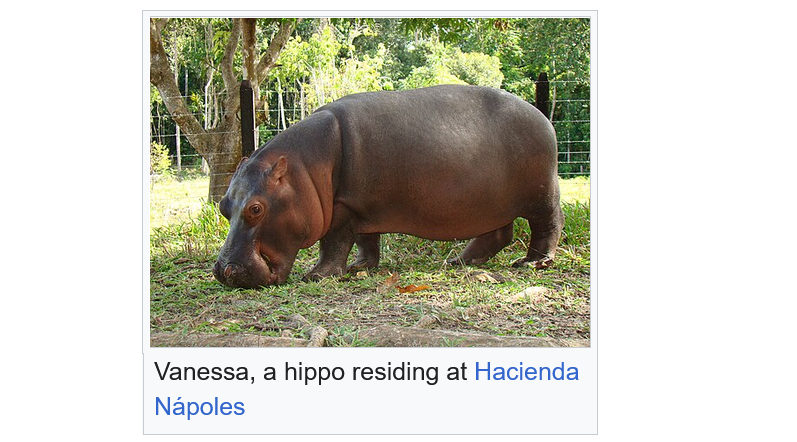
I’ve followed the story for a long time and I have many thoughts about these hippos. Here are some:
-- This of course also reminds me of Louisiana federal Congressman Robert Broussard’s notorious Hippo Bill (from 1910) and the aim to profit off of the proposed introduction of hippos to the Mississippi River system. History repeats itself as no-less-tragic farce. Only several decades earlier, British colonial agents had notoriously introduced rabbits to Aotearoa (along with pasture grasses and sheep, attempting to transmute Aotearoa into an idyllic English countryside); when the rabbits got out of control, Britain introduced stoats to Aotearoa in an attempt to attack the rabbits, but then the stoats themselves became The Problem and started killing Aotearoa’s globally-unique endemic species. Worth noting, because part of Broussard’s justification was for the US to introduce hippos in order to control rampant water hyacinth, a rapidly-proliferating non-native/invasive plant introduced a few decades earlier and which choked waterways. (Another part of Broussard’s justification was to establish hippo-meat and hippo-ranching industry in the US. A fascinating presentation of the geographic imaginary of the US, as if the US shared the regal connotations ascribed by Edwardian archaeologists and classicists to Egypt of antiquity, as if New Orleans was a reincarnated royal Thebes at the delta of a great river.) Step 1: Introduce a non-native species. Step 2: Introduce a second non-native species to destroy the first non-native species. Step 3: Profit briefly in the short-term? Step 4: Lots of creatures die. Step 5: Local and traditional communities lose foodways, knowledge, connections, etc.
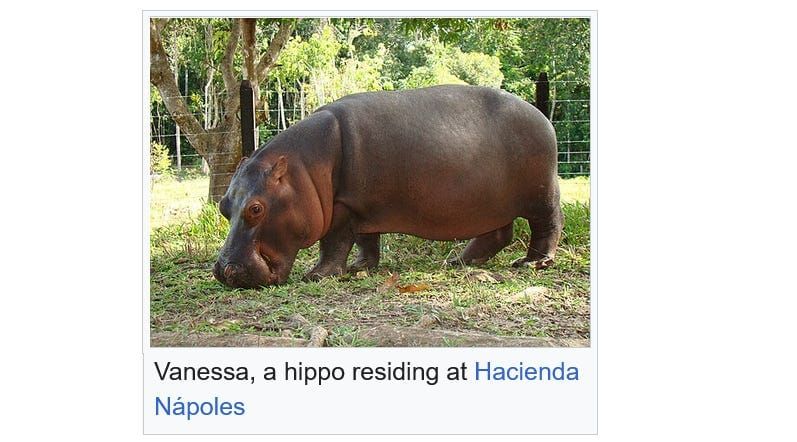
-- Ten or fifteen years ago, media coverage of the “cocaine hippos” seemed to treat them like a novelty. “Only a dozen or so hippos, mostly isolated. How funny. What a strange artifact of the Drug War.” (For anyone unfamiliar, the late cocaine aficionado Pablo Escobar had imported a couple of hippos to his Colombian home; the hippos have since grown in numbers.) Now, there are, apparently, over 100 hippos living in the region, across 2,000 square kilometers. Not great. It’d be different if they weren’t openly moving around such a large amount of land. Hippos are very large. Ecosystems where streams, rivers, and wetlands interact with comparatively drier nearby landscapes with less-inundated soils are important transition zones and meeting-points between landscapes, and the hippo’s preference for wallowing in these kinds of wetlands makes it a high-impact presence and a great danger outside of its native range. Non-native/invasive cane toads, beetles, worms, or other smaller creatures are difficult to detect due to smaller size and ability to hide amongst vegetation, and can also reproduce en masse and proliferate exponentially, meaning they’re also difficult to corral/isolate due to sheer numbers. So, as consolation, at least the hippos in the Magdalena River can be monitored as their population grows?
-- If there are less than 150/200 hippos in the region, would it be best to remove them right now? 2,000 square kilometers is a lot of space. The hippos threaten a lot of damage. Importantly, the removal of 200 hippos would not necessarily require killing them. Isolate, corral, put them in a refuge, etc. The Magdalena River system interacts with the entire eastern slope of the Andes within Colombia’s national borders; it interacts with tropical rainforest; it interacts with coastal lowlands; it influences and affects the Caribbean.
-- Regarding the study of the hippos in Colombia as a substitute for Pleistocene megafauna. In my opinion: Nah. (I see that in early 2020, many major US media outlets carried headlines about a study suggesting Colombian hippos might be a useful Pleistocene megafauna proxy. We’re talking NatGe0 and New York T!mes, among others; in early 2021, both L!veScience and WaP0 also carried renewed headlines about the hippos.) Hippos are an African creature. (Actually, hippos were also a Mediterranean creature. Islands in the Mediterranean hosted endemic hippo species until recent millennia.) And I understand that the hippos have been described as potentially similar enough to Toxodon, which was a native South American hoofed creature presumed to be partially aquatic. But nah. Because Toxodon would’ve existed in an environment also “stabilized” by a different global climate regime and other Pleistocene megafauna whose presence, effects, influence cannot be replicated in a case study of hippos. Instead, the hippos are apparently screwing up the lives of caimans and other riparian creatures generally while presumably ruining river banks and causing increases in cyanobacteria/algae blooms, which will have cascading negative consequences downstream on the Caribbean Sea’s ecology.
-- Have you heard that 20 percent of the whole planet’s bird species can be found living within the political borders of Colombia? There are over 160 species of, specifically, hummingbirds in Colombia (wow). Colombia famously hosts a lot of mountainous topography, and the tropical montane regions of the Andean spine in South America are well-known and celebrated worldwide by ecology-fans for being spectacularly biodiverse and for hosting very cool microhabitats and many endemic species. (Partially due to altitudinal zonation, the way that many diverse habitats exist at different elevations along the slope, especially in a tropical region, where the presence of high-elevation mountains allows for “colder” climates to exist near the equator and the topography of a mountain itself provokes orographic uplift and extra moisture/precipitation in an already-wet tropical region, allowing for cloud forests and enclaves of fog.) So there is the added weight of the hippos’ potential damage to such an unusually-biodiverse region.
-- Also regarding degrees of “naturalness” and the Pleistocene: I’ve often contemplated (and written about) how settler-colonial environmentalists and conservation groups in the US poetically long for “re-wildling” and “returning all of the great North American mammals” to landscapes, especially in the the Rocky Mountains and, to a lesser extent, the Cascades. Until the removal of 3 individual caribou from the South Selkirks herd in 2019, there was a small area of Washington, Idaho, and Montana where all of the pre-European major mammals still persisted (grizzly bear, black bear, wolf, fisher, wolverine, marten, lynx, puma, caribou, elk, moose, etc.). But I had always wondered: “Wouldn’t the milieu of so-called great North American creatures also include mammoth, mastodon, camels, lions, giant sloths, horses, sabre-toothed cats, etc. since those creatures lived alongside the grizzly, jaguar, elk, etc. for millennia and only such a short time ago, in the blink of a geologic eye?” So a question that scholars, theorists, ecologists, etc., ask is: To which moment in history are we trying to turn the clock back to? In the US, for example, are these re-wildling actors trying to rehabilitate landscapes to their conditions before the nineteenth-century intensification of Indigenous epistemicide and settlement of “the West”? Or, a return to before English colonies and the landscape changes of New England? A return to 1492? Outside of the Americas, as re-wilding campaigns in Europe try to return lynx and European bison, are we returning to a time before Roman state-building and imperial expansion?
-- Anyway, these questions are a bit of a tangent, sorry. Studying hippos as a stand-in for megafauna? If the hippos had been corralled and isolated in a relatively enclosed space, like at - only at - Escobar’s old grounds: Sure, maybe. Ten hippos on fifty acres. But not at this scale.
-- What is a “natural” environment during the Anthropocene, anyway? The myth of “wilderness” dismisses millennia of Indigenous influence on ecosystems. Even at the outset of sedentary agricultural guilds and and state-building in Indus, Yangtze/Yellow, Nile, and Tigris-Euphrates valleys, we know that there were urban constructions along the western coast of the Indian subcontinent (now submerged beneath the sea), and, even earlier, structures at Gobekli Tepe near the end of the Pleistocene. Surely, these humans had substantial effects on ecology. Some environmental historians propose that the Great Plains of Turtle Island (and perhaps much of the Asiatic steppes) were not such extensive grasslands, but more like intermittent woodlands, which humans helped transform into grassland and prairie by selectively burning woodlands. Or, at the very least, these humans helped instigate transition from woodland to grassland inadvertently by harvesting herds of mammals/megafauna. Many ecologists and scholars (taking cues from Plantationocene, planetary urbanization, planetary urban fabric, and other concepts) would also argue that, especially in the past three centuries, no corner of Earth is untouched or unaffected by the extraction, infrastructure, and waste/emissions of urban agglomerations. (Is the boreal forest of deep interior continental Siberia untouched by urban development, if corporations and the Russian state build pipelines and mines to harvest natural gas in that region?)
-- And then, dialogues of historical/social analysis and ecology meet, with controversial concepts of “hybridization”, etc. Some ecologists, especially in recent (2000 until present) disk horse argue that, with so many non-native species (especially plants and invertebrates) now so widespread globally, should we begin to accept that conditions have simply changed so much that people ought to work with non-native species to forge a “new” understanding of what counts as “natural”? (But careful: Does this disk horse function as a roundabout way of sneakily implying that humans, too, can “become-natural” to anywhere? So that, if a European colonial power inhabits a “new” place, they also can frame themselves as natural? Would this be a “settler absolution” that works to literally “naturalize” imperial occupation?) And these scholars also ask: How long does a creature have to have lived in a place, in a landscape, before it has been present long enough to be considered “natural”? When you see a European dairy cow grazing on non-native pasture in Aotearoa on land that was temperate rainforest, home to strange endemic flightless birds only decades ago, it is “unnatural”. But maybe when you see a coconut in western Polynesia, it might seem natural. However, the coconut species “swam” there, floating over the seas. It migrated. But has the coconut been around in Polynesia long enough to be considered natural to those islands? Is this also how the yam/sweet potato found its way from Southeast Asia, across the Pacific, to Latin America? Does the fact that coconut migrated on its own, (possibly?) without apparent deliberate human introduction, make a metaphysical/semiotic difference, does it mean that the coconut is more natural because it found its own way rather than through direct human introduction? But even if humans did “unnaturally” introduce a species to a new region, do we consider that species “natural” or “native” species after enough time has passed? What to make of the human-induced spread of apples and other fruits from the Tien Shan slopes, or the human cultivation of tomato in the Andes? If humans propagated an apple variant 8,000 years ago, has enough time passed that the apple variant has become “natural”?
-- Regardless of how we answer these questions about “what counts as natural,” the Colombian hippos have only been present since the 1980s. They’re not an “essential” part of the Magdalena River. And all of this talk of native non-human species should not obscure the lives of people who live along the Magdalena, within Colombia, or in the Andes or Caribbean. When ecology is disrupted by such a high-impact non-native species with potentially drastic ecosystem-wide or region-wide alterations (like algae blooms, or the increased bank erosion and sedimentation which large-mammal wallowing provokes), human communities pay the price, too. Rapid changes in topography; loss of food, at least partially due to how increased algae blooms or other irregular plant blooms can choke the river of life, leading to cascading effects.
---
I don’t know. I’m not an ecologist!