Fishmeal boom (and bust) in Peru and Chile: Ghost acres, global circuits, US-Dutch industry, and an environmental history of the state(s) vs. the Humboldt Current
(Originally posted elsewhere on 18 May 2022.)
Two excerpts, in conversation. Both about the boom and bust of fishmeal industry in Chilean/Peruvian ports; the role of the state in “mining the forest/sea”; the global web of agents/investors in postwar “protein production”; and the influence of El Nino and overharvest in provoking “unforeseen” Humboldt Current marine ecology.
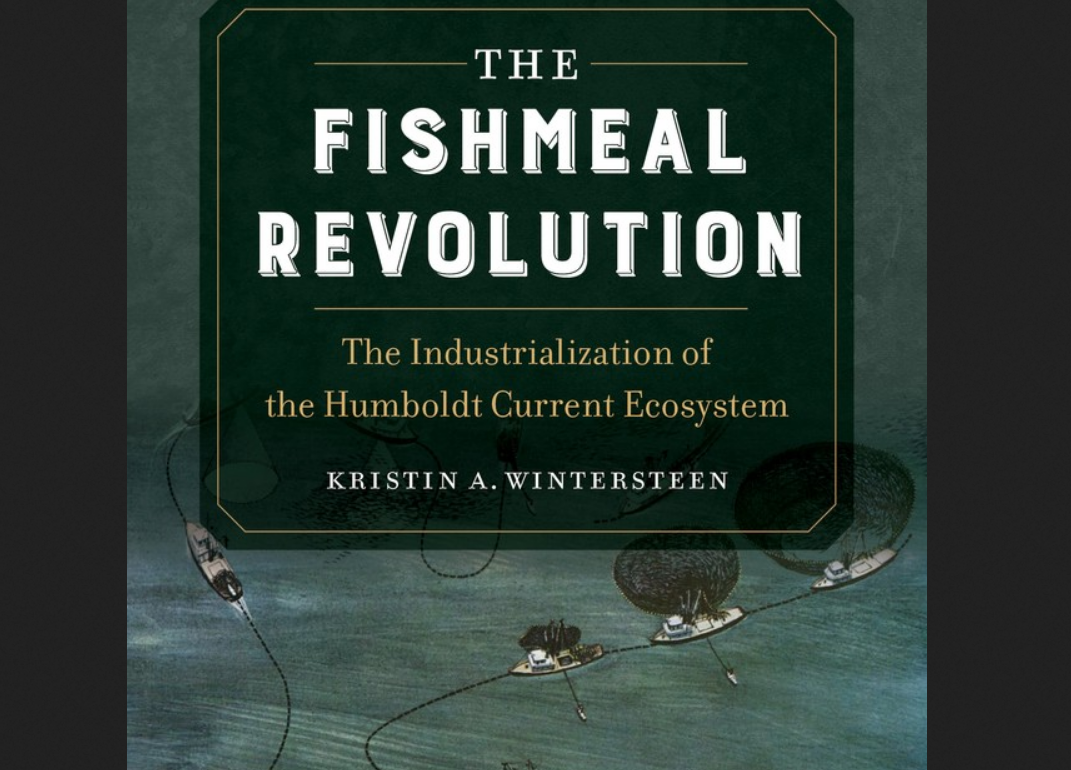
Each scholar here is, in part, discussing the work of Kristin A. Wintersteen, especially her The Fishmeal Revolution: The Industrialization of the Humboldt Current Ecosystem (University of California Press, 2021).
Interesting: Haalboom acknowledges Cushman’s assessment that US/European investment in the Peruvian/Chilean fishmeal industry constituted “neo-ecological imperialism,” like a neoliberal Blue Revolution. While connections can be made to how US “industrialistis,” corporate “subsidiaries,” and marine experts influence the birth of Peru’s fishmeal industry after 1945, Haalboom also argues that the postwar rise of “factory farms”—in both the US and Europe—was a major factor. He uses the Netherlands to make the point: With Dutch land dedicated to industrial livestock farming, pigs required cheap feed—what Nathan Stone here calls “trash fish,” in the language/perception of the 1970s. That’s where fishmeal comes in. By 1955, the Dutch were the second-largest importer of Peruvian fishmeal.
Both scholars invoke labor and inequity. Haalboom notes that, after the ascent to power of Pinochet—when the Chilean state “gave fishmeal industrialists free rein again”—Chile then surpassed Peru as the major fishmeal exporter.
Both scholars also describe the centrality of the Humboldt Current’s ecology to this whole system, in which the sea was originally perceived by the state as reservoir of replenishable resources—without understanding the complex mechanisms of marine ecology, in which the El Nino event of 1972 destabilized the whole scheme, resulting in a “bust in a spectacular way.”
Nathan Stone, in his review of Wintersteen, acknowledges how “the smell of money” attributed to the fishmeal plant in Iquique was really “just the stink of dead fish.”
Anyway.
—
Excerpt 1:
In August 1963, the Dutchveterinarian Dan (E.H.) Kampelmacher stepped on a plane to Lima, the capital of Peru. His destination: smelly factories in Lima’s port city which ground up tiny anchovy fish from the Pacific Ocean into huge amounts of animal feed. Peru exported one fifth of this ‘fishmeal’ to the Netherlands, where farmers used it to feed their quickly rising numbers of chickens and pigs in new intensive livestock or ‘factory’ farms. [...]
The ports of Lima and Rotterdam connected the ecosystems of Peruvian fishmeal plants and Dutch farms. [...] [H]ardly anyone showed any interest in what the stuff was made of. Although Dutch farmers had started to refer to their new industrial poultry and pig farms as ‘landless’ at this point in time, they did not intend this phrase to mean their growing dependence on oceans rather than land. Rather, it characterized a fundamental change in livestock farming: in the postwar era farmers could increase their numbers of animals independently of the area of land they had for growing feed. The phrase ‘landless’ erased from view that these farms in fact depended on places elsewhere on the planet. [...] [T]he fish, called “anchoveta” [were] from the Humboldt Current ecosystem [...].
Fishmeal was invisible, despite its crucial importance for two interrelated major changes in the Netherlands and the global north in general: the rise of intensive livestock farming, and the unprecedented increase in the consumption of meat and eggs. [...] How did fishmeal and its environmental impacts connect industrial livestock farming in the global north to its production places in the global south [...]? [...]
---
Shadow places are ‘all those places that produce or are affected by the commodities you consume, places consumers don’t know about, don’t want to know about, and in a commodity regime don’t ever need to know about or take responsibility for’. It is very similar to the ‘ghost acres’ concept used by environmental and global historians: the acres of land countries used elsewhere on the planet [...]. Cushman analyses the rise of the Peruvian fishmeal industry as another case of what he calls ‘neo-ecological imperialism’: the ‘Blue Revolution’ [...], to stress the connection between fishmeal production in the Pacific World and the rise of industrial livestock farming in the global north. [...]
Fishmeal fed the twentieth-century shift to industrial livestock farming – the Netherlands was among the top three fishmeal importers internationally from 1954 to 1972. [...] Animal proteins – and fishmeal in particular – played an essential role in this shift to industrial livestock farming [...]. But for poultry and pigs, animal proteins were an ‘indispensable ingredient’ [...]. Internationally, fishery landings tripled in the period 1950–1973 due to the rise in fishmeal production for animal feed. [...] During the Peruvian fishmeal boom from 1958 until 1970, [...] [t]he livestock sector started to refer to it explicitly as ‘Peru fishmeal’ [...]. The Netherlands was the second-largest importer after the USA in 1955 [...].
---
According to Cushman and Wintersteen, the spectacular rise of the Peruvian fishmeal industry was the result of [...] international interest in the Peruvian stocks of small fish suitable for fishmeal production, interest from the USA in particular.
After the collapse of the Californian fishmeal industry shortly after the Second World War, industrial fishmeal plants in Peru were realised with American marine expertise, investments by American industrialists, subsidiaries of American companies like Cargill and Ralston Purina, and second-hand American fishmeal equipment and technology. [...]
As a result, the Peruvian fishery industry changed radically during the 1950s. Rather than a being a by-product of fish canneries, fishmeal became its core focus. [...] [A]nd industrialists moved in entire fishmeal plants from the USA and Scandinavia. These plants could turn 5.4 tons of fish into a ton of fishmeal at the peak of the industry [...].
---
Angola exported fishmeal under Portuguese colonial rule (until 1975), and South Africa exported fishmeal during Apartheid (until 1994). In Chile the neoliberal dictatorship of general Augusto Pinochet (1973–1990) gave fishmeal industrialists free rein again from 1973 onwards, and Chile had replaced Peru as the major fishmeal exporter by 1980.
Social inequality was exacerbated [...]. Fishmeal industrialists made enormous amounts of money, and stock exchanges in the global north enabled speculation on fishmeal. Simultaneously, workers in the fishmeal plants were poorly paid and lived in slums with no paved roads, running water or electricity, unhealthy conditions and polluted air. Fishmeal’s volatile market resulted in labour unrest during the 1960s in Peru, and during the 1980s in Chile. [...] Many factories were moved to less-regulated places along the coast, taking the air pollution and resulting public health problems with them. One of these places was the city of Chimbote, which quickly grew into the largest fishmeal city of Peru, and became ‘one of the nation’s … most polluted cities’. [...] One place impacted by the feeding of fish to farm animals was in particular in shadows: the marine ecosystems from which the tiny fish were taken, like the Pacific Humboldt Current along the coast of Peru and Chile. [...]
The ocean ecosystems in the global south exploited to feed the industrial livestock sector in the north remained largely invisible. [...] The disappearance of the Peruvian anchoveta also made the ‘protein crisis’ move north. The Dutch livestock sector referred to the ‘true emergency situation’ of the Peruvian fishmeal crisis as the ‘protein crisis’ (‘de eiwit-crisis’). [...] But in 1972–1973 the Humboldt Current marine ecosystem created its own shadow places in both the north and the south. The extraordinary strong El Niño led to the sudden disappearance of the anchovy population [...].
---
All text above by: Floor Haalboom, “Oceans and Landless Farms: Linking Southern and Northern Shadow Places of Industrial Livestock (1954-1975),” Environment and History, vol. 28, no 4. (November 2022). DOI at: doi dot org slash 10.3197/v096734 020X15900 760737202 [Emphasis mine.]
—
Excerpt 2:
[T]he stink of the fishmeal plants in Iquique. [...] Local residents called it “the smell of money.”
Domestically produced fish flour had become the primary source for fish food in the new salmon farms that had begun to scar the [...] lakes and fiords in the Chilean south. It would also become dog food, and the “high protein cookies” on school lunch menus [...]. It would fatten pigs in Germany and chickens in California to satisfy the voracious appetites of a competing species now referred to simply as “the consumer.”
In her recent book, The Fishmeal Revolution, environmental historian Kristin A. Wintersteen follows the scent of the uniquely situated and environmentally sensitive biomass from the unusually cold and nutrient rich Humboldt Current that bathes the western coast of South America. [...] The sheer scale of biomass extraction for land-animal consumption constituted nothing less, in her view, than a colonizing expropriation of the world’s oceans. The masters of the land had claimed the vast wealth of the planet’s seas [...]. Moreover, like the British in India and the Spanish in Latin America, the colonizers did not understand the complexity of the space they had appropriated. [...] Wherein the abundant ocean life survives at all, that survival is a testament to species’ resilience and [...] the long [...] cycles [of the sea] [...].
---
During the late nineteenth and early twentieth centuries, from Norway to California, the ocean’s “trash fish” and offal from canneries had become the raw material for fertilizer and protein supplements in animal feed. As northern hemisphere fishing industries overfished their own waters, their gaze turned south. The magic of an apparently infinite supply of plankton-eating anchoveta off the western coast of Latin America depended on the frigid Humboldt Current that moved northward just off the west coast of the South America. But the abundance of anchoveta, and the prosperity of the complex ecosystem that depended on it, periodically gave way to an unpredictable cycle of warmer currents known as, El Niño. [...] [N]ineteenth and early twentieth-century agriculturalists created their own expanding niche in the maritime ecosystem by using fish parts [...]. [T]he golden anchoveta [...] became a special target [...].
Progress promised a bright future. [...] In the 1960s, the precariously built settlement of Chimbote, on the northern coast of Peru, became a boomtown. For a few short years, it was home to the world’s largest single-species fishery. That boom would bust in a spectacular way with the El Niño phenomenon of 1972. After 1980, [...] the Chilean ports of Iquique and Talcahuano began to harvest and process the anchoveta as its northern neighbor had done. [...]
---
In his study, La Frontera: Forests and Ecological Conflict in Chile’s Frontier Territory [...], historian Thomas Klubock observes how early twentieth century developmentalism treated the temperate forest of the Chilean south as if it were a non-renewable resource. The Chilean nation state had set about “mining the trees”, as it were, and leaving behind a charred wasteland, without regard to social or environmental impact. In Wintersteen’s account, a similar dynamic drove Pacific fisheries to self-destructive excess [...]. Producers assumed that “any fish not extracted from the sea had no value” (115). As the 1972 collapse unfolded in Chimbote, fishermen saw that two thirds of their catch consisted of juveniles, up from one fifth in normal times. And yet, they dutifully ground them all into fish meal, to meet their contracts with foreign hog and poultry farmers. [...]
[T]he modern state assumed that it could own the seas. Therein lies the rub. The Chilean national anthem triumphantly proclaims, the sea that peacefully washes your long coastline promises you a splendorous future.
Or, does it? [...]
---
Coastal communities had a word for the fluctuations of fortune, the vaivén, a contraction of the Spanish, va y viene - comings and goings.
The term reflects a[n] [...] acceptance of the unpredictable cycles of wind and wave to which humanity, like all other species, had to adapt. Neoliberal capitalism has no place for that kind of thinking. The linear growth charts of capitalized industry [...] presupposed an unlimited potential for growth. The Humboldt Current ecosystem has proven that the myth of unlimited growth is radically unsustainable. [...]
As any child in Iquique could tell you, what adults called the smell of money was simply the stink of dead fish.
---
All text above by: Nathan Stone. “Review of The Fishmeal Revolution: The Industrialization of the Humboldt Current Ecosystem by Kristin A. Wintersteen (2021).” Not Even Past. 22 September 2021. [Emphasis mine.]