'Glacier mice' research, the 'love letter to moss' from Halloween 1950, and Kimmerer's 'revelation' of seeing plants
(Originally posted elsewhere on 29 May 2020.)

Hi. No bother at all :)
Here is the text of my original post (from 22 May 2020):
So about the communities of moss balls which live atop glaciers and appear to be “moving” in a “coordinated” fashion. A bit of a sensational application of human intention to the behavior of moss, but the moss do seem to have “habits” (perhaps similar to how you’d characterize the slow movement of tree-roots as behavior). The news was announced by an April 2020 article (in Polar Biology), and the glaciologists studying the moss harken back to how, in a mid-twentieth-century informal letter from a glaciologist sent to an academic journal, these moss balls were affectionately referred to as jökla-mýs, “glacier mice.”
Looking at the biologists’ citations, I went to look at the original source of this anecdote, which was penned (on Halloween, no less!) in 1950 and printed the following year: Jon Eythorsson, “Jokla-mys,” Journal of Glaciology, vol. 1, no. 9 (1951), page 503.
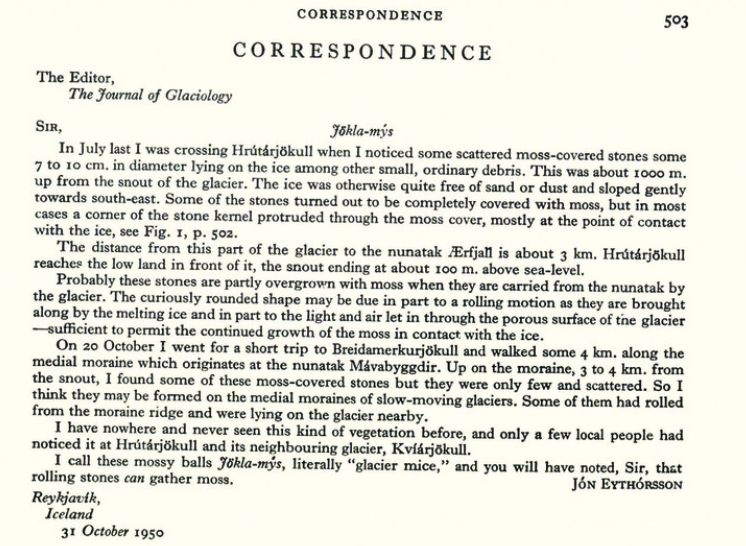
Abbreviated (by me), the text reads:
In July last I was crossing Hrutarjokull when I noticed some scattered moss-covered stones some 7 to 10 cm. in diameter on the ice among other small, ordinary debris. This was about 1000 m. up from the snout of the glacier. The ice was otherwise quite free of sand or dust and sloped gently towards south-east. Some of the stones turned out to be completely covered with moss […]. On 20 October I went for a short trip to Breidamerkurjokull and walked some 4 km. along the medial moraine which originates at the nunatak Mavabyggdir. Up on the moraine, 3 to 4 km. from the snout, I found some of these moss-covered stones but they were only few and scattered. So I think they may be formed on the medial moraines of slow-moving glaciers. Some of them have rolled from the moraine ridge and were lying on the glacier nearby. I have nowhere and never seen this kind of vegetation before, and only a few local people had noticed it at Hrutarjokull and its neighborhing glacier, Kviarjokull. I call these mossy balls jökla-mýs, literally “glacier mice,” and you will have noted, Sir, that rolling stones can gather moss.
Jon Eythorsson
Rekjavik, Iceland
31 October 1950
—
—
Anyway, I had originally shared that post because of the pop-sci conversations about moss mobility.
Such movement—the “rolling around” of the moss balls—is apparently not random (at least according to the 2020 research). Glacier mice are apparently known to live in the Andes, Iceland, Svalbard, and Alaska. At one Alaskan site, where this research was done, the moss balls apparently move an average of 2.5 centimeters each day. This was reported in a May 2020 article in Polar Biology:
Scott Hotaling. Timothy C. Bartholomaus. Sophie L. Gilbert. “Rolling stones gather moss: movement and longevity of moss balls on an Alaskan glacier.” Polar Biology.
You should be able to read the article for free, if you search for it (and if you read the short-ish NPR article linked below, it contains a link to the academic article, for free). Here’s a photo of the glacier moss balls, from one of the (May 2020) article’s authors:
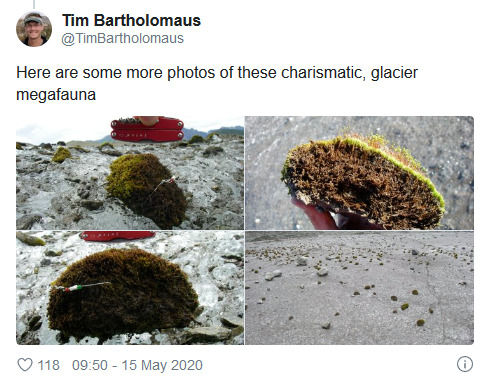
One of the first pop-sci/mainstream outlets to report on this was NPR, which provides a kinda nice summary of how the moss are moving and why the news is important. That article: Nell Greenfieldboyce, “Herd Of Fuzzy Green 'Glacier Mice' Baffles Scientists,” NPR, 22 May 2020.
From that article:
“The whole colony of moss balls, this whole grouping, moves at about the same speeds and in the same directions,” Bartholomaus says. “Those speeds and directions can change over the course of weeks.” […] The researchers had expected that the balls would travel around randomly by rolling off their ice pedestals. The reality was different. The balls moved about an average of an inch a day […]. The researchers considered several possible explanations. The first, and most obvious one, is that they just rolled downhill. But measurements showed that the moss balls weren't going down a slope. "We next thought maybe the wind is sort of blowing them in consistent directions," says Bartholomaus, "and so we measured the dominant direction of the wind.” That didn't explain it either, nor did the pattern of the sunlight. [...] Indeed, tiny critters including simple worms and water bears can even live inside moss balls, according to one study from 2012.
—
Proper biology/botany is beyond me; not my wheelhouse. So, I’d shared it simply for love of moss.
Obligatory citation of increasingly-famous Potawatomi botanist Robin Wall Kimmerer, from her Gathering Moss: A Natural and Cultural History of Mosses (2003):
The revelation of suddenly seeing what I was blind to only moments before is a sublime experience for me. I can revisit those moments and still feel the surge of expansion. The boundaries between my world and the world of another being get pushed back with sudden clarity, an experience both humbling and joyful. Mosses and other small beings issue an invitation to dwell for a time right at the limits of ordinary perception. All it requires of us is attentiveness. Look in a certain way and a whole new world can be revealed. […] Learning to see mosses is more like listening than looking. A cursory glance will not do it. Starting to hear a faraway voice or catch a nuance in the quiet subtext of a conversation requires attentiveness, a filtering of all the noise, to catch the music. Mosses are not elevator music; they are the intertwined threads of a Beethoven quartet. Knowing the fractal geometry of an individual snowflake makes the winter landscape even more of a marvel. Knowing the mosses enriches our knowing of the world. […]