Guacamole and the spectacle of the US Super Bowl? Think about the history of Purepecha people, NAFTA neocolonialism, and Michoacan's avocados

(Originally posted elsewhere on 11 February 2024.)
Just thinking about avocado, plantations, and advertisements.
Since I'm at my retail job and annoyed by the fucking Super Bowl.
--
Excerpt:
Avocado orchards had carpeted the gently undulating hills around the [...] lake of Pátzcuaro with stodgy green bushes. Here, before the cataclysmic arrival of the first envoys dispatched by Hernando Cortes from the Aztec capital over the mountains to the East, [...] the Purépecha had sown maize, amaranth, zucchini, cacao, cotton, tomato, beans, a dozen types of chili, and much more.
Now the monotonous “green gold” of the avocado boom had colonized the entire Mexican state of Michoacán. [...]
[I]t was shocking to think that the cause of the disaster was America’s great patriotic party: the National Football League’s Super Bowl.
A flurry of advertising creativity on behalf of the Mexican avocado was unleashed every year during the multi-million-dollar sports broadcast. [...] “Is your life just terrible?” asks the comic actor Chris Elliott, star of Scary Movie 2 and Scary Movie 4, in the 2019 spot. “You deserve more! Spread an avocado on top of everything!” [...] A few days before the Super Bowl, the domestic diva Martha Stewart [...] had released on social networks her latest recipe for guacamole [...]. Guacamole was now an obligatory snack for the 100 million or so Americans who watched the Super Bowl. In February of 2017, 278 million avocados - most of them from Michoacán - had been sold during the days before the game in [the US] [...].
---
The avocado had become the star product of Mexican food production in the age of the North American Free Trade Agreement (NAFTA) [...] since NAFTA was signed in 1994 [...]. [Mexican] farmers produced 16 times more than the formerly dominant Californian growers. [...] Moreover, the avocado was now classified as a “superfood” [...].
It had not always been like this. In the 1950s, the avocado was known unsentimentally as the crocodile pear [...]. Imports from Mexico were banned until 1997 [...] . When complete liberalization was announced in 2007, Michoacán had become an unbeatable competitor for the Californian avocado growers. The Mexican producers specialized, like their Californian rivals, in the Hass variety of avocado, more meaty than those that the Purépecha had [...] consumed over the millennia, and with a tough skin that protected the pears during long hauls in chilled container trucks to El Paso or Tijuana and then beyond to the big US consumer markets. [...] [T]he Hass avocado was perfectly suited to the global market [...].
Michoacán, whose crystalline lakes had earned it the name of the “land of fish” in the indigenous language of Tarasco, would never be the same. By 2020, 80 percent of the avocados consumed in the United States came from Michoacán [...].
---
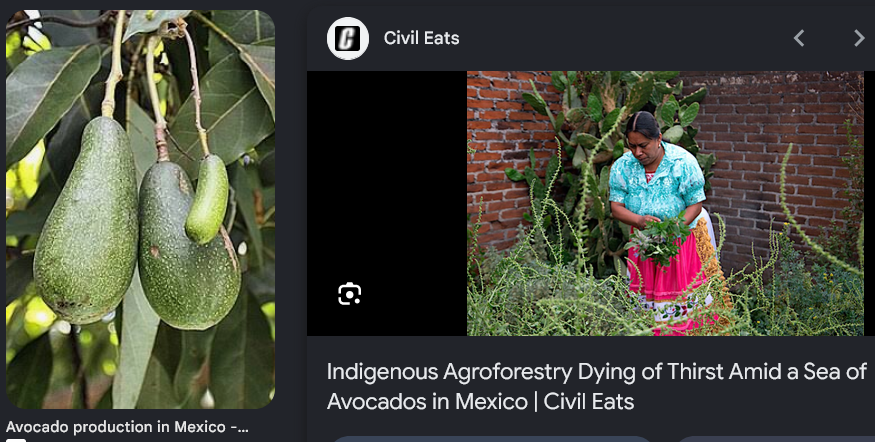
Now in the 21st century, on the outskirts of Uruapan, the frenetic capital del aguacate, the new economy of agribusiness took shape [...]. Further west on the shores of Lake Pátzcuaro, the monoculture had not yet colonized the entire landscape, but the advance of the avocado seemed unstoppable. [...] [A] resident of the Purépecha indigenous community of Jarácuaro [...] was horrified by the extent of environmental destruction. “They pump water from the lake to water the avocado orchards [...]. It’s pillage. [...]” Of the cornucopia of marine life that had fed the Purépecha cities, only the diminutive silvery charal remained. The same occurred at other great freshwater deposits in Michoaczán. [...] The Purépecha communities on the shores of the lake, a landscape of stunning beauty where dense pine and ilex oak forests met white nymphaea lilies floating on turquoise water, were girding themselves for the arrival of the aguacateros, avocado producers [...].
[GV], a sociologist at the University of San Nicolas de Hidalgo in Morelia [...] [explained:] “They pay a dollar per kilo of avocado here and sell it for eight at a Minnesota [W*lmart] [...]. [J]ust like the Canadian mining companies in Zacatecas [...]."
---
Text above by: Andy Robinson, Gold, Oil, and Avocados: A Recent History of Latin America in Sixteen Commodities (2021). [Emphasis mine.]