Imperial admins 'bedeviled' by insects in Dutch Indonesia and British India: Telegraphy 'information flows' undermined by 'goth foes of civilization' (termites!) and the specificity of local environmental context
(Originally posted elsewhere in two parts on 19 December 2020 and 7 October 2021.)
Rohan Deb Roy’s work on “white ants” as minor (sometimes more-than-minor?) frustrations for “the material foundations of the colonial state” (paper documents, railways, telegraph lines, other wooden structures) has been familiar to me for a while.
Toivanen’s piece was exciting for the connection to telegraphy as “dematerialization of long-distance information flows" meaning that local ecology/animals which upset telegraph lines therefore “bedeviled that progress.” From 1859 onward, the Dutch just couldn’t seem to get their telegraph lines (from Java/Sumatra to Singapore) to endure in the face of the specificty of local ecology of the Sunda Strait.
Good stuff here from Deb Roy on invocations of race, class, “misogyny,” “Malthusian anxieties,” and civilizing imperative in British naturalists’ figurative/imaginative construction of termites as a “parallel sovereign” to the human dominion of the empire.
In this case, just as Deb Roy describes white ants (term for “termite”) in India, Toivanen acknowledges white ants having eaten through the insulation of telegraph lines in 1873 (Toivanen even cites Deb Roy explicitly here).
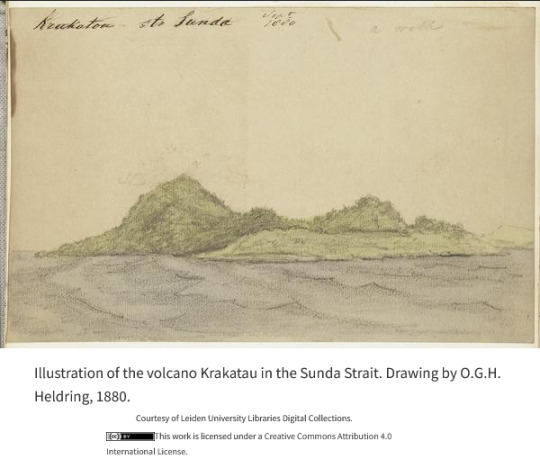
In 1876: coral! In 1879: Teredo shipworms! And finally, in a very dramatic conclusion to the failed project in 1883: KRAKATAU erupted, for good measure!
I’d give up at that point, too.
Coincidentally, Deb Roy’s excerpt here also invokes volcanoes: Prominent British “colonial official-turned-naturalist” Edward Hamilton Aitken (something of an authority on insects) called (in the Times of India) termite colonies “miniature volcanoes.”
Might we then say that the Dutch telegraphy project was undermined by two volcanoes (termites and Krakatau), one metaphorical and one literal?
Anyway.
—
Excerpt 1:
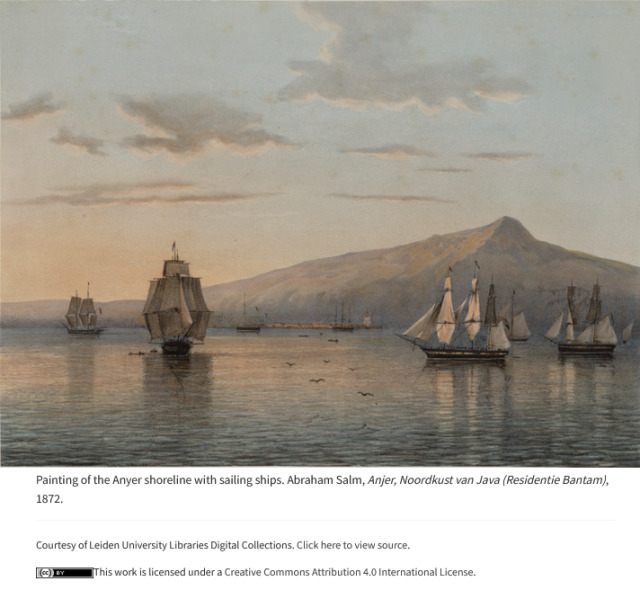
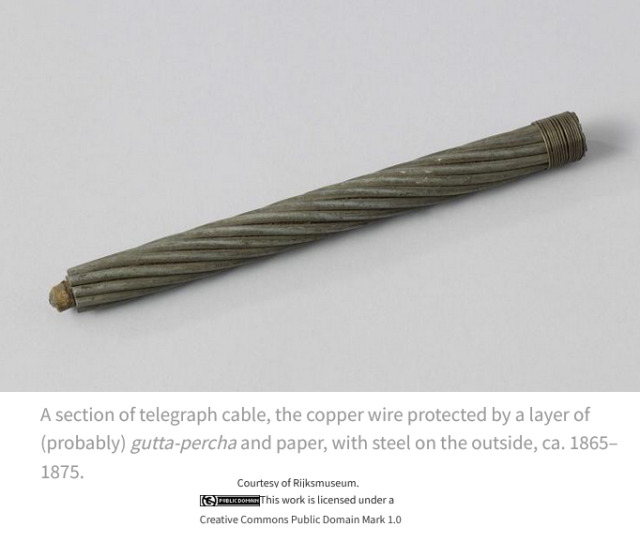
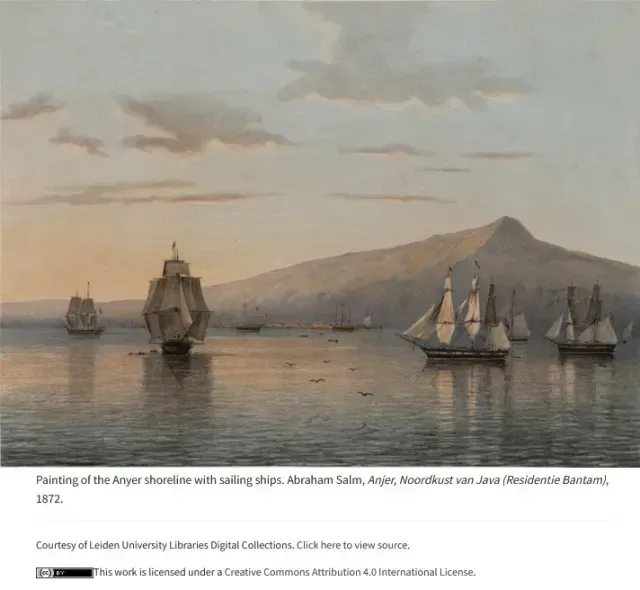
Nineteenth-century telegraphy is often seen as the beginning of “a historically unprecedented world wide web,” [...]. [Scholars have] highlighted the telegraph’s “dematerialization of long-distance information flows.” These are macro-level abstractions [...] despite the relatively common breakages and disruptions that bedeviled that progress [...]. [A] more locally specific [...] environmental history of the telegraph foregrounding materiality and locality [...] draw[s] attention to the very real frustrations [...]. The second half of the nineteenth century was a time of expanding telegraphic connections around the world, and Southeast Asia was no exception. The Dutch colonial administration was keen to link up its possessions to the global network at Singapore. The first undersea cable connecting the colonial capital Batavia (now Jakarta) with Singapore was laid in 1859 but failed almost immediately. The Dutch then turned to the Sunda Strait as an alternative route [...]. In 1863 it was decided to connect the town of Anyer on the north coast of Java and Teluk Betung on the southern tip of Sumatra. The history of that connection, littered with frustrations and mishaps, runs for two decades, and charts a complex story of human and technological engagement with the coastal ecology of the Sunda Strait. The first attempt to establish the connection, in the autumn of 1865, had to be postponed due to unspecified faults in the cable and the impending monsoon season. Much delayed, it was finally in working order in November 1866, but remained patchy, functioning for only 237 days in 1867 and breaking down completely in March 1868, with a new line laid only in 1871. [...]
What, then, caused all these disruptions? Many things, most of them somehow connected to the local ecology. In 1873 the cable was found - to everyone’s surprise - to be damaged by “white ants,” i.e. termites, that had got through the iron protection and eaten into the insulation. This was to be a recurring problem: as Rohan Deb Roy has recently shown, termites were a constant threat to colonial infrastructure. A little later the connection was again cut by the anchor of an American ship. In 1876, repairs were delayed by the heavy growth of coral that had attached to the cable. An 1879 report notes Teredo shipworms as a further cause of damage. The story of the Anyer to Teluk Betung underwater cable could be told as one of technology versus nature, the termites, shipworms, and corals representing local environmental obstacles to manmade globalization. Yet this is far too simplistic. On the one hand, technology was also a risk factor, as anchors from the busy traffic in the strait could - and did - cut into the cables. Notices were published to warn ships away, and guilty parties pursued for compensation through foreign consuls. Technological globalization could also be its own enemy. On the other hand, the cable itself can be seen as a product of the local environment. The insulating layers - the organic components vulnerable to termites and worms - were made of gemoetie, palm fiber-based rope long used locally and adopted by the colonizer; or of gutta-percha, a rubber-like material produced from the sap of Palaquium gutta, a tree species native to the region (the Malay word perca even refers to Sumatra). Indeed, gutta-percha’s usefulness for insulating undersea cables made it a key global commodity in the late nineteenth century. [...] The final break in the Anyer to Teluk Betung connection was also by far the most dramatic: the massive eruption of the Krakatau volcano in 1883 severed the cable and laid waste to both towns. The chief of the Anyer telegraph office was reported drowned, one of tens of thousands of deaths. This was as clear a reminder as could be imagined of the inability of colonial planning to control the local environment. It also represented the end to this particular project: when the connection was re-laid, a slightly different route was chosen, by-passing Teluk Betung.
Images, captions, and all text above by: Mikko Toivanen, “Disconnectivity in the Age of Globalization: Coastal Ecology, Telegraphy, and Empire in the Sunda Strait, 1863-1883,” Environment & Society Portal, Arcadia no. 28. (Summer 2021). [Emphasis mine. Images/captions are shown unaltered as they originally appear.]
—
Excerpt 2:
Insects were ubiquitous and fundamental to the shaping of British colonial power. British rule in India was vulnerable to white ants because these insects consumed paper and wood, the key material foundations of the colonial state. The white ant problem also made the colonial state more resilient and intrusive. The sphere of strict governmental intervention was extended to include both animate and inanimate non-humans, while these insects were invoked as symbols to characterize colonized landscapes, peoples, and cultures. […] British colonial officials-turned-naturalists such as Edward Hamilton Aitken (henceforth EHA) and D. D. Cunningham reinforced the view that white ants were an inescapable aspect of living in the subcontinent. Writing in 1880, EHA claimed that one of the most inevitable experiences that travellers to India were bound to encounter was ‘white ants eating up the bed in one night, so that in the morning we are lying on the floor’. The next year, EHA described India as ‘a land whose soil is three-fourths white ants and one-fourths earthy matter or stone’. Cunningham argued in 1909 that any account on common insects found in Indian gardens and houses that failed to devote attention to the white ants would be like ‘a performance of Hamlet with the name-role left out’. […]
In explaining the proliferation of white ants and their nests in India, imperial commentators referred to the peculiarities of the place itself […]. Meanwhile, books published from London speculated about the nature of white ants themselves and what happened within their nests. […] In similar anthropomorphic vein, white ants’ nests were frequently mentioned as a ‘colony’. The white ants […] were allegorically imagined to constitute a parallel, often underground, world of ‘dominion’ and ‘sovereignty’. Although these nests were lauded for their astute organization, British Indian officials-turned-naturalists considered them sinister. Writing for the Times of India, EHA referred to these colonies as ‘miniature volcanoes’, and called their insect inhabitants ‘the arch scourge of humanity…blight of learning…destroying hordes’, comparing them with defiant pre-medieval conquerors such as the Ostrogoths, Huns, and Vandals, rather than self-styled ‘liberal’ colonists of the Victorian era. Humorous descriptions of the queen of white ants’ colonies by these authors were colored with misogyny and racism. They also reflected Malthusian anxieties about overpopulation in famine-stricken British colonies. […] Meanwhile, in India, white ants were described by British naturalists like EHA as ‘the foe of civilization … the Goths … of Indian life’.
--
Text above by: Rohan Deb Roy. “White ants, empire, and entomo-politics in South Asia.” The Historical Journal, vol. 63, no. 2 (March 2020, pp. 411-436. [Published online 2 October 2019.] DOI: doi.org/10.1017/50018246X19000281. [Emphasis mine.]