In conversation: Coffee, inter-imperial 'slavery hinterlands,' uprisings, and revising the historiography on Dutch slavery in the eighteenth/early nineteenth centuries

(Originally posted elsewhere in February 2024.)
Just some excerpts from a couple of authors in the same special issue of Slavery & Abolition, which I liked contemplating together.
Aside from Combrink’s discussion of so-far-understudied Dutch role in promoting a commodity chain as an intermediary between Caribbean producers and eventual coffee consumers in Rhineland Germany (the formation of “slavery hinterlands” which scholars Pepijn Brandon and Ulbe Bosma also corroborate in their article excerpted here), I am intrigued by her ominous invocation of later brutality against laborers in Java under the notorious “enforced planting” regime and “Coolie Ordinance.” Combrink draws a connection between the Dutch frustration with the Boni-maroon wars (slave revolts) in the late eighteenth-century, on the one hand, and the Dutch willingness to pre-emptively curtail a repeat of labor rebellions in the nineteenth century when shifting their coffee production to the East Indies/Indonesia. (“Can’t let that shit happen again! Crack down early!”) Indeed, the Dutch governor-general of the East Indies, Johannes van der Bosch, was dispatched to both Surinam (Greater Caribbean) and Java (Indonesia) “to solve the labour issues and expand the colonial production of coffee.” Two archipelagos on opposite sides of the planet, being administered by the same figures.
Anyway, each author here is contributing to the same discussion: The Dutch role in promoting coffee consumption in continental Europe at a crucial moment around the time of the Haitian Revolution.
Elsewhere, in more “public-facing” language, editors (in presenting an article by Brandon and Bosma) put it thusly: “Dutch historians have long worked on the assumption that the significance of Atlantic slavery to the Dutch economy was marginal. […] [I]n the Flemish-Dutch magazine TSEG/Low Countries Journal of Social and Economic History the authors show that this assumption is incorrect.” (From: Brandon and Bosma, “Slavery Was of Major Importance to the Dutch Economy,” The Low Countries, 25 October 2019.) And there more substantial article in Slavery & Abolition includes a lot of data/statistics.
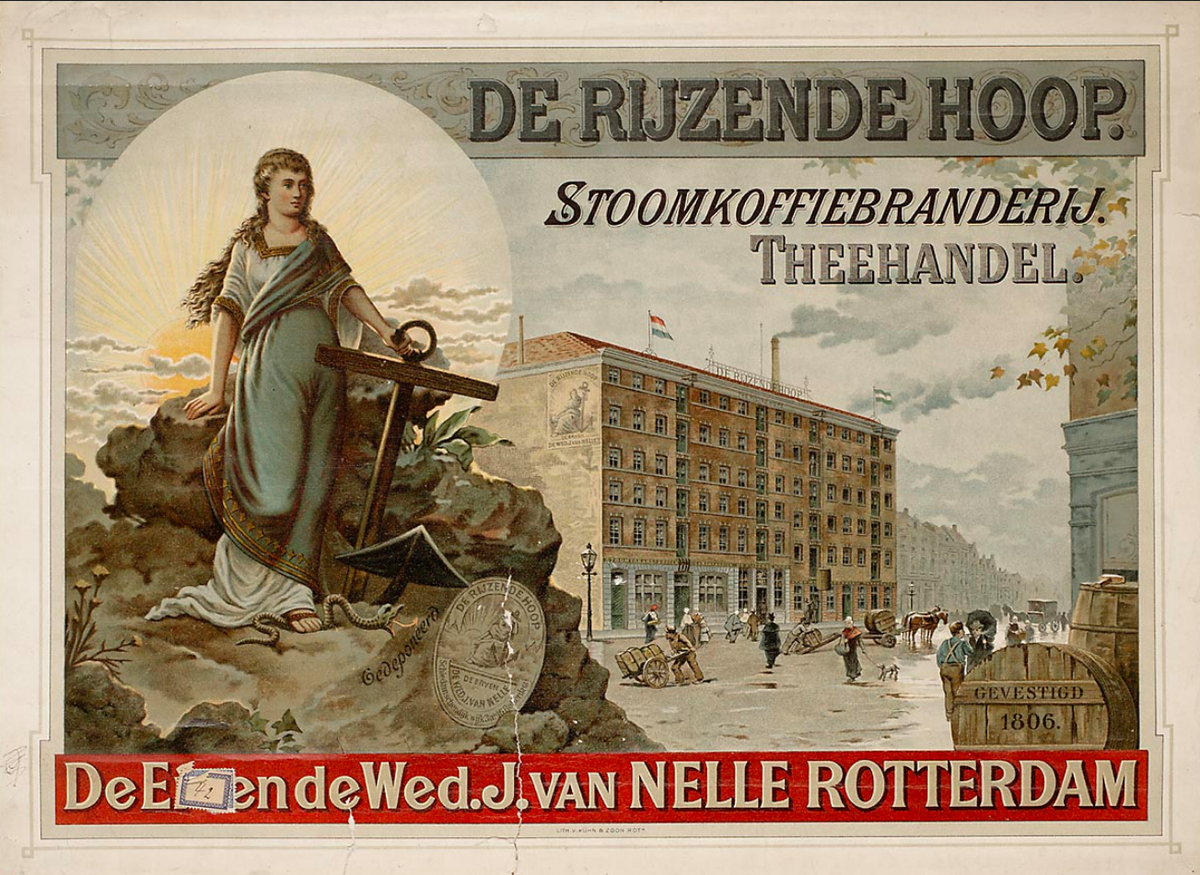
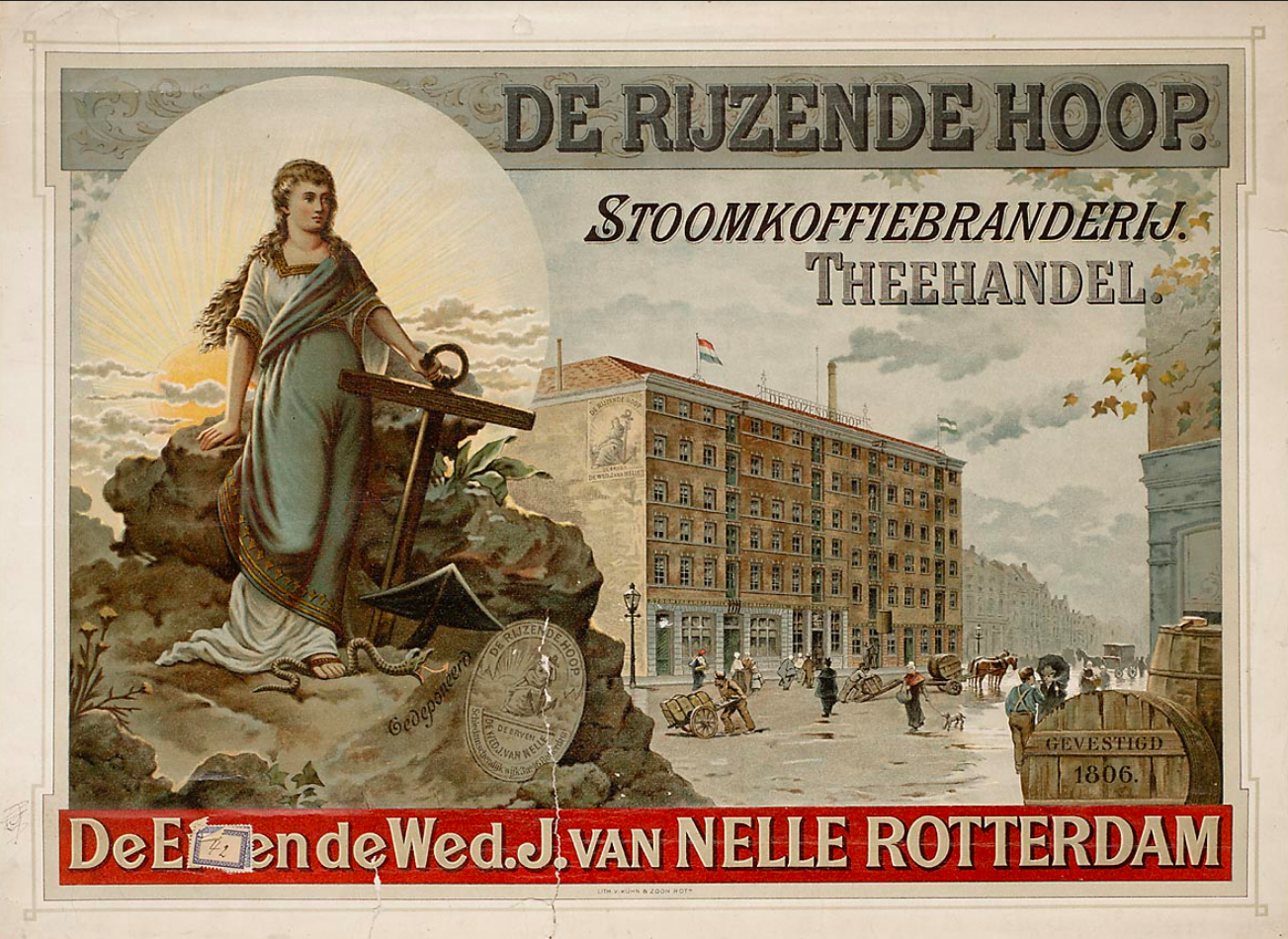
So, I went and looked around at archives. Here’s an advertisement for van Nelle, a coffee company based in Rotterdam. Image in public domain, accessible via Wikimedia Commons. Author listed as: merknaam: De Rijzende Hoop; opdrachtgever/adverteerder: Erven de Wed. J. van Nelle (Rotterdam); i.e. onbekend (unknown). URL: https://commons.wikimedia.org/wiki/File:De_Rijzende_Hoop_stoombranderij,_theehandel_Erven_de_Wed._J._van_Nelle_(Rotterdam).jpg
—
Excerpt 1:
[T]he phenomenal growth of [plantation slavery in] Saint Domingue [the French colony of Haiti] was partly made possible by the export market along the Rhine that was opened up by the Dutch Republic. [...] [C]offee was still a very exclusive product in Europe. [...] From the late 1720s, [...] in the Netherlands [...] coffee was especially widespread [...]. From the late 1750s the volume of Atlantic coffee production [...] increased significantly. It was at that time that the habit of drinking coffee spread further inland [...] [especially] in Rhineland Germany [...] [and] inland Germany [due to Dutch shipments via the river]. Although its consumption may not have been as widespread as the tea-sugar complex in Britain, there certainly was a similar ‘coffee-sugar complex’ in continental Europe [...]. The total amount of coffee imported to Europe (excluding the Italian [...] trade) was less than 4 million pounds per year during 1723–7 and rose to almost 100 million pounds per year around 1788 [...]. The rising prices in the 1760s encouraged more investment in coffee in Dutch Guiana and the start of new plantations in Saint Domingue [Haiti]. Production in Saint Domingue skyrocketed and surpassed all the others, so that this colony provided 60% of all the coffee in the world by 1789. [Necessitating more slave labor. The Haitian revolution would manifest about a decade later.]
Text above by: Tamira Combrink, “Slave-based coffee in the eighteenth-century and the role of the Dutch in global commodity chains,” Slavery & Abolition, vol. 42, no. 1 (2021), pages 15-42. [All text in brackets added by me for context. Emphasis mine.]
-
Excerpt 2:
[T]he Dutch Republic, like its successor the Kingdom of the Netherlands, [...] throughout the early modern period had an advanced maritime [trading, exports] and (financial) service [banking, insurance] sector. [...] Carefully estimating the scope of all the activities involved in moving, processing and retailing the goods [...] [shows] more clearly in what ways the gains from slavery percolated through the Dutch economy. [...] One point that deserves considerable emphasis is that [this wealth] [...] did not just depend on the increasing output of the Dutch Atlantic slave colonies. By 1770, the Dutch imported over fl.8 million worth of sugar and coffee from French ports. [...] Dutch sugar mills processed tens of millions of pounds of sugar from the French Caribbean, which were then exported over the Rhine and through the Sound to the German and Eastern European ‘slavery hinterlands’. Coffee and indigo flowed through the Dutch Republic via the same trans-imperial routes, while the Dutch also imported tobacco produced by slaves in the British colonies [...]. 1770 was a peak year for the issuing of new plantation loans [...] It has been estimated that in 1770 Amsterdam alone housed 110 refineries [...]. These processed approximately 50 million pounds of raw sugar per year [...].
Text above by: Pepijn Brandon and Ulbe Bosma, “Slavery and the Dutch economy, 1750-1800,” Slavery & Abolition, vol. 42, no. 1 (2021). [All text in brackets added by me for context. Emphasis mine.]
-
Excerpt 3 (from the same Combrink article):
In French historiography, the ‘Dutch problems’ are considered to be the slave revolts (the Boni-maroon wars) [at Dutch plantations]. [...] France made use of the Dutch ‘troubles’ to expand its market share and coffee production in Saint Domingue [Haiti], which accelerated at an exponential rate. [...] Slave-based coffee production was also crucial […] in Brazil during the ‘second slavery’, where slavery existed on an enormous scale and was reshaped in the world’s biggest coffee producing country [later] during the nineteenth century. [...] [This market] expansion ends in crisis [...] - a crisis caused by uprisings and revolutions, most notably, the Haitian one. Yet Germans still liked coffee. And the Dutch colonial merchant-banker[s] [...] learned something about [...] production, and perhaps also something about the role of the state in labour control: as soon as they could, they sent Johannes van der Bosch [Dutch governor-general of the East Indies] to Surinam and Java in order to solve the labour issues and expand the colonial production of coffee [by imposing in Java the notoriously brutal cultuurstelsel “enforced planting” regime, followed later by the “Coolie Ordinance” laws allowing plantation owners to discipline “disobedient” workers].
Text above by: Tamira Combrink, “Slave-based coffee in the eighteenth-century and the role of the Dutch in global commodity chains,” Slavery & Abolition, vol. 42, no. 1 (2021), pages 15-42. [All text in brackets added by me for context. Emphasis mine.]