Indigenous Amazonia and 'the politics of erasure': Paulo Tavares on the Brazilian state production of 'voids'

(Originally posted elsewhere on 11 June 2019.)
Two pieces from Paulo Tavares—one from an essay in Intercalations (2017), the other from an essay in the inimitable e-flux (2016).
Thought they worked well side-by-side.
—
Excerpt 1:
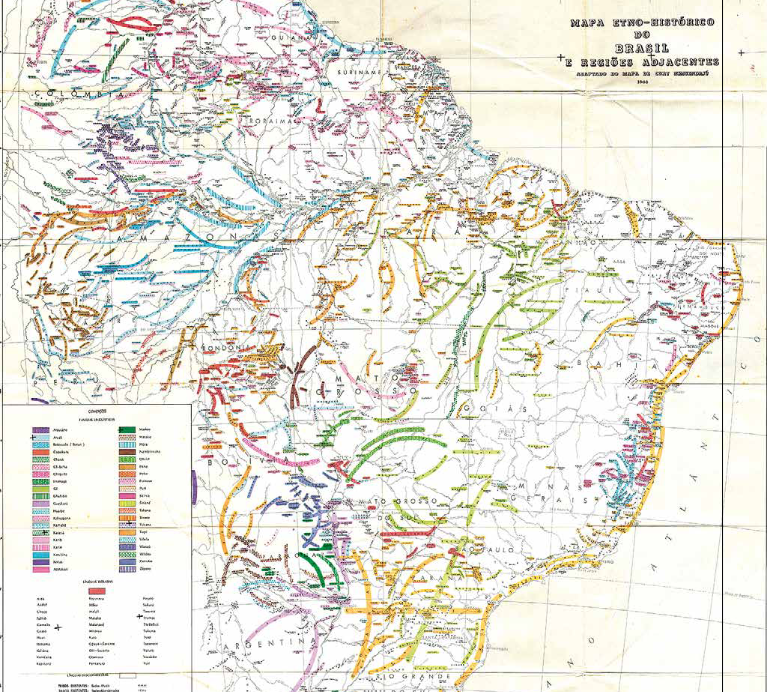
In colonial and modern imaginaries, the Indigenous peoples of Amazonia have always been defined by categories of incompleteness, absence, and lack […] Explaining the concept of his design for the master plan of Brasilia, the modernist capital of Brazil built from scratch in the hinterland plateaus in the late 1950s, urbanist Lucio Costa wrote: “[The city] was born out of the primary gesture of one who marks or takes possession of a place – two axes crossing at a right angle, the very sign of the cross.” Only in the early 1970s, when Brazil was under military dictatorship, did Brasilia become the de facto center of national political power. By that time, the colonial program (both symbolic and functional) embodied in the modernist design of the city – an urban cross demarcating the conquest of a territory – was rapidly expanding toward the depths of Amazonia. Like their colonial predecessors, modern strategists and planners defined Amazonia as a void space characterized by chronic lack: demographic emptiness, technological underdevelopment, economic stagnation, territorial isolation. In the book Geopolitics of Brazil (1967), General Golbery do Couto e Silva, the most influential intellectual author of the Brazilian National Security Doctrine, described Amazonia as a giant “island” floating at the margins of national society and outside the geometries of the state. This neo-colonial perspective led the military dictatorship (1964-85) to design a basin-wide strategy to “occupy and integrate” Amazonia” which Golbery described as a “geopolitical maneuver for the integration of the national territory.” This strategy was translated into a series of radical experiments in spatial planning deployed as if the extremely diverse and complex socio-natural environs of the rainforest could be planned and modified as a whole: a homogenous tabula rasa to be rationally domesticated, colonized, and re-engineered. […] In order to accomplish that plan, the military government sought to “pacify” the Native communities. […] These actions, […] when mapped together, draw the contours of a broader strategy to “produce demographic voids.” […]
One of the longest and most vicious operations of the “politics of erasure” was deployed against the Waimiri Atroari people, a Carib group of central Amazonia. Their land, a region rich in mineral deposits, was mapped as a key “pole of development” within the Generals’ strategy to occupy the frontier. In the late 1960s, after centuries of violent clashes and failed attempts to colonize their territory, the government created [...] a pacification operation aimed at curbing Indigenous resistance and resettling the population to make space for highways, the Balbina mega-dam, mining enclaves, and agricultural projects. Over the next two decades, FAWA conducted a sweeping campaign of forced removals and transfers […]. This caused the decimation of 90% of the Indigenous population […]. The Waimiri Atroari land [is] a very dynamic and populated territory sustained by a wide, intricate, and well-defined infrastructure of land and fluvial communications. To assume that this extensive territorial infrastructure could have completely vanished without leaving any ruins would be yet another act of erasure of the socio-historical agency of Indigenous peoples, perpetrating and perpetuating the military dictatorship’s genocidal politics by other means. Such an assumption would only reassert the colonial ideology according to which Amazonia consisted of an empty territory dominated by luxurious, pristine nature, and populated by small tribes [...] whose modes of engaging with the environment that they produced no significant modifications in the territory.
Text and images above from: Paulo Tavares, “The Political Nature of the Forest: A Botanic Archaeology of Genocide,” Intercalcations, vol. 4, Special Issue: The Word for World is Still Forest (2017).
—
Excerpt 2:
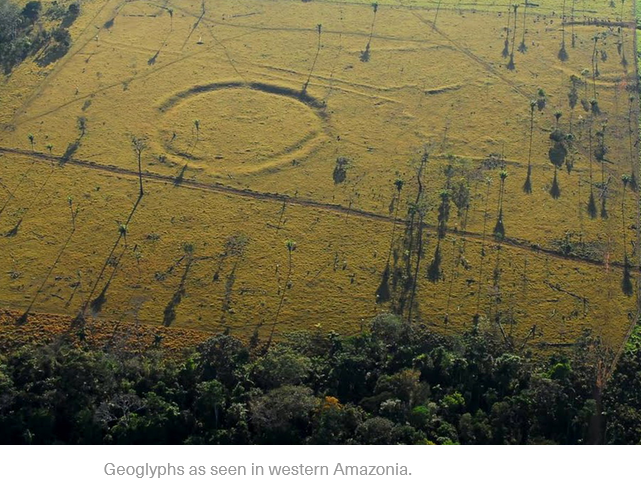
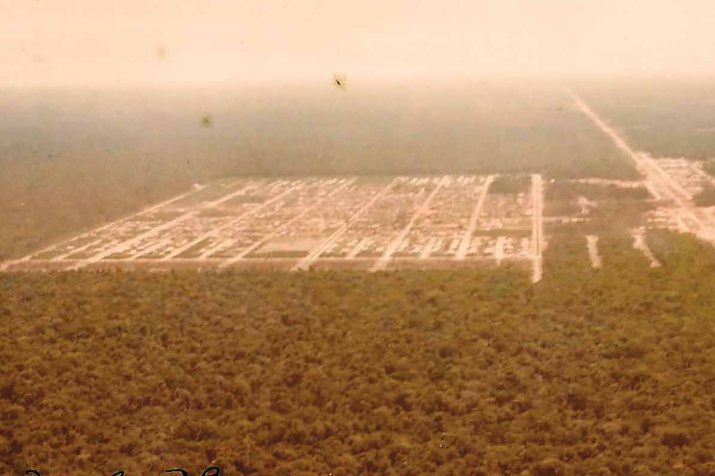
In 1986, during a flight over southwest Amazonia, the geographer Alceu Ranzi noticed a huge geometric earthwork cut through the middle of a vast tract of deforested land. [...] Ranzi recognized that the “geoglyph” was a pre-Colombian construction, and since then satellite-based surveys are showing that his striking finding is just one piece of a much larger archaeological complex formed by at least four hundred geoglyphs spread across a territory nearly the same size as the Netherlands.[...] More than historical documents of violence, the discovery of these structures shattered the colonial imaginary about the nature of the forest that animated frontier expansionism. Figurations of the pristine, wilderness, the “green desert” and many other images of de-humanized nature employed to describe the forest constituted other means by which the politics of erasure was perpetrated, displacing indigenous peoples and eliminating their histories [...]. But what does it mean to say that Amazonia, a territory which so profoundly shaped the idea of pristine nature in our imaginaries and epistemic constructions, is an artifact of human designs? [...] Rather than evidence of the lack of culture, we now know that the forest can be interpreted as a cultural artifact in itself [...].
Text, photo, and caption above from: Paulo Tavares, “In the Forest Ruins,” e-flux Architecture: Superhumanity (9 December 2016).