Introduced beavers, racial hygiene in 1940s Tierra del Fuego, racial/class borders in 1990s Buenos Aires, and obscuring the past to build the nation in the work of Mara Dicenta

(Originally posted elsewhere in April 2023.)
Fascinated by the themes at play in Mara Dicenta's work.
Two recent pieces by her: One from Arcadia and one from Edge Effects. Thought they worked well when considered together.
--
Excerpt 1:
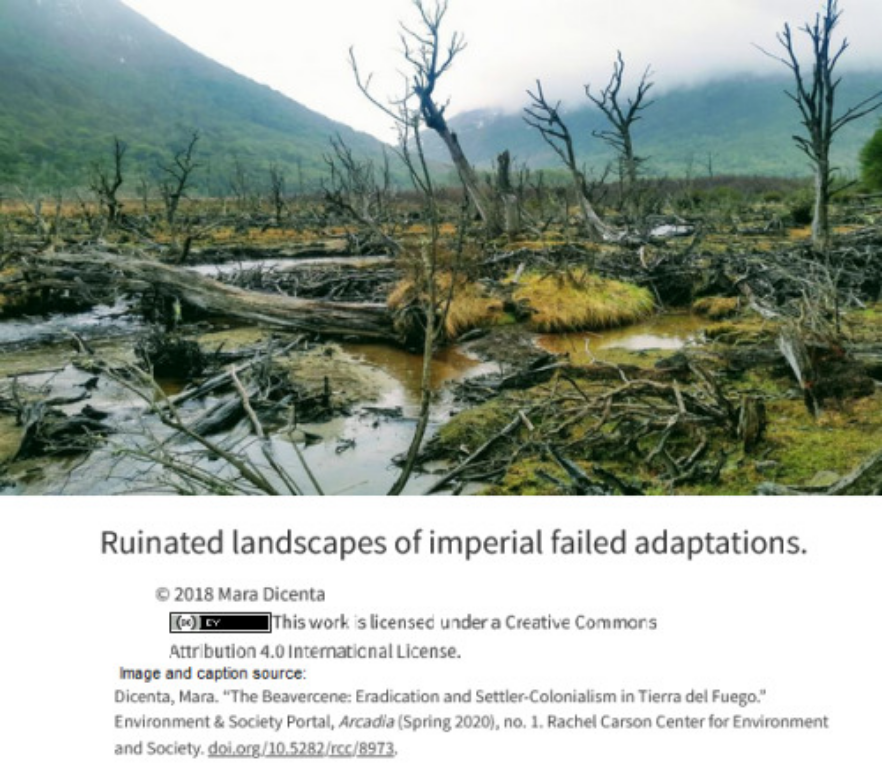
In 1946, Argentina introduced twenty beavers (Castor canadensis) to Tierra del Fuego (TdF) to promote the fur industry in a land deemed empty and sterile.
Beavers were brought from Canada by Tom Lamb, [...] known as Mr. North for having expanded the national frontier [...]. In the 1980s, local scientists [...] found that beavers were the main disturbers of sub-Antarctic forests. The fur industry had never been implemented in TdF and [...] beavers had expanded, crossed to Chile, and occupied most of the river streams. The Beavercene resulted in apocalyptic landscapes [...]: modified rivers, flooded lands, and dead native trees that, unlike the Canadian ones, are not resilient to flooding. [...]
At the end of the nineteenth century the state donated lands to Europeans who, in building their farms, also displaced and assassinated the indigenous inhabitants of TdF. With the settlers, livestock and plants also invaded the region, an “ecological imperialism” that displaced native populations. In doing this, eugenic and racializing knowledges mediated the human and nonhuman population politics of TdF.
---
In the 1940s, the Argentinian State nationalized these settlers’ capitals by redistributing their lands. [...] In 1946, the president of the rural association in TdF opened the yearly livestock [conference]: We, settlers and farmers of TdF have lived the evolution of this territory from the times of an absent State. [...] [T]hey allied with their introduced animals, like the Patagonian sheep or the Fuegian beaver. At a time when, after the two world wars, the category of race had become [somewhat] scientifically delegitimized, the enhancement and industrialization of animals enabled the continuation of racializing politics.
In 1946, during the same livestock ceremony in TdF, the military government claimed:
This ceremony represents the patria; it spreads the purification of our races … It is our desire to produce an even more purified and refined race to, directly, achieve the aggrandizement of Argentina.
---
The increasing entanglement between animal breeding and the nation helped to continue the underlying Darwinist logic embedded in population politics. Previous explicit desires to whiten the Argentinian race started to be actualized in other terms. [...]
Settlers had not only legitimated their belonging to TdF by othering the indigenous [people], [...] but also through the idea that indigenous communities had gone extinct after genocide and disease. At that time, the “myth of extinction” helped in the construction of a uniform nation based on erasing difference, as a geography textbook for school students, Historia y Geografía Argentinas, explained in 1952: If in 1852 there were 900,000 inhabitants divided in 90,000 whites, 585,000 mestizos, 90,000 [Indigenous people] and 135,000 [...] Black, a century later there was a 90% of white population out of 18,000,000 inhabitants. (357) [...] [S]tate statistics contributed to the erasure of non-white peoples through the magic of numbers: it is not that they had disappeared, but that they had been statistically exceeded [...]. However, repressed communities never fully disappear.
---
Text by: Mara Dicenta. "The Beavercene: Eradication and Settler-Colonialism in Tierra del Fuego". Environment & Society Portal, Arcadia (Spring 2020), no. 1. Rachel Carson Center for Environment and Society. [Emphasis mine.]
--
Excerpt 2:
Nordelta, one of Buenos Aires’s most exclusive areas, is a conglomerate of gated communities with over 50,000 residents. It sits on the wetlands of the River Paraná, second only to the Amazon in South America. And it was built by emptying and refilling canals, which [...] reduced the wetlands’ capacity to absorb rainfall. Nordelta opened in 2001, right when the economy collapsed after a decade of extreme neoliberal adjustments. In 2001, Argentina had five presidents in the span of 11 days, police killed 39 citizens during protests, and personal bank accounts were frozen [...]. Nordelta’s main attraction for consumers was [...] a distinguished, United States lifestyle. [...] Master-planned communities (MPCs) are privately built and designed neighborhoods in the city outskirts constructed by large-scale developers, offering amenities, services, and rules through homeowner associations. [...]
While driving through the main road to the conglomerate, [...] to the right, malls, apartments, and private schools with English names that are only accessible by car. [...] Over 8,000 workers cross these gates daily to provide multiple services. [...] These workers cannot walk on the avenues because “Nordelta residents do not want to see them around,” [...]. This segregationist structure of Nordelta emerged alongside the expansion of the neoliberal state. While Nordelta today resembles Miami, it was initially thought of as the French ville nouvelles (“new towns”), which aimed to integrate rural migrants within European cities.
---
In 1977, engineer Julián Astolfoni acquired the first plot of land from the descendants of [...] a general who had obtained the lands previously peopled by Guaraníes and Carupás after fighting in the “Desert Campaign against the Indians.” When Astolfoni got the plot, Nordelta was conceptualized to fix the problem of undesired urban sprawl at a time when the [...] state of the last civic-military dictatorship was trying to “eradicate” the villas miseria (shantytowns) for being “filthy” spaces threatening private property and national moralities.
The project goals shifted once it was finally approved in 1992 when Astolfoni partnered with businessmen [EC] and other North American corporations, [...] including [...] a U.S. real estate specialized in MPCs. [...] Nordelta retained the enduring idea of the desert as a space to be filled. Like every pioneer narrative, it positioned Astolfoni and [EC], the engineer-corporate duo, as heroes saving “neglected” environments and conquering a wetland that would remain otherwise “vast, useless, dangerous, and vacant.” They would do this by emulating the U.S. MPCs of the 1960s, the ones that turned public malls into consumption centers [...].
---
In the 1990s, president Carlos Menem’s government extended neoliberal measures and promoted Miami as a tourist destination for middle-class families [...]. Despite its diversity, Miami became a symbol of whiteness and economic success [...]. The neoliberal reconfiguration of white exceptionalism as a desire to emulate western geographies became Nordelta’s mark, offering global lifestyles to the elites who can now “live like in Miami, but a few miles away from the Buenos Aires Obelisk,” as an Argentinian newspaper with connections to Nordelta claimed. [...]
---
In 2001, when the machines were opening the soil, a woman [...] found ceramic pieces and bones. The finding led to an organized movement [...]. A team of archaeologists who had been working in the area before visited the place, corroborated the existence of an ancestral site, and registered it as the Punta Canal archaeological site. [...] Despite protests [...], the company sent excavators and destroyed a significant portion of the site. [...] [T]he organized group of neighbors and Indigenous peoples constituting the Movimiento en Defensa de la Pacha Mama set out to protect the archaeological remains and the Indigenous cemetery [...]. [T]heir organization pushed for the recognition of the land, now named Punta Querandí, as communitarian in 2020 [...]. Furthermore, [...] the movement achieved the return and reburial of 42 bodies from ancestors whom an archaeologist from the U.S. Central Intelligence Agency had exhumed in 1925. [...]
[T]his long, complex, and well-documented story of the emergence of Punta Querandí [is told] in the museum, el Museo Autónomo de Gestión Indígena, which also has a digital archive. Despite the developers’ representation of the area as wild and rural, Punta Querandí has “made visible that the reality of Indigenous Peoples also occurs in Buenos Aires,” [...]. [T]he desegregationist project of Punta Querandí, a land not attached to geneticized or archaeologized visions of Indigeneity, but rather a Territory where Guaraní, Qom, Colla, Moqoit, or Aymara Peoples, among many others, can reunite [...].
---
Punta Querandí and its desegregationist project shows the power of edges. [...]
Exemplified by Nordelta, MPCs generate profit by transforming rural into elite lands while rearticulating racial and spatial borders that make distinctions sharper, more guarded, and less porous -- between centers and peripheries, grounded and flooded land [...]. MPCs originated in the U.S. and continue to circulate American imaginaries of race, segregation, and neoliberal commons worldwide. [...] By selling reductionist archetypes, such as the fantasy of white Miami, in order to profit from them, real estate developments obscure how environments continue to be complex, multiple, and diverse despite the violence enacted upon them.
---
Text by: Mara Dicenta. “The Violence of Gated Communities in Buenos Aires’s Wetlands.” Edge Effects. 20 April 2023.