Iyko Day's work: 'Colonial unknowing,' 'alien capital,' and entanglements of Hiroshima, New Mexico, and the Congo

(Originally posted elsewhere on 2 April 2020.)
Three snippets from reviews/discussions of Iyko Day’s work. She is author of Alien Capital: Asian Racialization and the Logic of Settler Colonial Capitalism (Duke University Press, 2016). In 2019, Day gave a presentation at University of Connecticut—”Settler Colonialism’s Hirsohima”—as part of a panel with fellow scholar Alyosha Goldstein. Shared here is an intro (press release) to Day’s talk; a published response to Day’s talk; and an excerpt on the shared concept of “colonial unknowing” from an article by Goldstein.
—
Excerpt 1:
It is relatively unknown that in the 1940s, uranium from the Belgian Congo and the Northwest Territories in Canada was used in the first atomic bomb that was tested in New Mexico and detonated over Hiroshima in 1945. This presentation explores the ways in which settler colonial racial capitalism designates Indigenous lands as non-sights of nuclear modernity, making them available for what Traci Brynne Voyles calls “wastelanding.” These are sites that are deemed unproductive, backward, and peripheral to the technological superiority of the global north but are nevertheless mined for “resources.” […] Through analyses of visual representations of extractive wastelands by artists of color, it conceptualizes the wasteland as the dispossessed, grotesque other of the pristine colonial landscape. These artworks demonstrate that the wasteland is also a repository of forgotten, intimate histories of land and labor, whose representation allegorizes the abstraction of human labor. Moving past what Gabrielle Hecht identifies as a nuclear exceptionalism that remains focused on First World electricity and military production, the project probes the convergence of nuclear logistics and the repressed histories of colonial dispossession that coalesce in the capitalist wasteland.
Text above by: Christopher Vials, from a now-defunct web portal “Events Calendar” press release for an event held at University of Connecticut and publicized at events.uconn.edu/humanities-institutes/event
—
Excerpt 2:
Day began her talk, “Settler Colonialism’s Hiroshima,” by taking up the question of how the 1945 atomic bombings in Japan structure our knowledge of a post-war, nuclearized world, and how the dominant perceptions of this event rely on forms of “colonial unknowing,” a concept that Goldstein helped theorize. By mapping capitalism’s logistical networks, she traces a “supply chain of violence” back to the sites of accumulation that allowed for the production of these weapons of mass destruction in the first place. Some of these sites include the Belgian Congo, the Northwest Territories in Canada, and Navajo communities in New Mexico. These areas have been disastrously affected by uranium mining, radioactivity, and nuclear testing. Uranium mining in particular requires hyper-exploitable and disposable labor; yet even though Indigenous lands, resources, and workers are essential to nuclear modernity, they are construed as non-places and non-persons by the settler colonial state. […]
How can such a magical hegemony be challenged? How might the violent non-worlding of Indigenous peoples and the occlusion of living labor be subverted? Day attempts to do this by examining Asian and Asian-American visual culture. By connecting nuclear non-sites to the works of multi-media artist Allan deSouza and sculptor Takahiro Iwasaki, Day endeavors to rethink these spaces and histories outside of anthropocene cataclysms. Popular media of nuclear disasters and fallout (what some refer to as “ruin porn”) rarely includes human beings. Consider the iconic image of the mushroom cloud rising over Hiroshima, the eerie deserted cityscapes of the Chernobyl exclusion zone, or even the “blighted” neighborhoods of post-industrial Detroit. They all give the impression of a gradual process of degradation devoid of human agency and labor; they serve as abstractions […].
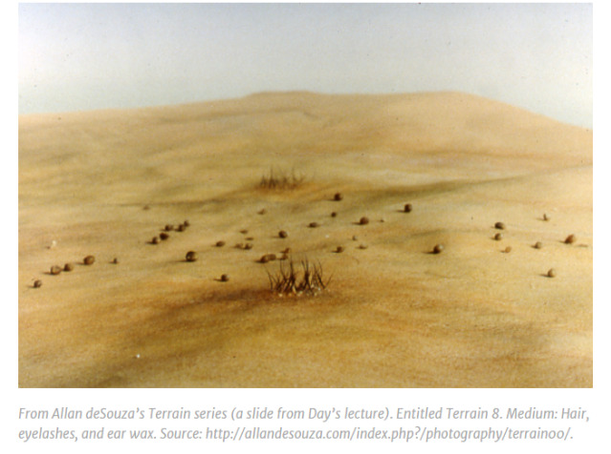
Both deSouza and Iwasaki reveal the abstractions of capitalist production by using forms of detritus. In deSouza’s Terrain series, he uses his own bodily detritus—eyelashes, ear wax, nail clippings, and pubic hair – as a medium to construct grotesque landscapes that subtly satirize the masculinist and nationalist motifs in the art and photography of American 19th and 20th century artists like Thomas Cole and Ansel Adams (Day extensively unpacks the “romantic anticapitalist” ethos of these American icons in her book 2016 book Alien Capital).
Text, image, and caption above by: Austin D. Huffman, “Defining the Social Technologies of Non-Worlding: Challenging Nuclear Hegemony and Neoliberal Colorblindness,” [Response to Drs. Iyko Day and Alyosha Goldstein panel for Racial Capitalism Symposium at UIUC], Kritik (4 April 2019). URL: https://unitforcriticism.wordpress.com/2019/04/04/undermining-indigenous-sovereignty-techniques-of-wastelanding-and-welfare-provision-response-by-austin-d-hoffman-anthropology/
—
Excerpt 3:
Colonial unknowing takes many forms. For instance, borrowing from Jodi Byrd, the idea of colonial agnosia conveys how colonialism remains pervasive but not comprehended as an extensive and constitutive living formation by those situated in complicity with colonial occupation […]. How do we understand our locations in the colonial present as we contemplate and work toward the ongoing imperative of decolonization? In North America and the Caribbean, the predominant lack of acknowledgement or engagement with the histories and contemporary relations of colonialism – especially with regard to the specificities of Indigenous peoples and colonial entanglements of differential racialization – is not simply a matter of collective amnesia or omission. The magnitude of this disavowal is not primarily a matter of a forgotten or hidden past, at least to the extent that forgetting might be viewed as a passive relation or a concealed past might suspend culpability. Instead, this ignorance – this act of ignoring – is aggressively made and reproduced, affectively invested and effectively distributed in ways that conform the social relations and economies of the here and now. Colonial unknowing endeavors to render unintelligible the entanglements of racialization and colonization, occluding the mutable historicity of colonial structures and attributing finality to events of conquest and dispossession. As with Jodi Byrd’s theorizations in The Transit of Empire, we emphasize how colonialism requires a constitutive relation to Indigenous peoples and differential racialization for its claims to place, emplotment, and worldings that notions of forgetting, elimination, and absence tend to neglect […].
Text above by: Manu Vimalassery, Juliana Hu Pergues, and Alyosha Goldstein. “Introduction—On Colonial Unknowing,” Theory & Event, vol. 19, no. 4 (2019).