Making sense of time-passage and recent extinctions with the mammoths of Wrangell and the spike-tailed horned turtle of Vanuatu
(Originally posted elsewhere on 18 March 2022.)
About the South Pacific giant land-roaming spike-tailed horned turtle beast:
Some time around 5,000 years ago, Sumerian storytellers formulating tales of Gilgamesh could have (completely theoretically; of course they weren’t making trips up to the Arctic Ocean) maybe, possibly met a living woolly mammoth, had they somehow brokered passage to the Arctic. Prob didn’t happen, but they could’ve shared the planet together.
But some strange “prehistoric” creatures survived even more recently.
When talking about how cool it is that some very unique and charismatic creatures have gone extinct since the beginning of the Holocene and/or the advent of so-called “hydraulic civilization” on the planet, one way to think of things is to consider that, about 10,000 years ago, there were modern people living alongside camels, massive giant ground sloths, lions, and sabre-toothed cats in the Americas, at the same time that art and elaborate architecture were being built at Gobekli Tepe; meanwhile, woolly mammoths seem to have survived until after the construction of Giza’s great pyramid (if the Wrangell Island estimations are to be believed). But most of those truly unique creatures, these “Pleistocene megafauna,” went extinct millennia ago, and so plenty of creatures are framed as irretrievably remote to us.
So, in our imaginations, so much time (10,000-ish years) has passed, that we might experience dissonance, we might perceive a sort of imaginative, temporal, historical, whatever distance between those creatures and our modern institutions, modern architecture, etc.
Another way to think of things is to consider which animals have been lost more recently, in only the past few centuries.
Tigers in Anatolia, the Caucasus (in the most recent century!), Persia, and the edge of the Black Sea. Jaguars in the Sonoran Desert. Hippopotamus in the lower Nile near the Mediterranean. Bison living across the Great Plains.. Asian elephants and rhinos living across China as far north as Beijing. But for the most part, those creatures, who have disappeared from so much planetary space in recent centuries, still have surviving members of the same species, extant analogues, so that we have a reference point to imagine them. For example, Caspian tigers disappeared from Central and Southwest Asia, but that same wider tiger species itself still exists. After the advent of irrigation infrastructure (among other engineering projects) which ostensibly drove the so-called “retreat of the elephants” which pushed elephants and rhinos southward and away from the Yellow and Yangtze rivers, these large mammals now no longer live anywhere near northern China, but both species still survive elsewhere on the planet, now in tropical Southeast Asia.
But some of the stranger, most alien creatures survived very recently, too. The giant spike-tailed horned turtle beast and the terrestrial mollusc-eating mini land-crocodiles of Polynesia were still on this planet recently.
These are creatures that have the almost-alien-like bizarre qualities of long-gone Pleistocene megafauna, and yet still lived at the same time as people like William Shakespeare or George Washington.
I’m thinking of Mekosuchus inexpectatus (from New Caledonia, possibly until about 4,000 years ago) and Mekosuchus kalpokasi (from Vanuatu, possibly until about 3,000 years ago), the small, semi-terrestrial, crab-eating crocodiles from the South Pacific.
I’m thinking of Voay robustus, the so-called “horned crocodile”, a large crocodilian from Madagascar which was thought to be known by the first people on the island, surviving alongside the Malagasy hippopotamus and elephant bird until 2,000 years ago or perhaps later.
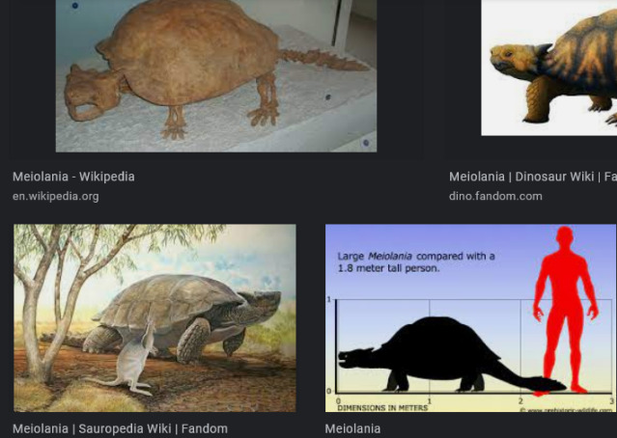
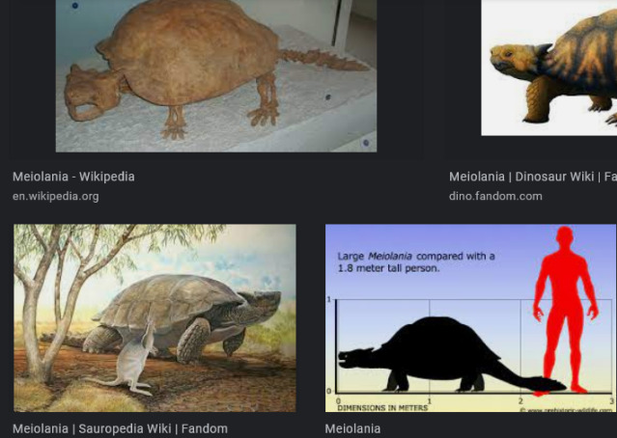
I’m thinking about the Meiolania species that also survived on New Caledonia and Vanuatu until the arrival of human seafarers possibly 3,000 years ago. (These are the giant terrestrial spike-tailed horned turtles.)
I’m thinking about the newly-reported 20-foot-long Chinese gharial (Hanyusuchus sinensis; a large crocodilian) from Bronze Age China.
Closing the gap, narrowing the gulf, between us and “prehistoric beasts”.
Even woolly mammoths breach this border between “us” and “the past.” A now kinda-famous supposition is that woolly mammoths survived on isolated Arctic islands (like Wrangell Island) until perhaps about 2000 BC, or 4,000 years ago. Separated from young hydraulic civilization by the ocean (a mere ocean of space, rather than an ocean of time), in the same temporal setting where people built their little empires.
Pretty neat that an entity as immense and distinct as the Steller’s sea cow still lived on this planet in the 1760s. This creature, whose shape we associate with the manatees of tropical waters, who instead lived in the cold kelp-filled waters of the North Pacific alongside sea otters and adjacent to brown bears. This giant siren in the coastal seas, while the US’s white-washed mythological deities Benjamin Franklin and Thomas Jefferson were alive, while Boston was a bustling harbor, while London was an imperial capital built on Caribbean slavery, Istanbul was a cosmopolitan and commercial center, over a full century into the Qing dynasty, while Napoleon waited in the wings, and the revolution in Haiti helped inspire similar agitation in Philadelphia and Paris.
And there were these creatures, still here.