Narratives of Atlantic piracy and crises of imperial legitimacy (part 3 of 3): Slavery, Black rebellion, and the 'Black Pacific'

(Originally posted elsewhere on…..
While Alexandra Ganser’s book examines the elevation of the image of pirates and Black rebels in US literature/popular print press after the 1830s in the midst of abolition discourse, Ganser also elsewhere (an article in Atlantic Studies from 2018) on Melville’s "Benito Cereno” and the imaginative expansion of empire/force labor into what she terms the “Black Pacific” (of course, a riff on Gilroy’s “Black Atlantic”). Interesting intervention!
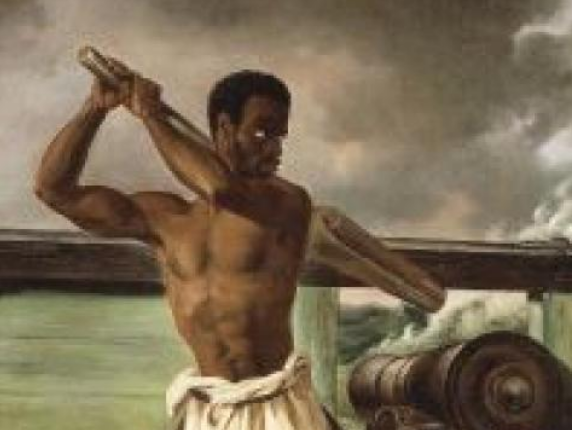
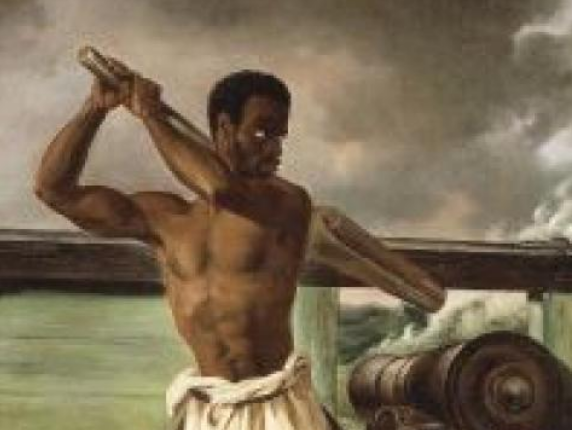
Detail of a piece depicting a slave rebellion aboard a slaveship. By Edouard Antoine Renard (1802-1857) from 1833, oil on canvas.
Excerpt 1:
As early as 1700, Samuel Sewall, the renowned Boston judge and diarist, connected “the two most dominant moral questions of that moment: the rapid rise of the slave trade and the support of global piracy” in many American colonies [...]. In the course of the eighteenth century, [...] [there was a] semantic shift in the [literary] trope of piracy in the Atlantic context, turning its [...] connotations from exploration and adventure to slavery and exploitation. [...] [A] large share of Atlantic seafaring took place in the service of the circum-Atlantic slave trade, serving European empire-building in the Americas. [...] Ships have been cast as important sites of struggle and as symbols of escape in [...] Black Atlantic consciousness, from Olaudah Equiano’s Interesting Narrative (1789) and Richard Hildreth’s The Slave: or Memoir of Archy Moore (1836 [...]) to nineteenth century Atlantic abolitionist literature such as Frederick Douglass’s My Bondage and My Freedom (1855) or Martin Delany’s Blake (1859-1862). [...] Black and white abolitionists across the Atlantic world were imagining a different social order revolving around issues of resistance, liberty, (human) property, and (il)legality [...].
---
Using black pirates as figures of resistance [...], Maxwell Philip’s novel Emmanuel Appadocca (1854) emphasizes the nexus of insatiable material desire and its conditions of production: slavery. [...] [T]he consumption of commodities produced by slave labor itself was delegitimized [...]. Philip, a Trinidadian [and “illegitimate” “colored” child] [...], published Emmanuel Appadocca as a protest against slavery in the United States [following the Fugitive Slave laws of 1850.]. [...] [The novel places] at its center [...] a heroic non-white pirate and intellectual [...] [whose] pirate ship [...] [is] significantly named The Black Schooner [...]. One of the central discourses in [the book] is that of legitimacy, of rights and lawfulness, of both slavery and piracy [...]. About midway into the book, Appadocca gives a [...] speech in which he argues that colonialism itself is a piratical system:
If I am guilty of piracy, you, too [are] [...] guilty of the very same crime. ... [T]he whole of the civilized world turns, exists, and grows enormous on the licensed system of robbing and thieving, which you seem to criminate so much ... The people which a convenient position ... first consolidated, developed, and enriched, ... sends forth its numerous and powerful ships to scour the seas, the penetrate into unknown regions, where discovering new and rich countries, they, in the name of civilization, first open an intercourse with the peaceful and contented inhabitants, next contrive to provoke a quarrel, which always terminates in a war that leaves them the conquerors and possessors of the land. ... [T]he straggling [...] portions of a certain race [...] are chosen. The coasts of the country on which nature has placed them, are immediately lined with ships of acquisitive voyagers, who kidnap and tear them away [...].
In this [...], slavery appears as a direct consequence of the colonial venture encompassing the entire “civilized world,” and “powerful ships” - the narrator refers to the slavers here - are this world’s empire builders. [...] Piracy, for Philip, signifies a just rebellion, a private, legitimate [resistance] against colonial exploiters and economic inequality - he repeatedly invokes their solidarity as misfortunate outcasts [...].
---
All text above by: Alexandra Ganser, “Cultural Constructions of Piracy During the Crisis Over Slavery,” Crisis and Legitimacy in the Atlantic American Narratives of Piracy: 1678-1865 (Palgrave Macmillan, 2020). [From her chapter: “Cultural Constructions of Piracy During the Crisis Over Slavery.”]
—
Excerpt 2:
[Some] readings of Herman Melville’s novella “Benito Cereno” (1855/56) rarely consider the significance of the Pacific island and coastal settings of a story grounded in the transatlantic slave trade. While Melville’s canonical tale about a slave uprising on the ship San Dominick, and its detection and suppression by an American captain has been insightfully discussed in the context of Paul Gilroy’s black Atlantic paradigm and New World slavery, the tale, in fact, starts off the coast of Chile, near the island of Santa María, and ends in Lima, the capital city of the Viceroyalty of Peru, where the rebellious slaves are tried and executed [...].
“Benito Cereno” is prophetic regarding the violent imperial scenarios that would come to characterize US-Pacific relations in this period, with America “Pushing Out Pacific Frontiers” already since mid-century and creating what John Eperjesi calls “the American Pacific,” an economic and cultural frontier, both politically and in literature. Eperjesi defines the American Pacific as [...] “a regional, or regionalizing [Orientalist] myth,” and “a space of conflict,” with the possessive American expressing the “will to mastery and control [...],” and continuing a providential national design eventually leading to the “Pacific Century.” [...] Just as the pursuit of the sperm whale “began in the Atlantic and gradually pulled American whalers up the coast of Chile and then across the Pacific” and as the gruesome Pacific sealing industry took off, the African (and later Pacific Islander) slave trade entered this maritime region. [...]
---
[T]he novella remains historically grounded as it re-constructs these Atlantic relations in the Pacific [...], a “transoceanic imaginary” of slavery and piracy. Unlike the myth-building texts that Eperjesi examines, [...] “Benito Cereno” imagines the Pacific as more complicated, a space of contradiction beyond stable colonial binaries, between metaphor and historicity, between possibility (for revolt and the renegotiation of justice/legitimacy; for a black Pacific counterculture) and the continuity of unequal, racialized power relations [...]. Oddly, the tale thus both highlights Peru as a crucial Pacific agent in the context of the South American trade to Manila during the formation of the early modern Pacific, including transpacific slave traffic, and foreshadows Peruvian slavery in Polynesia in the early 1860s [...]. Blackbirding, the raiding of Melanesian and Polynesian coasts for slaves, represented a “trans-Pacific fate” with the rise of white supremacy in the Pacific since mid-century. Indigenous populations were racialized as colored already at the end of the eighteenth century, which facilitated rationalizing their enslavement [...]. Susan Gillman and Kirsten Silva Gruesz have read the novella as Melville’s “most overtly hemispheric work” as it maps out “a New World or ‘Americas’ history of race-slavery and colonialism, revolt and revolution.
---
Melville’s novella [...] [is] haunting and [...] pervaded by the imagery of death, ghosts, and a deep sense of gloom [...]. Scholars have criticized that the novella leaves no space for utopian possibility or “remedial action,” “no […] hope about the fruitful merging of cultures”; “[b]ecause of the question of race, we are not saved, we remain in the shadow” in an “aprogressive narrative [...] of modernity” that resists closure and historical teleology. [...]
The tale yokes together Europe, Africa, the Atlantic, the Americas, and the Pacific as tainted by the institution of slavery [...]. As Lawrie Balfour concludes, the novella’s “great, troubling success may consist most dramatically in its capacity to foreshadow dangers that would linger long after the storm.” In this light, US-American perceptions of itself as exceptional in, and pushing forward, world history appear as self-complacent, continuing to repress the shadow of “the negro” (101) while simultaneously emulating the hegemonic ambitions of Old World powers. [...]
The novella’s Pacific triangle, continuing the socio-cultural and political effectuality of the triangular [slave] trade, reaches back to the Panamanian isthmus, which was crossed in the late seventeenth century by Anglo pirates like Dampier, to Cape Horn as the main maritime entry point to the Pacific, and to Lima as one of the centers of Pacific slavery. While the novella negotiates national tensions in the 1850s, “recast[ing] the collective consciousness of the nation through a critique of New World slavery,” its geography can “help us to re-encounter the histories of those Pacific shores in ways that make the kinds of problems represented […] by the ‘Atlantic’ more than a specter.”
---
All text above by: Alexandra Ganser, “From the black Atlantic to the bleak Pacific: Re-reading ‘Benito Cereno,’” Atlantic Studies, vol. 15, no. 2 (2017), pages 218-237. Published online 13 March 2018. DOI: doi.org/10.1080/14788810.2017/1384612 [Emphasis mine.]