Narratives of Atlantic piracy and crises of imperial legitimacy (part 2 of 3): US 'maritime nationalism,' the 'recuperated revolutionary' image, and Barbary 'monstrosity,' 1800-1850

(Originally posted elsewhere on 18 February 2022.)
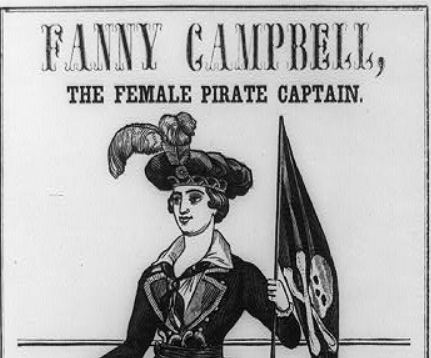
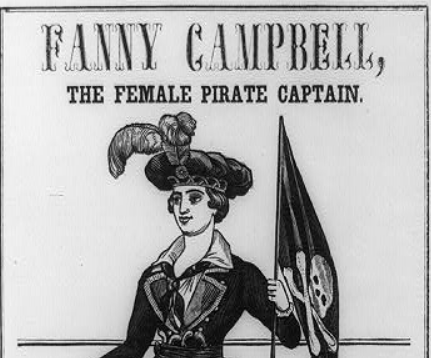
Detail (public domain image) of the title page of Murray, Fanny Campbell: the female pirate captain (F. Gleason, 1845).
Excerpt 1:
Notably, [Thomas] Jefferson’s distinctions between the United States and Britain in the Declaration of Independence draft draws on the cultural difference constructed between Christian and heathen, associating the British King with the “infidel powers” of North Africa and their corsairing economies […]. The comparison between George III and the so-called Barbary corsair states of Morocco and Algiers hints at the third critical moment of literary associations of slavery and piracy: the genre of the Barbary captivity narrative, flourishing during the first foreign policy crisis with which the young Republic was confronted. […] The crisis became of national importance in 1794, when Algerian corsairs extended their actions to the Atlantic, and culminated in the wars with “Barbary pirates” (1801-1805 and 1815), which also came to be the young nation’s first armed conflict after independence from Great Britain. […] [T]he demand for ransom and tribute money […] eventually led to the First Barbary War (or Tripolitan War) in 1801, with a recently institutionalized American Navy eventually defeating the Ottoman powers of North Africa […] under Thomas Jefferson. […] The Barbary crisis hence constituted the “founding period” in which “the blueprint for the American empire was drafted” (Mackenthun 2006, 4), with Jefferson’s “crusader-like self-stylization” of the United States as an “empire for liberty” guiding this vision after the Louisiana Purchase (1803). […] Texts dealing with the Barbary crisis “singled out the most despicable pirate behavior and compared it with the loftiest American ideals” (Lambert 2005, 106). “Barbarians” preferred piracy over legitimate trade, in this view, because they “simply operated outside the cultural norms of civilized society” (106). […]
Rojas reports that the Barbary captivity tale was indeed “vital to the development of U.S. diplomatic practice and foreign policy (2003, 159) as they […] legitimized military action. […] [T]he captivity narrative fueled the development of a national U.S. American literature in the Early Republic […] thus negotiating the future character of the United States as slave-holding or free […]. Through these narratives, Americans tried to make sense of American identity by exploring differences between the U.S. and Barbary “pirates” (Sutton 2009 […]). In addition, “[i]n dehumanizing the exotic and terrifying Other, the writers of the Barbary pirate slave narratives convinced the American public of the young nation’s need to assert itself and triumph over a barbarous Republic’s interactions with its own native populations.” By harking back to the Indian captivity narrative and its tropes of Othering (especially those of savagery, paganism, and effeminacy), the genre’s intertextual references Americanized it and distinguished it from its British counterparts. […] The delegitimizing rhetoric of Othering foreign agents by calling them pirates – in this case, an ‘Oriental’ Muslim Other […] – was prominently articulated in this immensely popular genre. It mostly used an Orientalist dis/course of monstrosity, inhumanity, and ungodliness in its construction of the Barbary pirate […]
Text above by: Alexandra Ganser, Crisis and Legitimacy in Atlantic American Narratives of Piracy: 1678-1865 (Palgrave Macmillan, 2020). [Emphasis mine. From her chapter: “Cultural Constructions of Piracy During the Crisis Over Slavery.”]
—
Excerpt 2:
The early American Republic and the first half of the nineteenth century were obsessed with what Henry Steele Commager famously called the “search for a usable past” [...] and the cultural construction of the “imagined community” (B. Anderson) of U.S.-American citizens to create and consolidate a national identity. [...] [H]istorical romances in early American literature that thematized the legitimacy of the Revolution appropriated the romantic concept of piracy - albeit with twists and modulations - in order to debate antebellum issues of legitimacy, authority, and equality with regard to race, class, and gender. [...] The idea of the young United States as a leading seafaring nation which, ideally, “carr[ied] the idea and the practice of individual liberty everywhere in the world” [...] brought forth a maritime nationalism still prevalent in discourses about the United States’ national identity and future destiny in the 1820s [...].
Readings from a Black Atlantic perspective have recently drawn attention to Cooper’s literary response to slavery and the slave trade, which often constitute “absent presences” [...].
In the 1830s and 1840s, the romantic pirate enters mass-market literature [...]. Maturin Murray Ballou (1820–1895) of Boston [...] is best known as the editor of the widely successful illustrated magazine Gleason’s Pictorial Drawing Room Companion [...] and first editor of the Boston Daily Globe. [...] Ballou’s intent was to found a distinctly American medium, printing only American authors [...]. Besides Fanny Campbell, first published with the subtitle The Female Pirate Captain. A Tale of the Revolution, he also wrote [other] pirate narratives [...]. The text’s repeated emphasis on the hissing of the American flag is reminiscent of the performative act of territorial appropriation through symbolic gestures (planting flags, signing treaties) in the European legal/colonial tradition [...]. This extension of the U.S.-American sphere of action, the description of the island in terms of a colonial hermeneutics, as well as the evocation of Columbus and the representation of the Spaniards as tyrannical colonizers, oppressing Cuba similar to the British in North America, partakes in the fledgling discourse of American imperialism, bringing it to a mass audience. [...]
---
The imperial transformations of antebellum America coincided not only with a critical state of the meaning of U.S. citizenship in the mid-nineteenth century (regarding the population of new territories, Native Americans - who appear in Fanny, as in Cooper, as remnants from the past and folk-tale figures only - and immigrants), but also with the increasingly radical debates about slavery in these decades. [...][E]thnic and racial categorizations were being critically renegotiated everywhere in American cultural articulations, including popular literature. Fanny Campbell ties these debates together, significantly choosing Irish sailors as bonding figures [...].
This ambivalence of ethnic/racial categorization is subtly reflected in the novelette, in which not a single African American character appears. Following Toni Morrison’s argumentation in Playing in the Dark: Whiteness and the Literary Imagination (1992), Fanny can be read as substituting prevalent discourses about African American enslavement in the 1840s with a number of adjacent discourses, simultaneously denying and affirming the presence of blacks and of racial tension in a nation idealized as the natural habitat of liberty [...].
---
The narrative [...] in Fanny Campbell dramatizes the crisis of legitimacy and the nation’s ambivalence in coming to terms with its past (Anderson 2011, 99) - and its future, one could add. It is not just a text about a general notion of piracy, but functions only in the context of the myth and romance of American history that the novelette affirms (see also Woertendyke 2013, 217). Indeed, it is then not a narrative that heroizes piracy per se, but rather limits its legitimizing discourse to “this pirate of a rebel” (68): a revolutionary, patriotic cross-dressing pirate in the service of the American nation. Katherine Anderson, noting that Fanny acts “during the transition of legal authority from one government to another” (2011, 105), draws attention to the fact that legal authority in Fanny is in limbo [...].
In the text, the mythology of American freedom not only obscures, but also attempts to solve a crisis of legitimacy, personified by a cross-dressing pirate, by (re-)integrating her into her fictional society and [...] the national narrative. The crisis of U.S. legality indicated by the use of the term “pirate” is resolved by a discourse of American patriotism; in the end, piracy is consequentially externalized: “The ocean is the place for excitement … . You have the storm to contend with, and happy are you if you master it in room of becoming its victim. You have tides and currents to watch, winds …, and not unfrequently some daring rover to repel” (82). The process of incorporating the pirate into a U.S.-American national narrative thus happens on two distinct temporal levels in Fanny Campbell: first, in the context of the American Revolution, which, by the 1840s, had already been patriotically legitimized in American culture; and second, at the time of writing the novelette in preparation of an American Empire that needed to make use of such patriotic feelings about “pirates” in the ongoing process of legitimizing territorial expansion: “the narrative, its characters, plot, and motifs are poised to move across water, releasing space-time connection with U.S. national history” and “a sense of simultaneity, as American revolutionary zeal is sutured to Cuban piracy, Spanish imperialism, and U.S. maritime space” (Woertendyke 2013, 220).
---
Text above by: Alexandra Ganser, Crisis and Legitimacy in Atlantic American Narratives of Piracy: 1678-1865 (Palgrave Macmillan, 2020). [Emphasis mine. From her chapter, “Pirate Narratives and the Revolutionary Atlantic in the Early Republic and the Antebellum Period.”]