Narratives of Atlantic piracy and crises of imperial legitimacy (part 1 of 3): Frontiers, 'domesticating the outlaw,' and 'rebels in service of empire'

(Originally posted elsewhere 22 March 2022.)
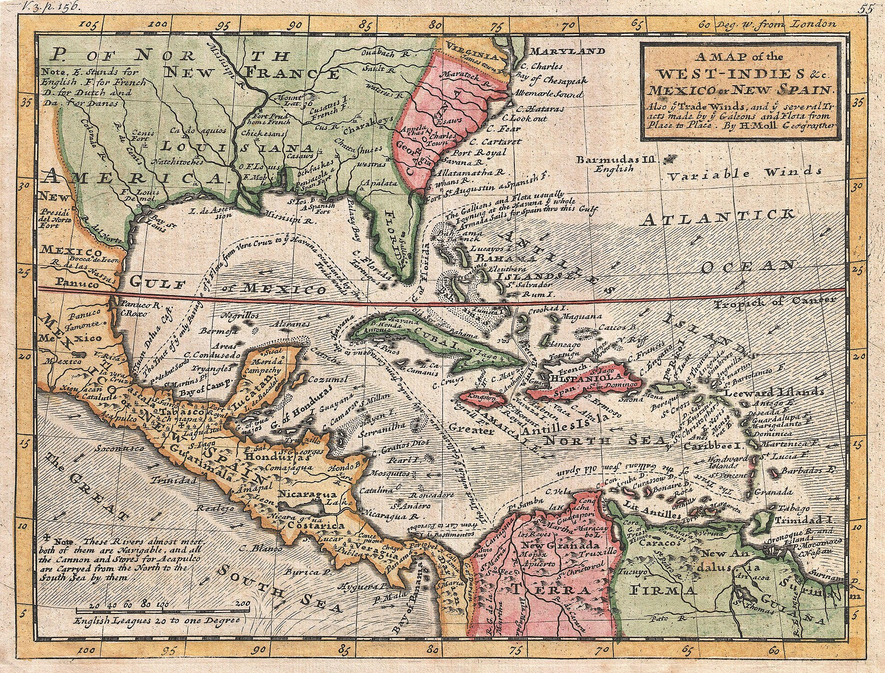
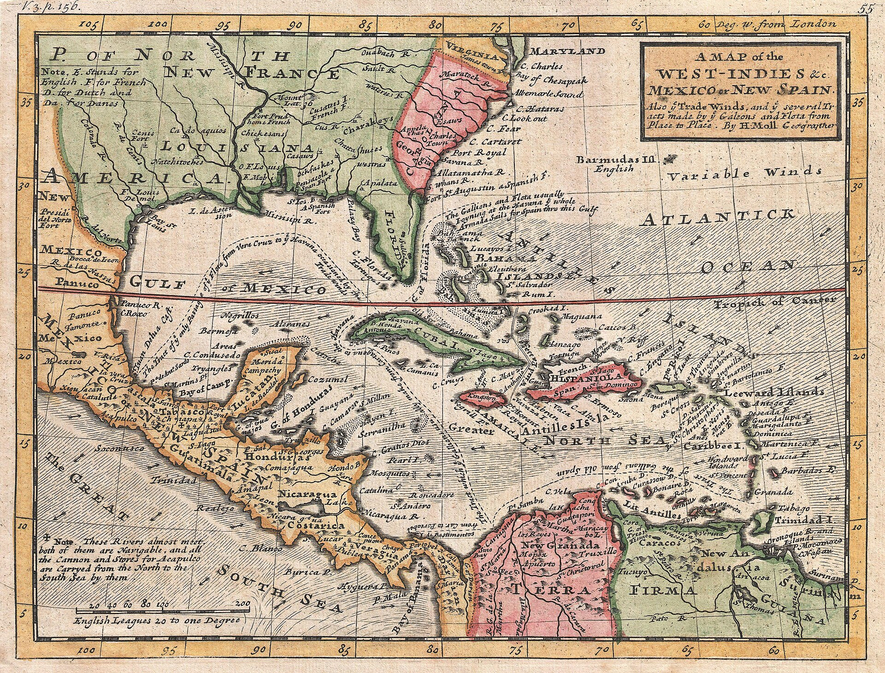
Detail of public domain image, a late 1720s/early 1730s map of the Caribbean (just after the “golden age of piracy”) by artist Herman Moll, “A Map of the West-Indies & c. Mexico or New Spain: Also ye Trade Winds, and ye Several Tracts made by ye Taleons and Flota from Place to Place.”
Excerpt 1:
As Ansgar Nünning and others argue, narrative is central to the construction (an d resolution) of scenarios of crisis, as crises constitute “medial transformations and (re-)presentations of situations in specific stories and narratives” [...]. Similarly, Stuart Hall suggested that in times of greatest crisis, the manufacture and manipulation of public consent is crucial to the maintenance of power [...]. This crisis was answered symbolically by the transformation of the pirate into a colonial agent and scientist before and around 1700 [...]. This period was also a time of crisis in colonial relations: when colonized groups turned against their colonizers and started to collaborate, both politically and economically, with illegitimate agents […] A.O, Exquemelin’s Buccaneers of America [...] inspired a series of ethnographic narratives about the New World by former ‘pirates’ at the close of the seventeenth century (e.g., William Dampier, Basil Ringrose, Bartholomew Sharp, and Lionel Wafer), written as evidence of their authors’ gradual transformation into scientists [...]: they adopted a discourse of science and helped legitimize colonial plunder -- material and symbolic -- as beneficial to the European “empire of knowledge.” [...] Historical romances in early American literature, such as James Fenimore Cooper’s The Red Rover (1827), used romantic/Byronic piracy to narrate the legitimacy of the revolution, appropriating the pirate as a foundational figure and an ideal type of patriotic outlaw masculinity [...]. Even in narrating the crisis in gender relations, as revolutionary femininities first gave way to Republican motherhood and then to the “cult of true womanhood” (Welter) in the course of the nineteenth century [...], [f]ormer revolutionary heroines (here in the form of a patriotic female pirate) were domesticated in such historical romances and novelettes to make palpable the ongoing transition to a more conservative nineteenth-century femininity. [...] In the context of a genealogy of popular culture in America, the pirate has always been an important figure of mass appeal. His/Her popularity was essential for appealing to a non-elite audience to whom normative concepts of nation and empire, femininity and masculinity as well as race also needed to be brokered. These readers, of course, developed their own ways of appropriation, one of them being the pirate’s heroization -- whitewashing the ethnically hybrid figure along with the translation of “a revolutionary multiracial mob into storybook (white) American heroes” in early American literature, as Cathy Davidson suggests (2004, 23).
Text above by: Alexandra Ganser, Crisis and Legitimacy in Atlantic American Narratives of Piracy (2020). [Emphasis mine. From her chapter: “Introduction: The Pirate as a Figure of Crisis and Legitimacy.”]
—
Excerpt 2:
It is notoriously difficult to disentangle a righteous claim to self-defense from an abusive (or, at least, unfounded) claim. [...] [A]ny modern Western claim to legitimate violence can be considered strategic and abusive if compared with the traditions that preceded modernity. […] [T]he hostis humani generis constellation helps pinpoint as well as navigate the gray zones in cultural constructions of defensive violence [...]. Thus, in modernity, an important second function of the constellation comes to the fore: the ability of the constellation to absorb contradictions and to retain categorical flexibility within the overarching framework of Anglo-American modernity. [...] [T]he most important of these communities were the imperial civilization that claims a duty to transform the world in its own image; a national community in Frederick Jackson Turner’s sense […] Until the mid-eighteenth century, the properties of hostis humani generis were developed mainly in the context of pirate law. After William Blackstone’s influential definition of hostis humani generis, which constructed the pirate as only one variation of the more general figure of the Lockean invader, hostis humani generis was increasingly both actively and deliberately used as a constellation. […] Sea space became the model for the in-between zone, and the intertwined notions of race and space helped formulate the properties of sea space as the generalized properties of any space in which praedo and pirata were encountered (for example, precolonial, urban, and planetary space).
Text above by: Sonja Schillings, Enemies of All Humankind: Fictions of Legitimate Violence (2016). [Emphasis mine.]
—