Non-places, eerie ecology, 'keeping the past open,' and speaking back to 'commodified histories' (part 1 of ?)

(Originally posted elsewhere on 22 July 2020.)
Fantastic message. Thank you.
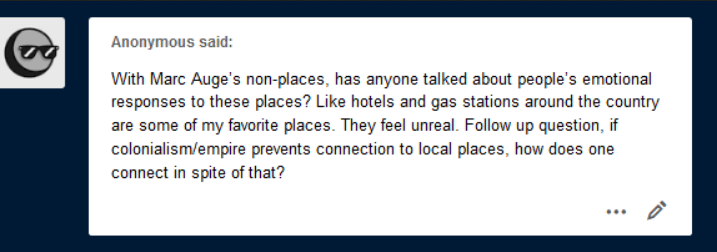
“Has anyone talked about peoples’ emotional responses to these places?” Absolutely. I’ll riff here, and then share some more direct excerpts from those scholars/theorists/writers in an additional post.
And I’m with you, regarding the strange allure of non-places.
I’d imagine plenty of people (myself included) can find themselves excited by “liminal space” and landscapes’ ability to induce “numinous encounters.” Perhaps in times of spatial or imaginative expansion (frontiers of both worldview/epistemology/knowledge and physical space) the sensation might be more widely acknowledged: I’m thinking vaguely of “taxonomies” of “monsters” printed in Europe upon the rise of “physicks gardens” and encounters with the New World, or late-eighteenth-century British engagement with marine cartography, or the popular interest in spiritaulism/Theosophy at the fin de siecle as US/European metropolitan publics/institutions grappling with awareness of microbiology, radio, electrical infrastructure, aerial flight, etc.
The mere existence of “an ecosystem” on Earth, itself, invites me to think … “What invisible histories are here, shaping this place? What forces, of atmosphere or sea, on the other side of the planet, have an influence on this stand of old-growth cedars?” There is the vast Pacific Ocean; sockeye salmon swim at sea and then return to the coast; salmon bring marine nutrients upriver, into the temperate rainforest; bears eat the salmon; the carcasses of the fish nurture the hemlock and fir. Isn’t this land then connected to what happens out there, at sea? There is contemplation of “local” and “global.” And I might realize: “What’s the difference? Where is the border?” Am I an individual human being? Or are there bacteria in my digestive tract, part of my body? Where is the boundary, then, between me and those other lifeforms?” And so that’s supposedly the appeal of Gothic horror, too, right? That monsters invite contemplation of, and transgression of, those boundaries. Exciting and intimidating, simultaneously. Terror and awe, together. The numinous. And so when encountering a mediated standardized place, like a highway rest stop or something, I imagine: “What’s unseen, here? This place has no meaningful connection to the local ecology. How did it come to be?” And sometimes (always) there are violent histories of dispossession, or a recent past where modernity sacrificed real lives to build this asphalt parking lot.
Those places constantly remind us that there are conditions of using space. Citizenship, credit score, legality, criminality, passport. Break the rules, and you can’t access space. Can’t get on the airplane.
De Certeau and Auge might say something similar. Indeed, Auge kind of has:
The real non-places of supermodernity - the ones we inhabit when we are driving down the motorway, wandering through the supermarket or sitting in an airport lounge waiting for the next flight - have the peculiarity that they are defined partly by the words and texts they offer us: their ‘instructions for use,’ which may be prescriptive (’Take the right-hand lane’), prohibitive (’No smoking’) or informative (’You are now entering the Beaujolais region’). [...] [T]he user of a non-place is in contractural relations with it (or the powers that govern it). He is reminded, when necessary, that the contract exists. One element in this is the way the non-place is to be used: the ticket, the card [...]. Proof that the contract has been respected [...]. Boarding pass and an identity document [...]. So the passenger accedes to his anonymity only when he has given proof of his identity. [...] The supermarket customer gives his identity when he pays by cheque or credit card; so does the autoroute driver who pays the toll with a card. In a way, the user of the non-place is always required to prove his innocence. Checks on the contract and the user’s identity [...] stamps the space of contemporary consumption with the sign of the non-place: it can only be entered by the innocent. [...] There will be [...] (no right to anonymity) without identity checks.
From: Marc Auge, Non-Places: Introduction to an Anthropology of Supermodernity (1992).
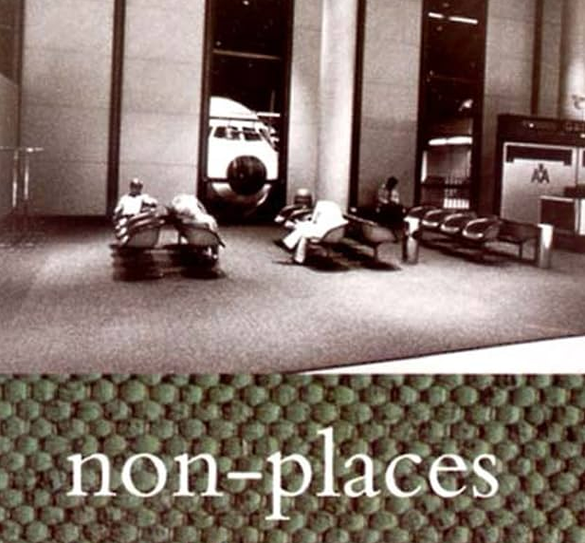
(Detail to the cover of Auge’s book, an English translation by John Howe.)
Non-places, in deliberate conformity or utilitarianism, may often erase difference—intentionally or not. They’re easier to commodify or replicate. Think Roman imperial architectural facades and road-building mirrored by bare-bones, easily-replicable building plans for late twentieth-century fast-food interiors. Empire, power, the state—whatever you want to call that kind of thing—can also make good use of those models. Visit an Applebee’s anywhere in the US: Looks the same. How comforting.
A conspicuous “absence” might be encountered at a non-place like an empty highway rest stop in the middle of the night. Clearly, there is design/intention behind the location’s architecture/purpose. But shown a photo (without much visible background vegetation/geology) of a rest stop along a US highway, it might be hard to estimate where—between, say, the Ohio River and the Rocky Mountain Front—the stop was actually located.
Which architect designed the feature? Who physically built it? Which local government or company paid for it? There was agency involved in its construction, but that agency may not be immediately apparent.
There’s an irony, because if a state/power/agent wants to streamline utility or eliminate deviation/strangeness—to make a site comforting/familiar—by “banishing ambiguity,” some non-places end-up actually multiplying the strangeness. Weird sites because they tried to eliminate weirdness. Control of space can come off as uncanny.
The empty-eyed corporate mascot on a bag of potato chips, glaring at you, whether you’re at a supermarket in Sydney or Toronto, on opposite sides of the planet. The same logo, the same catchphrase, the same mascot glaring at you with the same eyes. That’s strange.
It might be that the artificial non-place with a standardized aesthetic design—with no obvious cultural indicators drawing inspiration or demonstrating connection to local land and history—means that you cannot avoid or ignore thoughts about that very artifice. It might invite thoughts about temporality, absence/presence, etc.
In other words, non-places can feel hyper-real. They suggest evidence and invite thought about something beyond the obvious “real.”
That sort of transgression, evocation of threshholds, blurring distinctions: Not entirely dissimilar to the Gothic engagement with border-transgression or the cosmic horror engagement with “beyond-the—human".
De Certeau wrote, in reference to how people can retain folklore and remain defiant of the forced standardization and “totalizations” of non-places:
There is no place that is not haunted by many different spirits hidden there in silence, spirits one can invoke or not. Haunted places are the only ones people can live in -- and this inverts the schema of the Panopticon.
Auge’s writing on the proliferation of rules, mediating symbols, and enclosure of space based on contractural relations (passport, bank card, train ticket, etc.) might be aligned with de Certeau’s interpretation of such sites as “totalizing.”
Given your mention of non-places being something of a “favorite” site—reveling in the strangeness?—I’m also reminded of geographer/cultural studies scholar Tim Edensor’s writing. He writes:
Cities [and places, generally] seem to becoming increasingly regulated. [...] To fix the past [...]. Ruins are sites where we can construct alternative stories to decentre commodified, official and sociological descriptions, and conjure up spooky allegories that keep the past opened. [...] These marginal locations are the most densely haunted spaces of the city, and following these ghosts allows us to pay our dues to the unheralded.
If de Certeau noted that the Concept-City attempts to maintain imaginative/spatial order and is yet undermined by the persistence of other symbols/practices, then Edensor echoes this when noting that ruined sites provide evidence that a corporate- or state-built site which was once a demonstration of a sort of modernist/technocratic utopianism can ironically provide evidence of that very state’s/power’s fragility.
Because non-places are corporate-y and manufactured, and might have little apparent connection to the local ecosystem or culture, there might be an attraction to the uncanny when we ask: “What forces are at play, here? What is the history of this landscape. What is unseen?” And we also ask: “What other possibilities are there?” We consider what lies “beyond” the edges of what we’re told is the only possible world.
There can be an urge to play, frolic, whatever.
Other scholars who I recently read and who come to mind include:
Writer Rebecca Giggs. Her words: As multinational corporations seek to comfort and disarm through their “commonplace” design, they also run the risk that such places become indirectly disturbing in their duplication. Things are ambiguous [...]. Human-animal-machine. Everywhere-anywhere-nowhere. Alive-dead-stimulant. Evolve-devolve-mutate.
Bob Cluness, whose MA thesis (in Cultural Studies) examined non-places specifically, and how those non-places evoke the eerie and uncanny.
Interdisciplinary independent scholar Anna Boswell, somewhat famous for writing about the longfin eel, the introduction of non-native stoats, and other ecological histories of Aotearoa. She had substantial things to say about the inherent “eerieness” of imperial and settler-colonial “world reordering,” particularly in her article on “anamorphic ecology” in the British draining of wetlands.
I’ll include some of their more relevant excerpts in an additional post :)