Oceanian literature, the imaginary of the 'empty space' of Pacific, and retorts to US (nuclear) imperialism
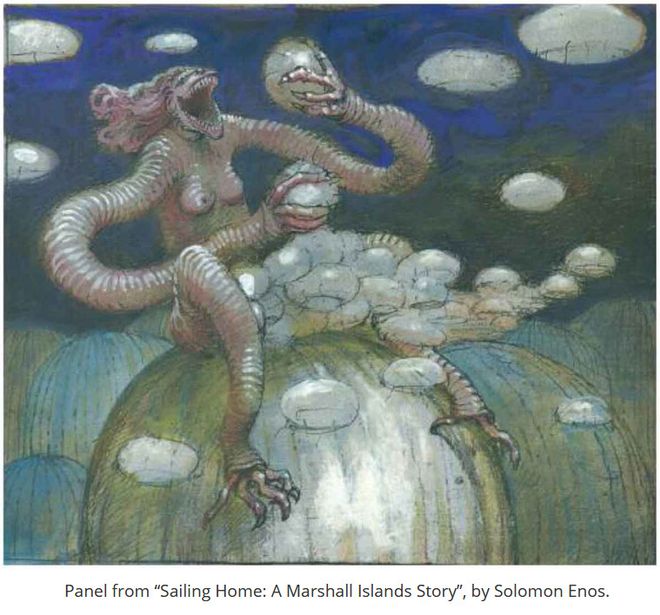
(Originally posted elsewhere on 18 January 2021.)
While reading some Oceanian/Pacific fiction, I’d gone and checked out Kathy Jetnil-Kijiner’s poetry.
Here, I wanted to contextualize the significance by sharing an excerpt scholar of literature/English, Michelle Keown, who addresses legacies of US/nuclear imperialism, environmental toxicity, and the colonial geographical imaginary of the Pacific as “empty” space.
—
Excerpt:
On Kili Island
The tides were underestimated
patients sleeping in a clinic with
a nuclear history threaded
into their bloodlines woke
to a wild water world
a rushing rapid of salt
In her poem “Two Degrees” […], Marshallese […] poet […] Kathy Jetñil-Kijiner reflects upon the successive waves of environmental and corporeal damage visited upon the people of Bikini Atoll, where the US undertook 23 nuclear bomb tests between 1946 and 1958. Persuaded by the US governor of the Marshall Islands to leave their homeland “for the good of mankind”, and initially believing their displacement would be temporary, Bikini islanders are living in near-permanent exile, with the half-life of the plutonium that has contaminated their homeland estimated at 24,000 years (Johnston 2015). The Bikini people have experienced multiple phases of displacement, relocating first to Rongerik (an atoll 200 kilometres east of Bikini) in 1946, then in 1948 – after insufficient food resources brought them to the brink of starvation – to Kwajalein Atoll (site of a US military base, and subsequently a ballistic missile testing range), and on to Kili Island in the southern Marshall Islands. […]
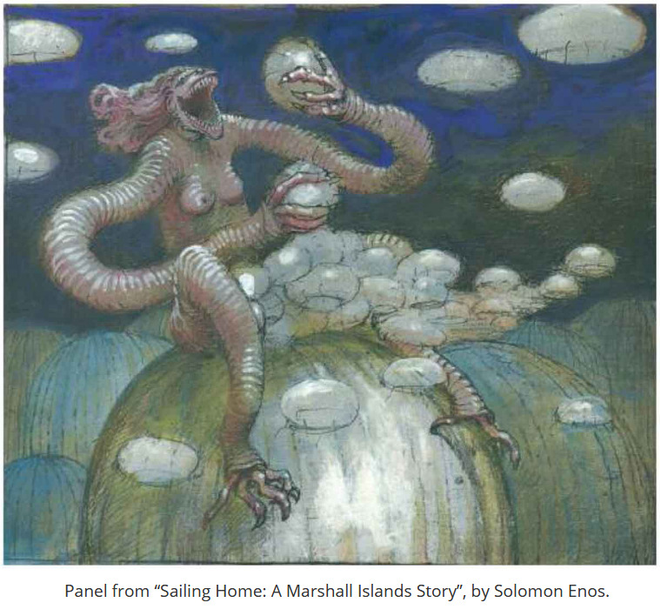
As Tongan scholar Epeli Hauʻofa (2008) has pointed out, colonial conceptualizations of the Pacific as a constellation of tiny, putatively isolated and sparsely populated “islands in a far sea” have played a key role in creating a context in which Britain, France and the US justified their decisions to test nuclear weapons in the region during the half-century following the Second World War (31, 37, 46).
Long-established western understandings of the Pacific as a realm remote from metropolitan centres of power and comparatively “empty” of people created a context in which, as Hauʻofa notes, “certain kinds of experiment and exploitation can be undertaken by powerful nations with minimum political repercussions to themselves” (46). Britain, France and the US all minimized the risk of international scrutiny by undertaking their nuclear tests in sites over which they had colonial jurisdiction […].
—
Gorodé’s “Zone Interdite”, also written during her 1974 imprisonment, reflects upon the stark contrast between “postcard” images of the Pacific paradise […] and the “forbidden” zones (such as Moruroa and Fangataufa atolls) where the nuclear fallout “poisons” Oceania, and transforms the watery Pacific into a realm of fiery destruction (“minant le Pacifique maintenant enfer”; Gorodé 1985, 17). “Wave-Song” also alludes to the fiery heat of nuclear explosions, contrasting the liquid mutability of the sea beyond the prison walls with the “overwhelming heat” of the sun, thereby invoking and transfiguring the “heliotropes” that […] are widely evident in atomic discourse. In the early years of the US nuclear testing programme, politicians, journalists and other commentators figured the nascent atomic era as “a new dawn, a rising sun, and the birth of a new world” […]. Influential New York Times journalist William Laurence, for example, compared one of the early atomic bomb blasts in the Marshall Islands to “a gigantic white sun” harnessing the “awe of a new cosmic force”, and likened the mushroom cloud from the 1946 Baker test (the first underwater detonation at Bikini Atoll) to a gigantic tree of knowledge, […] as “ordained by nature, the cosmos, and divinity” […]. Given that such rhetorical sleights of hand were used by Americans to deflect attention away from the destructive toxicity of the nuclear bomb, it is significant that Gorodé’s poem rejects this convention, pointing towards the deadly potential of the bomb […].
—
This recurring analogy between the sun and the nuclear bomb has a specific resonance within the context of US nuclear testing in the Marshall Islands, particularly with reference to the 1954 detonation of a hydrogen bomb codenamed BRAVO. […] 23 nuclear tests were conducted on Bikini Atoll between 1946 and 1958, but the 15-megaton BRAVO bomb – 1000 times more powerful than the atomic bomb dropped on Hiroshima – was the largest and “dirtiest” ever tested by the US. Visible from 250 miles away, with a mushroom cloud stretching across 60 miles, the explosion vaporized three islands on Bikini Atoll, left a mile-wide crater through the reef, and spread radioactive fallout across a 50,000-square-mile area, including the inhabited northern atolls of Rongelap, Ailinglae and Utirik […].
These islanders had no advance warning that the test was about to take place (though they had been evacuated for previous, smaller tests), and the day on which the BRAVO bomb was detonated was described as “the day of two suns” by Marshallese witnesses […]
The nuclear fallout, which was mixed with pulverized coral, resembled snowflakes falling from the sky, and local children played in the debris, not realizing it was deadly “poison”, as the radioactive particles came to be known afterwards. The people of Rongelap, Ailinginae and Utirik were not evacuated from their islands for several days, and by the time they were taken to Kwajalein Atoll for medical treatment, they were suffering various symptoms of severe radiation poisoning, including vomiting, skin lesions and hair loss. […] [M]ost of the islands in the atoll remain uninhabitable. […]
—
[T]he slow violence of radiation poisoning in the Marshall islands is barely registered outside the islands themselves – even within the continental US […]. “Two Degrees” […] s presented as a kind of creative manifesto registering Jetñil-Kijiner’s commitment to her task: she describes herself as “writing the tide towards / an equilibrium / willing the world / to find its balance”, reminding her global audience that Oceania is not an “empty” space, nor what has been dismissively termed by outsiders as the “hole in the doughnut” of the affluent Pacific Rim (Hauʻofa 2008, 42), but rather a vibrant, living space […].
—
Image, caption, and all text by: Michelle Keown. “Waves of destruction: Nuclear imperialism and anti-nuclear protest in the indigenous literatures of the Pacific.” Journal of Postcolonial Writing Volume 54, Issue 5, pages 585-600 (2018). Published online February 2019.