Precarity in Istanbul: Connecting popular movements, developmentalism, disaster, and neoliberal disavowal in contemporary Turkish urban histories

(Originally posted elsewhere in September 2023.)
Wanted to contextualize popular movements for housing in Istanbul (and Turkey more broadly). Really enjoyed Kostem's piece on rumor/communication. Both scholars here address development: In Kostem's case, an infrastructure project cutting through an urban commons. In Tugal's case, urban redevelopment and real estate speculation.
Burç Köstem (here writing for University of Calgary's environmental magazine Heliotrope) is Assistant Professor of Media and Technology Studies at UNC, where he studies intersections of cultural studies, political ecology, and communication.
Cihan Tugal (here writing for Jadaliyya, about housing precarity and the progression of Turkish state suppression of popular movements from Gezi to the 2023 earthquake rebuilding process) is an instructor in sociology at UC Berkeley and studies social movements, populism, and capitalism.
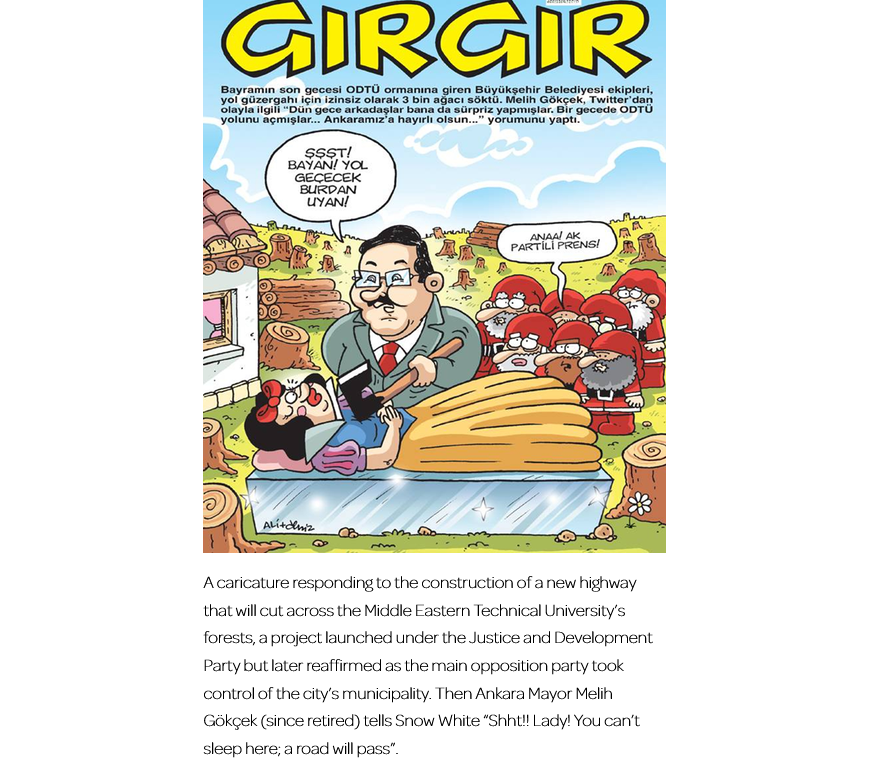
The image in the header comes directly from Kostem's piece, shown unaltered with original caption, which reads: A caricature responding to the construction of a new highway that will cut across the Middle Eastern Technical University’s forests, a project launched under the Justice and Development Party but later reaffirmed as the main opposition party took control of the city’s municipality. Then Ankara Mayor Melih Gökçek (since retired) tells Snow White “Shht!! Lady! You can’t sleep here; a road will pass”
Excerpt 1:
[N]ear the Küçükçekmece lake near the Western peripheries of İstanbul. [...] We are waiting to cross a ditch that has been dug [...] [through] an agricultural field that belongs to the İstanbul University over which Kanal İstanbul is planned to pass. Ayşe [...] is crossing back from the field with two plastic bags full of wild mustard she and her friends have collected. The ditch serves both as an obstacle and a reminder of the ever-looming construction efforts. [...] She asks, “Are you taking these people out for a stroll?” (Sen bunları mı dolandırıyorsun), a well-crafted double entendre. “Dolandırmak” literally means to take someone on a stroll, but could also be used to indicate deceit, to “take someone for a ride” the way tour guides, or taxi drivers sometimes do to unsuspecting foreigners. When I laugh and explain that I’m a student she points to a field. “There,” she offers, “this is where the Kanal will pass” (“Buradan Kanal geçecek”).
Kanal İstanbul is a mega dredging project and an accompanying urban transformation plan that promises to open a new waterway between the Sea of Marmara and the Black Sea. As such, it combines the spectacle of a megaproject with the more practical effects of shifting the city’s peripheries. The dredging of such a waterway will prove disastrous for the unique ecology of the Sea of Marmara [...] [and] forests, wallows, and lakes located across the Northwest of İstanbul. This area will be subsumed not only by the Kanal but also the accompanying expansion of the city Westwards with new logistics ports, waterfront housing, roads, and bridges.
Ayşe’s comment “this is where the Kanal will pass” is on the one hand a stock response one might hear from the residents of İstanbul’s Western peripheries. The project was originally launched into public consciousness as a speculative election promise in 2013 and recently became a more concrete plan. Either way, it has long haunted this geography, with the path that the Kanal would take remaining a mystery until 2018. It became the source of intense speculation, rumors and several defrauding schemes. [...] And now that the bridges, roads, water, and electricity infrastructure to sustain such a project are being built, there is some chance the project might come to fruition [...].
---
But this stock response “this is where the Kanal will pass” (“buradan Kanal İstanbul geçecek) also echoes another familiar phrase in Turkish “this is where a road will pass” (“buradan yol geçecek”). The phrase hints at both the promise and the perils of infrastructural development in Turkey (Kostem forthcoming).
Begüm Adalet points out in her book Hotels and Highways (2018), how theories of modernization were actively tested in Turkey through the construction of material infrastructure like highways in the 1950s and 1960s by a team of experts and engineers from the United States and Turkey. Yet this particular locution captures a more diffuse and affective valence to the ideology of modernization and the way it intersects with mega construction projects and the promise of economic growth.
---
Its declarative mode “where a road will pass” ties in macro phenomena such as economic growth and modernization with the promise of personal advancement and financial security or fear of violence and repression. [...] Yet such phrases also present a broader communicative logic that subtends infrastructural development especially in such peripheral spaces that exist on the edges of the city. This communicative logic carries a promissory element that is both familiar and as Appel, Anand and Gupta note, multivalent (2018, 7), at times communicating a threat, at times promising development, at other times offering economic advancement, often shifting between the three and for different subjects.
Yet this communicative structure also resembles a rumor, since the declaration that “a road will pass” or “the Kanal will pass” does not have a subject. Instead, it is often accompanied with the indefinite “so they say” (“yol geçecek diyorlar” or “yol geçecekmiş”). Indeed, this is how I instinctively responded to Ayşe “is that what they say?” (“öyle mi diyorlar?” ). More than a simple locution this communicative logic is reflected in how the state carries out infrastructure development, which takes place under conditions of great secrecy, especially in such peripheral spaces. What is prohibited and allowed, who owns which land, where a construction project might pass, how long it will take is often obscured, true enough for any construction project but doubly so on the peripheries of İstanbul, an area that has witnessed multiple generations of migration and extraction. [...]
---
In her work, on İstanbul’s more urbanized Tarlabaşı district, [...] Alize Arıcan argues (2022) that rumors act as a kind of autonomous and collective archive for the racialized communities of this neighborhood, a site of history-making. Addressing the obvious criticisms of Kanal İstanbul that the project was being launched for the sole purpose of creating waterfront property and hence extracting rent, the Turkish Minister of Transportation Adil Karaismailoğlu recently insisted “Kanal İstanbul is a technical issue, we are talking of a world vision here. This is not a matter of political rumors”.
And yet rumors seem to constitute the field of struggle over which financialized infrastructural development takes place both in İstanbul’s and especially also in its peripheries. [...] Turkey moves ahead with a contested election shortly after a devastating earthquake that has once again brought attention to the destructive character of a society organized around the imperatives of construction, economic growth and capitalist expansion, all underwritten by state violence. [...] In this environment, what would it mean for rumors to be an archive of political memory, knowledge-making and even resistance for an autonomous social opposition?
---
Text above by: Burç Köstem. ‘”A Road Will Pass”: the Communicative Logic of Infrastructure in the Peripheries.’ Heliotrope, Environmental Media Lab at the University of Calgary. 19 April 2023. [Emphasis mine.]
--
Excerpt 2:
Guided by international authorities, the Turkish state [...] set sails to a path of massive creative destruction in 1980. Social forces that could negotiate or resist this route were crushed. They have been trying to reorganize ever since [...]. The roots of Turkey’s financial and ecological destruction were in the policy packages of two World Bank figures: Turgut Özal and Kemal Derviş. [...] 1980 was a crucial turning point. World Bank-imposed economic decisions [...] lowered wages [...] while opening the gates to more systematic – and now commercialized – urban plunder. [...] Turgut Özal, the engineer-turned-economist who brought the World Bank’s neoliberal turn to Turkey, served as prime minister and then president between 1983 and 1993. Even though he sparred with Kenan Evren (the NATO-trained counter-guerilla officer who led the junta of 1980-1983) over the issue of military-civilian balances, the two had a unified agenda: commodification of everything including housing, the abolition of social rights, and the crushing of unions. [...]
[T]he model they implemented shaped Turkey from head to toe. Throughout the 1980s and 1990s, [...] [s]mall to medium sized housing acted as a replacement for secure jobs. This amounted to a Ponzi scheme [...]. [I]nstead of creating one to two story buildings as happened up until the 1970s, both construction workers and contractors built 4-story squatter units, with the intention of collecting rent from the units not inhabited by the original occupier. In other words, the newcomers to the cities now shifted part of the cost of the neoliberal package to the newer-comers from the countryside. [...] [T]he consequences of quick and cheap housing (not just for neighborhoods but for the entire society) were not yet well-understood [...]. We still don’t know what ratio of the buildings that were destroyed during the 2023 earthquake were built in the 1980s and 1990s, but they (and therefore, the social-political actors behind them) certainly share a huge part of the blame. [...]
---
The 1999 earthquake changed this.
The direct links between the quality of buildings and the unusually high number of deaths during the Gölcük earthquake opened everybody’s eyes – or so it seemed, back then. [...] The AKP of 2002, voted in partially as a reaction to the poor governmental response to the 1999 earthquake, had a vast popular mandate to enforce the new regulations. [...] But they weren’t enforced. [...] The increasing central regulation under the AKP was not for safety, as promised by the party. The AKP rather streamlined the wealth creation through cheap buildings, roads, and other infrastructure. In other words, urban rents and profits were centralized and concentrated at the top [...].
After this point, the shoddy construction was not a side effect, but a central choice.
The top-down reason for this [...] was a conscious strategy of wealth concentration. [...] [C]heap housing continued to substitute for high wages and secure jobs, as it did throughout the 1980s and 1990s. In other words, shoddy buildings were what an impoverished people could afford. And in the meantime, they were employed in passing jobs in construction and related sectors, further embedding their lives in the systematic creation of cheap housing, as part of a much more massive, and state organized, production of profit-oriented construction spree when compared to 1980-1999. [...]
[T]his path was devised by the World Bank, but the AKP rendered it much more rapacious. [...] Millions still couldn’t afford any decent housing, and now (further de-unionized in the 2000s) they couldn’t even afford units in these poorly constructed (but now giant, instead of 4-story) buildings. The new World Bank policy package (the Derviş rather than the Özal version) had a solution to this too: Household debt. Ordinary people started to live an apparently more comfortable life, thanks to mortgages and credit card debt.
But, as now they say in Turkey, they were buying not chic lives but tombstones. [...]
---
The links between Gezi [2013] and the Maraş earthquake [2023; over 59,000 deaths] are both structural and intimately personal. [...] The same individuals and associations that were active in the Gezi Uprising were and are involved in earthquake preparation and post-earthquake relief. [...] Urban rights, anti-extraction, and environmental movements flourished in Turkey after the 1980s. [...] The devastation caused by February 6 [2023] is yet another wakeup call. Ecologists, feminists, socialists, labor unions [...] [have] been organizing mutual aid once again. Self-organization has become a constant topic of discussion [...].[C]olonialism, racism, capitalism, and ecology are not separate issues. They are all intertwined. [...] Kurds and Alevis undertook impressive aid efforts in the earthquake-affected regions, despite explicit attempts by the government to thwart their relief campaigns. [...] Several associations and movements which we saw on Gezi’s stage – from the Chamber of Architects to the ever-growing multiplicity of feminist and LGBTQ organizations – have been providing the most basic necessities, whereas the neoliberal state has sunk so deep [...] that it has started to sell basic necessities in the earthquake region.
---
All text above by: Cihan Tugal. "From the Gezi Uprising to the 2023 Earthquake: Charting Turkey's Ecological Destruction and Reconstruction". Jadaliyya. 7 April 2023.