Prefiguring regionalism and Anglo-US imperial law: Early Modern legal margins, borderlands historiography, and legitimate power in Turner's (urban?) frontier (Lauren Benton and Sonja Schillings side-by-side)

(Originally posted elsewhere in February 2022.)
Reading on early maritime law.
Just wanted to put Sonja Schillings and Lauren Benton in conversation.
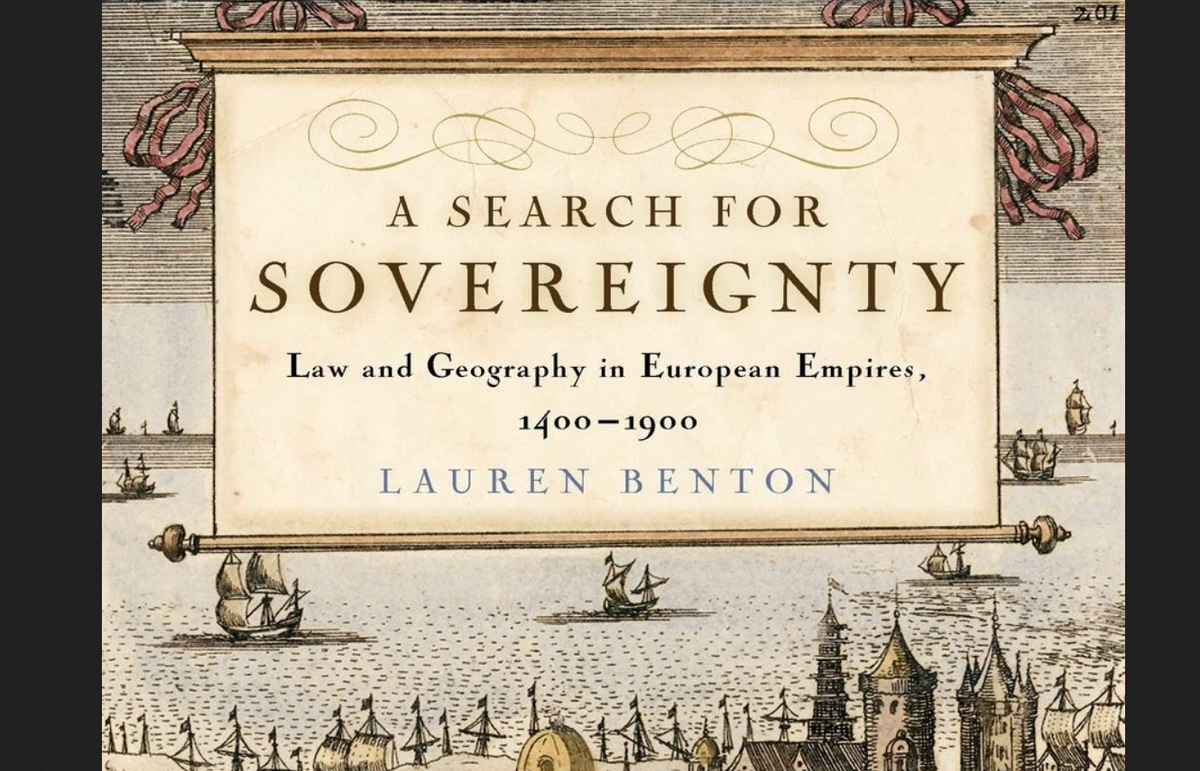
Benton, of course, is author of Rage for Order: The British Empire and the Origins of International Law, 1800-1850 (2016) and A Search for Sovereignty: Law and Geography in European Empires, 1400-1900 (2010)
--
Excerpt 1:
If American national space is an in-between zone, questions immediately arise about the nature of representation and the derived narrative conditions for claims to legitimacy. Which elements of the nation-state can be presupposed to be civilized […] and which elements can – or must – be transformed because they represent fragments of the wilderness that have to be removed? During World War I and the interwar period, important early concepts were developed that help answer these questions.
Especially in urban space, the notion of spatial restructuring was influential, and as a result the frontier model of civilization was often applied to urban space. By the 1930s, urban restructuring was routinely called for with references to “urban frontier” in Frederick Jackson Turner’s sense […], and such language thus informed the spatial manifestation of industrial development in the city.
—
In this context, the relationship between collective violence and the law soon emerged as the most important site for the hostis humani generis constellation’s production of illegitimate Other collectives as political factions. This becomes evident in the First Red Scare in the aftermath of World War I (circa 1919–21). The First Red Scare marks a period of upheaval and civic unrest in the United States that “accompan[ied] American industrial development” […] and that associated communism with domestic violence carried out by excluded groups, especially within the American urban population. “Native Americans, blacks, Catholics, immigrants – all, at one time or another, embodied the threat of internal subversion,” Ellen Schrecker explains, and she adds in reference to the First Red Scare: “By the twentieth century, the American ‘Other’ had become politicized and increasingly identified with communism […].”
—
As Bruce Franklin notes, the classic European notion of inherent civilization is fundamentally shattered by World War I, especially because the war was largely waged in Europe itself.
As […] discussion of pirate figures in Victorian literature has indicated, European discourses of civilization still depended on the assumption that Europeans and European space were inherently civilized. European discourses of civilization were not able to explain the war’s “insane orgy of mass murder and devastation” in any way that allowed Europeans to continue to insist on their inherent civilization. Indeed, it seemed that either Europe was civilized (in which case, World War I should not have occurred) or it had degraded into savagery (which would explain the war but was deemed an unacceptable notion). World War I thus occasioned the widespread formulation of alternative models of civilization in Europe that could restore the lost premise of inherent civilization.
These discourses borrowed from the American frontier model, especially in their references to the constitutive importance of transformative revolution and the premise of national space as an in-between zone that was the site of a perpetual civilizing effort. […]
—
Totalitarianism, in this emerging understanding, held that the massification of populations in twentieth-century Western nation-states required a new form of political organization that responded to, and was thus theoretically based on, the notion of atomized masses. Such masses were to be justly governed by a state that loosely combined Hobbes’s idea of the Leviathan with Rousseau’s idea of social progress. The totalitarian Leviathan, representative of all, was also endowed with a coherent will that corresponded directly to the collective will of the masses. The totalitarian state was to be a living and constantly self-purifying body, made up of all the humans within it. Because of the oneness of state and human, the totalitarian state always legitimately acted on behalf of “its” humans.
—
Text above by: Sonja Schillings, “The Democratic Frontiersman and the Totalitarian Leviathan,” Enemies of All Humankind: Fictions of Legitimate Violence (2016). [Emphasis mine.]
--
Excerpt 2:
In his geographical treatise of 1537, the Portuguese chornicler D. Joao de Castra explained that it would be possible to correlate all newly discovered lands with astronomical markers to produce an accurate map of the world. The result would be, he wrote, a “true and perfect geography.” The movement toward this vision, from the cartographic revolution of thirteenth-century Portolan charts to the use of surveying to map colonial territories in the nineteenth century, is a compelling narrative of the rationalization of space, and of the reinforcement of this trend by the pursuit of European imperial interests. This narrative needs to be placed alongside the history of “imperfect geographies” and their production in empire. [...]
While an iconic association with empire is the pink shading of British imperial possessions in nineteenth- and early twentieth-century maps, this image obscures considerable variation across imperial holdings. Empires did not cover territory evenly but composed a fabric that was full of holes, stitched together out of pieces, a tangle of strings. Even in its most paradigmatic cases, empire’s spaces were interrupted, politically differentiated, and encased in irregular and sometimes undefined borders. [...] The history of these other ways of understanding and producing space in empire is important in part because they played a role in the composition of world regions. These historically new designations have been studied very little by world historians, who have developed methodologies for bridging the “local” and the “global” without giving much attention to categories that defy either label. [...] Yet territory, as we have learned from historians of borderlands regions, was constructed not just for empire but also in empire, and at its margins.
Law comprises a particularly important part of the social construction of territory and region. This function of the law is often obscured by an enduring emphasis on the study of legal systems that appear more or less coterminous with political jurisdictions. But legal practices crossed boundaries and helped to constitute legal cultures of unruly dimensions. In empire, law traveled with legal officials and also with merchants, sailors, soldiers, sojourners, and settlers. Legal practices often closely intertwined with those of the peoples with whom imperial agents came into contact, creating continuities in patterns of legal pluralism across substantively different legal orders. Yet we should not confuse global legal continuities with the homogenization of territory. Legal routines and institutions also marked discrete spaces of empire – the corridors and enclaves of imperial control. [...]
[There is] the link between globalizing legal practices of one kind -- the circulating legal strategies of mariners in the late seventeenth and early eighteenth centuries -- and sharpening distinctions between the Atlantic and Indian oceans as separate regulatory spheres. Pirates are the central characters in a story about the mutual influence of Atlantic legal politics and Mughal-European relations. [...] In my sea yarn, the oceans have a quality of lumpiness about them, pirates strain not to break the law, and international norms take shape not at Westphalia but at the edges of the Indian Ocean.
The pattern of imperial expansion in which empires laid claim to vast stretches of territory but exercised control over only narrow bands, or corridors, and over enclaves of various sizes, was represented most clearly in early modern European maritime empires. Extensive claims to ocean territory coexisted with effective control over sea-lanes connecting dispersed settlements or trading posts. For example, Portuguese claims in Asia recognized by the Treaty of Tordesillas included control of the eastern seas, but the geography of the Portuguese trading-post empire in sixteenth-century Asia was shaped by the ability to monitor sea lanes and ports. Both Spanish and Portuguese rulers understood the Treaty of Tordesillas as an agreement dividing the globe into spheres of influence rather than realms of sovereignty.
European powers had long recognized the Indian Ocean as in some respects a different sort of ocean space, one of crowded sea-lanes dominated by coastal polities and ethnic traders. This idea matched the Ptolemaic image of the Indian Ocean as a separate sea encircled by land. But mariners after de Gama, especially from the second half of the sixteenth century, increasingly experienced travel around the Cape of Good Hope as routine and carried expectations about maritime affairs across ocean basins. Europeans did not invent a new maritime politics for the Indian Ocean but sough to continue older practices from the Mediterranean and, later, from the West Indies. [...]
The boundaries between separate ocean worlds at the beginning of the eighteenth century were thus surprisingly blurred. World maps still did not consistently label the “Atlantic Ocean” or the “Indian Ocean,” and each region was often represented as comprising multiple seas. [...]
The legal authority of ship captains was one variety of a wider array of [...] semi-autonomous legal authorities. [...] The arrangement also presupposed the right of state legal officials to oversee and intervene in regulating maritime affairs. Ships thus played a dual role as sources of order in the oceans: they were islands of law with their own regulations and judicial personnel, and they were representatives of “municipal” legal authorities -- vectors of crown law thrusting into ocean space. [...] Mariners, in other words, carried law beyond the line, even or especially when they acted as privateers or pirates. [...] [A]n important and growing difference with Atlantic conditions lay in the political impact of Mughal authority. Kidd’s undoing was not, after all, the coordination of British legal authority but the importance of the protests of the Mughal emperor. [...] Doing so required, after all, only an extension of existing Mughal land-based jurisdictional arrangements [...]. The taking of English ships [by Mughal authorities in reprisal for European piracy] was an example of Mughal action in coastal waters to complement the pressures it exerted on land. To insist that Europeans collaborate to pacify the pirate-ridden Indian Ocean was, in effect, to hold these powers to their jurisdictional claims over ocean space. And while Mughal officials protected their rights by paradoxically reaffirming English ocean sovereignty, English company officials reinforced Mughal legal authority on land and on the coasts as a way of protecting English enclaves and European-Mughal arrangements for trade. [...]
While emerging European understandings of international law and mariners’ practices reinforced a pattern of regulatory regionalism of the seas in the early decades of the long eighteenth century, European empires were struggling to construct coherent maritime imperial policies – an elusive goal. The definition of the “high seas” as a special legal category formed out of institutional tensions within separate imperial legal orders [...]. Meanwhile, jurisdictional jockeying among competing polities composed a broader maritime legal politics. All these institutional processes had regional variations. The same forces whose similarities across empires helped to compose a global legal regime were generating new kinds of ocean regionalism. [...] Globalizing legal practices could set in motion different regional political trajectories, resulting in an uneven spatial distribution of regulatory practices, and the creation of multiple, regional “legal spaces.” If colonial and metropolitan sovereignty depended upon articulated positions about when the rule of law did not apply, or when and where it applied differently, both also relied upon routines and exceptions for extending law [...] Outside Europe, there was abundant law “beyond the line” of both European and non-European origins, while the extension of European legal practices followed spatial patters of conquest and settlement, traveling along corridors of imperial control, encircling imperial enclaves, and composing these elements into new regional agglomerations.
---
Text above by: Lauren Benton, “Legal Spaces of Empire: Piracy and the Origins of Ocean Regionalism,” Comparative Studies in Society and History, vol. 47 (2005). [Emphasis mine.]