The Black pirate and the softening the image of insurrection: Ganser and Warren on Equiano, Emmanuel Appadocca, and maritime slave revolts in Anglosphere literature at times of abolitionist discourse

(Originally posted elsewhere on 14 February 2022.)
--
Recuperating the image of the Black pirate and the lessening of Black agency in slave/pirate narratives.
Just two excerpts that worked together.
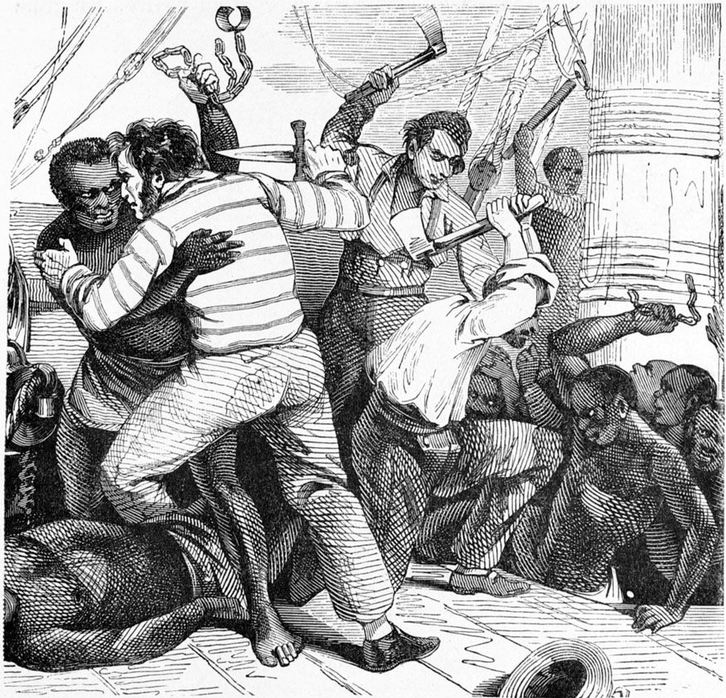
(Image in header, by the way, is "Revolt on a slave ship," engraved by Auguste Trichon, circa 1883, now in the public domain.)
--
Excerpt 1:
As early as 1700, Samuel Sewall, the renowned Boston judge and diarist, connected “the two most dominant moral questions of that moment: the rapid rise of the slave trade and the support of global piracy” in many American colonies [...]. In the course of the eighteenth century, [...] [there was a] semantic shift in the [literary] trope of piracy in the Atlantic context, turning its [...] connotations from exploration and adventure to slavery and exploitation. [...] [A] large share of Atlantic seafaring took place in the service of the circum-Atlantic slave trade, serving European empire-building in the Americas. [...] Ships have been cast as important sites of struggle and as symbols of escape in [...] Black Atlantic consciousness, from Olaudah Equiano’s Interesting Narrative (1789) and Richard Hildreth’s The Slave: or Memoir of Archy Moore (1836 [...]) to nineteenth century Atlantic abolitionist literature such as Frederick Douglass’s My Bondage and My Freedom (1855) or Martin Delany’s Blake (1859-1862). [...] Black and white abolitionists across the Atlantic world were imagining a different social order revolving around issues of resistance, liberty, (human) property, and (il)legality [...].
---
Using black pirates as figures of resistance [...], Maxwell Philip’s novel Emmanuel Appadocca (1854) emphasizes the nexus of insatiable material desire and its conditions of production: slavery. [...] [T]he consumption of commodities produced by slave labor itself was delegitimized [...]. Philip, a Trinidadian [and "illegitimate" "colored" child] [...], published Emmanuel Appadocca as a protest against slavery in the United States [following the Fugitive Slave laws of 1850.]. [...] [The novel places] at its center [...] a heroic non-white pirate and intellectual [...] [whose] pirate ship [...] [is] significantly named The Black Schooner [...]. One of the central discourses in [the book] is that of legitimacy, of rights and lawfulness, of both slavery and piracy [...]. About midway into the book, Appadocca gives a [...] speech in which he argues that colonialism itself is a piratical system:
If I am guilty of piracy, you, too [are] [...] guilty of the very same crime. ... [T]he whole of the civilized world turns, exists, and grows enormous on the licensed system of robbing and thieving, which you seem to criminate so much ... The people which a convenient position ... first consolidated, developed, and enriched, ... sends forth its numerous and powerful ships to scour the seas, the penetrate into unknown regions, where discovering new and rich countries, they, in the name of civilization, first open an intercourse with the peaceful and contented inhabitants, next contrive to provoke a quarrel, which always terminates in a war that leaves them the conquerors and possessors of the land. ... [T]he straggling [...] portions of a certain race [...] are chosen. The coasts of the country on which nature has placed them, are immediately lined with ships of acquisitive voyagers, who kidnap and tear them away [...].
In this [...], slavery appears as a direct consequence of the colonial venture encompassing the entire “civilized world,” and “powerful ships” - the narrator refers to the slavers here - are this world’s empire builders. [...] Piracy, for Philip, signifies a just rebellion, a private, legitimate [resistance] against colonial exploiters and economic inequality - he repeatedly invokes their solidarity as misfortunate outcasts [...].
---
All text above by, Crisis and Legitimacy in the Atlantic American Narratives of Piracy: 1678-1865 (Palgrave Macmillan, 2020). [From her chapter: "Cultural Constructions of Piracy During the Crisis Over Slavery."]
--
Excerpt 2:
The period between 1759 and 1771, Equiano's time at sea, saw the highest incidence of insurrection, both by slaves in transit from Africa and by those who reached the plantations in the Americas. From the standpoint of captured Africans, antislavery demanded violent actions to free themselves from their captors. [...] [D]uring this period, abolitionist rhetoric emerged that defined freeing slaves as abolition rather than as liberation. [...] [Depicting] the slave as a victim rather than as a freedom fighter became a more compelling trope for early abolitionists. In portraying the slave as a victim of the slave trade, the longer history of the shipboard insurrection is lost, and abolitionists would struggle with the place of insurrection within antislavery discourse well into the nineteenth century.
In 1781 Captain Luke Collingwood of the slaver Zong threw 132 slaves overboard, alleging disease and lack of water. Through the work of Olaudah Equiano, Thomas Clarkson, and others, the Zong case would come to epitomize the evils of the slave trade, dramatizing as it did the corrupt nature of slave-ship captains, the maltreatment of sailors, and of course the deplorable conditions for slaves. The slave as a victim would become a popular trope both in Great Britain and later in American abolitionist circles. Yet at the same time that slaves were being thrown overboard, beaten, and starved, they were also revolting on ships in great numbers, particularly during the mid-to-late eighteenth century.
The question of how insurrection got written out of the early abolitionist narrative matters because, in the first place, it highlights the way in which abolitionists were conscious of the problem of slave violence in the decades leading up to the San Domingo revolt. In the second place, writing insurrection out of the narrative also erases these early traces of black revolutionary activity. Erasing these early traces ignores a trend of resistance outside of those discourses of abolition couched either in Chr!stian morality or in Enlightenment logic. Revisiting the role of shipboard insurrection in shaping abolitionist rhetoric not only allows us to explore the process through which one narrative prevails over another, but also how remnants of the alternative narrative remain. [...]
---
But the rising concerns regarding San Domingo would necessarily force both Clarkson and Equiano to contextualize shipboard insurrection carefully in order to dissociate slave violence with full-scale revolution. How abolitionists used evidence of insurrection in their own printed materials reveals the way in which telling the story of the Middle Passage became a process of garnering sympathy, coping with the absence of the slave's voice, and ultimately of choosing to highlight the slave as victim rather than the slave as revolutionary. [...] In effect, the years immediately before and after Tacky's Rebellion [1760 to 1761] witnessed some of the bloodiest incidents in the history of shipboard insurrection. In the spring of 1750, a group of Africans succeeded in taking the King David, killing 14 crew members including the captain. The ship was eventually retaken off the coast of Guadalupe nearly two weeks later. In December 1764, immediately off the coast of Africa, captured slaves aboard another ship successfully revolted, killing the entire crew and escaping to freedom. Altogether, 69 shipboard insurrections were documented between 1760 and 1771. But overall, slave rebellions became less frequent until the San Domingo revolt in 1791, in which the slaves succeeded in revolting and expelling the French. [...]
The image of sick sailors abandoned to die in the Caribbean ports appears calculated to disabuse the public that the slave trade was anything resembling a “nursery” for British seamen, with the final image of their bodies interred next to a Negro cemetery meant to blur the line between the fate of the sailors and the slaves. [...] [The] blurring of this line [was] designed to use the plight of the sailors to also incite sympathy for the slaves [...]. What comes through is not the full horror of the trade as it affected both sailors and slaves, but the indignity of white Britons, mistreated and abandoned, to be buried among blacks. Sympathy for the sailors in this instance takes over at the expense of any kind of sympathy for the slave. [...]
Assessing the impact of the San Domingo uprising on the British Abolitionist movement also reveals the ways in which it became possible to use slave insurrection as evidence of the brutality of slavery, rather than as evidence of the slaves’ right to revolt. While events in San Domingo were very much on the minds of both British pro- and anti-slavery factions, according to Clarkson's writings (as well as Blackburn's), it seems as though the British viewed events in Haiti less as a revolution in itself than as an outgrowth of the French Revolution. That this kind of thinking prevailed reveals how deep the assumptions of the absence of slave autonomy ran even within the sympathetic circles of the abolitionists. [...]
Clarkson's testimonies, appearing as they do in the aftermath of the height of shipboard and plantation insurrections and on the eve of the San Domingo rebellion, needed the evidence of violence in order to frame it as a reason for abolition. But the testimonies themselves are problematic because they reveal the slave as more autonomous actor rather than innocent victim. [...] Yet, the testimonies, in sympathetically representing shipboard insurrection, present a possible alternative to the trope of slave as victim, namely the slave as revolutionary. This momentary recognition of the natural right to revolt would not be seen again within abolitionist rhetoric until the Amistad case in the nineteenth century. It is within this context that Equiano's Interesting Narrative was conceived, written, and received. If Clarkson's testimonies established the sailor as a surrogate for the slave, Equiano's biography fuses the two personae into one. In doing so, he appears to be reclaiming autonomy from white abolitionists by adding his apparently first-hand account of the slave's experience in the Middle Passage. [...]
---
Slave violence would remain a conundrum for the abolitionists by displaying evidence of the slaves’ innate savagery, and bolstering proslavery arguments against emancipation. But in reexamining the works within the context of shipboard insurrection, a more complete picture of the slave resistance emerges, one in which the slave's position on the slave ship transforms from mere victim to actor. The space of the ocean makes these acts of rebellion more elusive than plantation insurrection and therefore more easily elided. Recovering the history of shipboard insurrection not only complicates our understanding of how the history of the Middle Passage gets narrated, but also brings to light the ocean as a site for slave resistance.
---
All text above by: Lenora D. Warren. “Insurrection at sea: violence, the slave trade, and the rhetoric of abolition.” Atlantic Studies Volume 10. 2013. [Emphasis mine.]