Prisons prioritizing 'dread'/'pain' over profitability: Guiana, Bengal, and convict transportation as punishment

(Originally post elsewhere on 11 November 2025.)
Just a compilation of scholarship on the use of convict transportation and spatial confinement as both means and ends, sometimes prioritizing punishment over and beyond efficiency, prison profitability, and book-balancing… at least in the words of the very administrators who managed those programs. These include: postcolonial studies scholar Sophie Fuggle on the “doublage” system in French Guiana and the isolation of Vietnamese prisoners; historian Jeff Sparrow on the lack of middle-class sympathy for convicts in post-abolition Britain; anthropologist Peter Redfield on the “parade of punishment” and convict colony as “public spectacle” in French Guiana; anthropologist Avery Gordon on the condition of “non-person” and the arrangement of prison as “a time-motion laboratory” which “exterminates time”; and historian Anand Yang on British administrator’s prioritization of “dread, apprehension, and …pain” in Bengal, where the 1864 prison committee convened across London and Calcutta acknowledged that Bengal prison commissioner Mouat had made the prisons efficient/profitable by introducing a handicraft production industry making use of prisoners’ labor, yet the committee felt this distracted from the “deprivation” of the confinement.
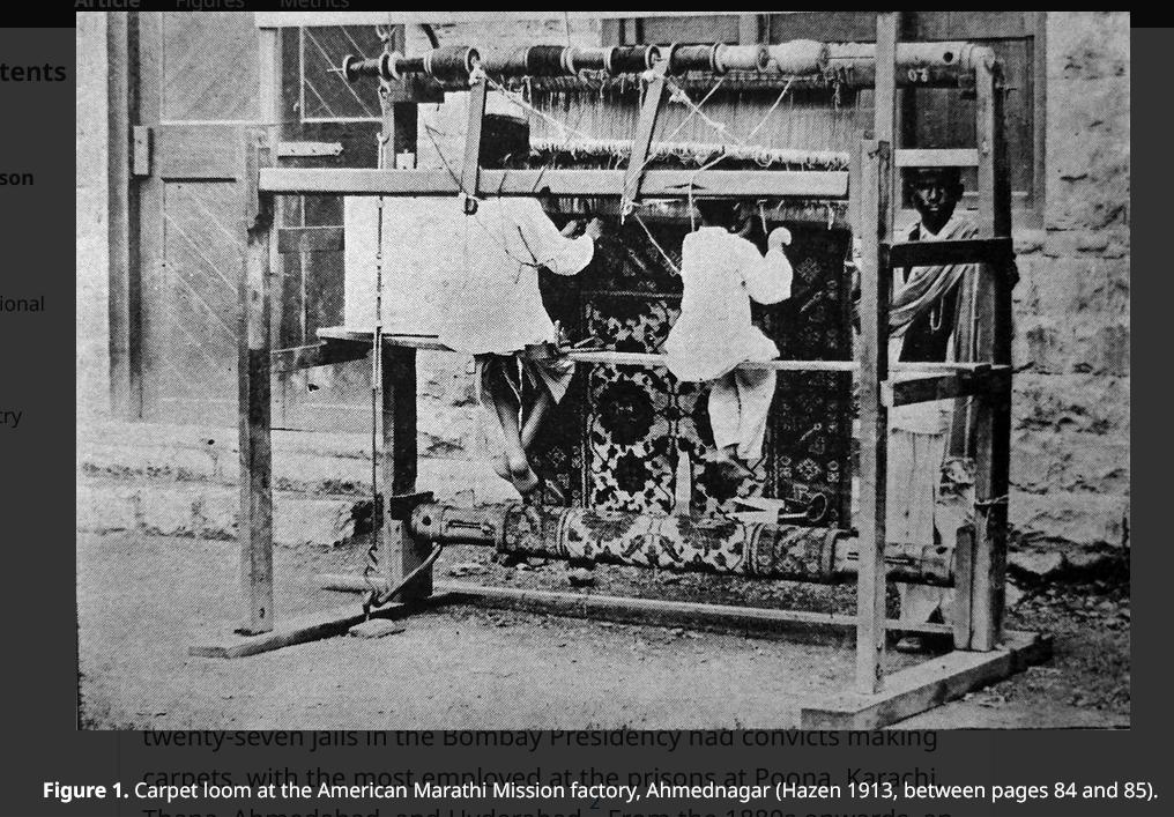
Image of handicrafts production site in British India:
—
Excerpt 1:
[T]he infamous Diable (Devil’s Island) [...]. Seventy thousand convicts were sent to French Guiana between 1852 and 1938. […] French Guiana […] was predominantly used as a depository for the unwanted citizens of France and its colonies. The last remaining French and North African convicts were repatriated in 1953, whereas the last Vietnamese prisoners were not given passage home until 1954 […]. [T]he same form of built environment and carceral technology […] structures found on Con Dao [French prison in Vietnam] and [the French prison in Guiana] [were] built at almost the same time […] to house the same convict populations […]. Many of the Indochinois convicts transported to the forest camps of French Guiana in 1931, including the Bagne des annamites, had originally been classed as political prisoners. The transfer was intended in part […] to remove a number of anticolonial actors from Indochina. […] As political deportees sent to French Guiana were usually exempt from labour according to the political decree of 1850, this status had to be revoked to ensure the maximum labour force possible. Consequently, those arrested on suspicion of specific acts of violence or property damage were reclassed as common criminals. Described by Dedebant and Frémaux (2012, 7) as “little arrangements between governors,” this was not simply a sleight of hand but written into legal codes. […] After their sentences were completed, convicts were not simply repatriated to France or other colonies. A system of “doublage” intended to shore up colonial development meant they had to serve the same length of their sentence again on the colony. For those condemned to eight years or more, this became life. Opportunities for sustainable livelihood were limited in a territory possessing swathes of free convict labour. Worn out and sick from their time in the bagne [...]. [T]he last living convict [of the Guiana penal colony] […] died in Algeria in 2007 after being repatriated to Annaba. In an interview given in 2005, he claims that every night he dreams he is back in Cayenne: “when I think about it, I get vertigo, I spent my life there” […].
Texy by: Sophie Fuggle. “From Green Hell to Grey Heritage: Ecologies of Colour in the Penal Colony”. Interventions: International Journal of Postcolonial Studies, Volume 24 (2022), Issue 6, pages 897-916. Published online 8 April 2021. [Emphasis mine.]
-
Excerpt 2:
The Riot Act banned public disorder; the Combination Act made trade unions illegal; the Workhouse Act forced the poor to work; the Vagrancy Act turned joblessness into a crime. Eventually, over 220 offences could attract capital punishment--or, indeed, transportation. […] [C]onvict transportation--a system in which prisoners toiled without pay under military discipline--replicated many of the worst cruelties […]. Middle-class anti-slavery activists expressed little sympathy for Britain’s ragged and desperate, holding […] [them] responsible for their own misery. The men and women of London’s slums weren’t slaves. They were free individuals--and if they chose criminality, […] they brought their punishment on themselves.
Text by: Jeff Sparrow. “Friday essay: a slave state - how blackbirding in colonial Australia created a legacy of racism.” The Conversation. 4 August 2022. [Emphasis mine.]
-
Excerpt 3:
Louis-Napoleon, still serving in the capacity of president of the republic, threw his weight behind […] the exile of criminals as well as political dissidents. “It seems possible to me,” he declared near the end of 1850, “to render the punishment of hard labor more efficient, more moralizing, less expensive […], by using it to advance French colonization.” […] For those in Metropolitan France the penal colony served as a hidden punishment, a distant if graphic terror, retaining elements of torture out of public view. [...] For those sent to French Guiana, however, the penal colony served directly as a public display, a constant reminder of the operations of justice. The convicts were not merely confined but forced to labor on public works. [...] A slower execution, [...] reminding the convicts that this punishment could only happen here and not within Metropolitan boundaries. [...] And for those already living in French Guiana, the penal colony also served as a public spectacle, if one not aimed directly at them or of their making. Not only did the proximity of prison life to their own lives parade the power of justice before them in an immediate fashion, but the constant importation of prisoners for this apparatus of punishment emphasized the particularly colonial nature of this power. [...] Modernizing France, a convulsive patchwork of provinces, cities, farms, and factories, casts its shadow overseas.
Peter Redfield. Space in the Tropics: From Convicts to Rockets in French Guiana. 2000.
-
Excerpt 4:
A ‘nonperson’ […]. This is fatal […]. [S]laves, prisoners, undocumented migrants, the very poor, the abandoned, the enemy, the subversive [...]. People without future are suitable, in this schema, for confinement in an institution that controls both space and time. And, of course, the daily life of the prison is organized like a sadistic […] time/motion laboratory: regular and surprise head counts […]; meal and shower times designed for maximum inconvenience (always too early) and for maximum control over fraternizing; the routine exercise of internal discipline not only by the temporally disorienting solitary lockdown but by the extra judicial extension of the prison sentence. […] Dylan Rodriguez writes that the ‘prison’s logic of death exterminates time as we know it. Bodies fill up spaces that have been … constructed within a … time … alienated from history’ […]. Part of the ‘terror of the prison regime’ is the ‘endless sameness … that convinces the imprisoned that their very subjectivity is in question’ […]. As Ray Luc Levasseur writes, ‘It seems endless. Each morning I look at the same grey door and hear the same rumbles followed by long silences. It is endless’ […]. In the prison, state power renders the distinction between illusion (’It seems endless’) and reality (’It is endless’) into a weapon to force the prisoner to serve the time, to assume this alienation. [...] [T]hat ‘painful’ time Maryland prisoner Q calls ‘the dragon’ […].
Text by: Avery Gordon. “Some Thoughts on Haunting and Futurity.” borderlands 10:2 (2011).
-
Excerpt 5:
Mouat [was] a medical officer who became the inspector-general of prisons in Bengal in 1855 and convened the first ever province-wide exhibition in Calcutta in 1856 to celebrate and stimulate jail handicrafts in the region. […] That began to change, however, as administrators at different levels of government raised concerns about the lack of severity of indoor penal regimens […]. Indeed, colonial debates about mobilizing convict labour to work indoors or outdoors were always centred on concerns about ensuring and maximizing the severity of imprisonment and not the rehabilitation [...]. London and Calcutta encouraged local officials to employ prisoners in […] roads in particular [because the conditions were more brutal] […]. They also broached the possibility of moving convicts away from their home districts so that they would not have access to friends and family. […] And with local officials eager to capitalise on prison labour, judicial authorities helped increase convict numbers […]. [But] Mouat’s plan was to transform jails into ‘schools of industry’ […]. [He wanted to make jails profitable. To do this, he advocated indoor handicrafts production.] [H]e singled out certain jails for their productivity, Alipore […] in particular […] producing ‘an actual profit of £74,232 […]’. But the 1864 Committee […], [m]uch more so than the Bengal inspector-general ever did, [in] its report emphasized making imprisonment ‘a matter of dread, apprehension, and avoidance’. Everything was to be secondary to that guiding principle [...]. As the lieutenant-governor put it, the prevailing system focused overly on manufactures and sanitary conditions and not enough on the ‘penal effect of imprisonment’. Therefore, it needed revamping to make the punishment of short-term prisoners more ‘stinging’, labour more penal, […] so that Bengal jails would not be ‘a complete liberty hall’ [...] [and instead] ensuring that incarceration entailed pain and deprivation.
Anand A. Yang. “The prison-handicraft complex: Convict labour in colonial India”. Modern Asian Studies, Volume 57 (May 2023), Issue 3, pages 808-834.