Nostalgia, Indigenous dispossession, colonial forestry, and Paul Bunyan getting slapped: Contextualizing the battle between Ojibwe hero Nanabozho and a US mascot through history of Minnesota extraction and marketing imagery

(Originally posted elsewhere on 12 March 2023.)
So this post was circulating among acquaintances online:
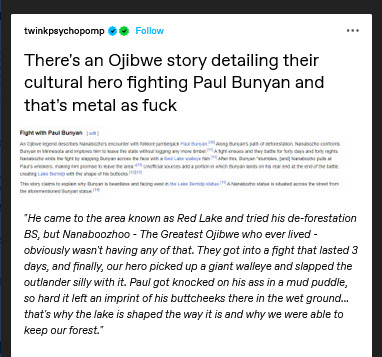
And I'd recommend checking out an essay by Kasey Keeler and Ryan Hellenbrand, published at Edge Effects in 2021.
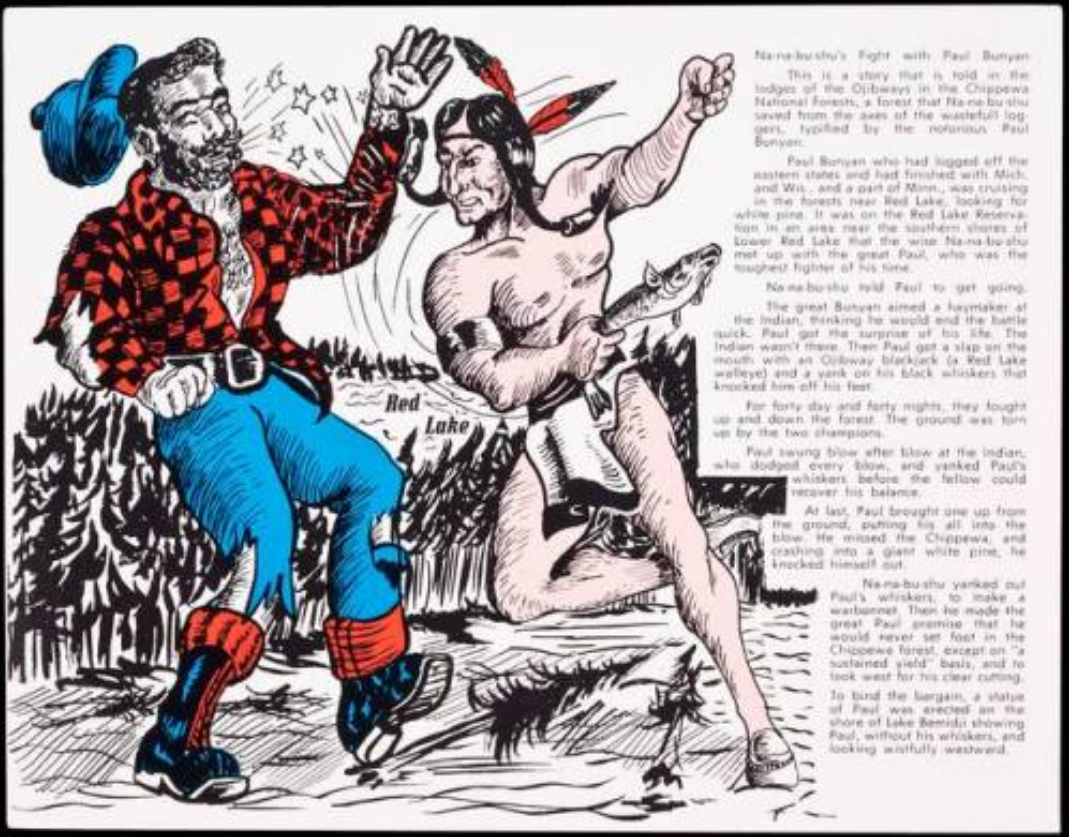
Aside from addressing the Ojibwe story about the Nanabozho fighting against logging (including an image of the encounter), they also describe Paul Bunyan’s entanglement with the transition from clear-cutting timber logging to the later advent of the US federal government’s “German-style” extraction and “sustained yield” management (an approach, like early twentieth-century “British forestry” style, which still pursues profit-oriented extraction). Basically, they recount/argue: Story-telling makes claims to landscapes. Nostalgia can be a powerful tool. Paul Bunyan stories became more widely known after 1914. A logging company which used Paul Bunyan in promotional marketing owned the land that would become Paul Bunyan State Forest and Chippewa National Forest (the first national forest established by act of Congress rather than presidential proclamation), which functioned as a “laboratory”.
All text (images and captions, too) below is excerpted from their article.
--
Excerpt:
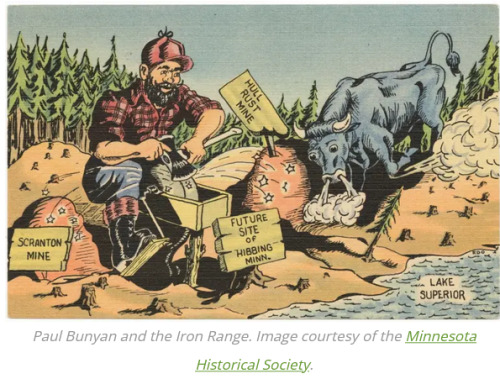
Across the Northwoods, a geography that spans the U.S.-Canada border, stories are used to make and claim space. […] Throughout northern Minnesota, legends of Paul Bunyan, the fictional giant lumberjack, have been used to claim space. […] Bunyan has been credited with creating Minnesota’s 10,000 lakes, the Mississippi River, and the Grand Canyon, while simultaneously logging millions of acres of forest. […] Together, we juxtapose the history of two forests - the Paul Bunyan State Forest and the Chippewa National Forest - to reveal how German settlement, logging, and forestry have contributed to placemaking narratives, and how […] nostalgia links past and present. Paul Bunyan’s literal and figurative imaginings advance American Indian erasure narratives, leading to the invisibility of these same communities today. […] The Northwoods have been popularized and imagined as America’s version of northern Europe. […] Across Minnesota, towns like New Ulm, New Munich, Heidelberg, and Luxemburg bear witness […]. More recently, Native scholars Michael Dockry and Christopher Caldwell have examined […] “the Menominee people’s profound sense of place and their intimate relationship with place.” […]
Ojibwe dispossession, well underway by the late nineteenth century, is not told in any Paul Bunyan story. […] The “heroic labor” of logging formed a significant portion of Great Lakes region economies […] on the heels of, and entangled with, Ojibwe dispossession. […] Formally established in 1908, the 1.6-million-acre Chippewa National Forest (CNF) lies nearly contiguous with the Leech Lake Reservation. […] [T]he CNF was the first national forest created “for the benefit of [American] Indian people.” […] In 1902 came the Morris Act. Authored by [a] Duluth congressman […], the act “created the first forest reserve established by congressional action rather than presidential proclamation.” The act established the 225,000-acre Minnesota Forest Reserve as a “compromise,” a way to tackle the “Indian problem” while allowing for timber harvest. Here, Ojibwe homelands became “a laboratory for the first comprehensive forest management plans undertaken by a federal agency.” In 1928, the forest was renamed the Chippewa National Forest, as it remains today.
While the Chippewa National Forest forces us to consider the many ways logging and forestry has usurped American Indian peoples’ access to land, the nearby Paul Bunyan State Forest encapsulates the material legacy of symbolic myth. […]
Officially recognized in 1935, the Paul Bunyan State Forest evolved from the site of the Red River Lumber Company sawmill. Founded in 1884, the Red River Lumber Company (RRLC) directly participated in and contributed to Ojibwe dispossession. By the end of the nineteenth century, he RRLC had purchased most of the land that comprises the present-day Pual Bunyan State Forest, milling millions of board feet of lumber at the company town of Akeley. […]
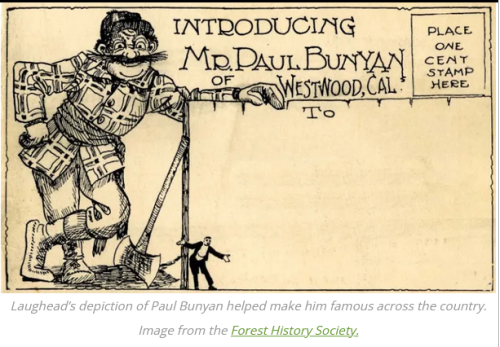
The expansion of RRLC to California precipitated another key move: using Paul Bunyan in their marketing. William B. Laughead (pronounced Log-head), advertising manager in 1914 and a logger himself, spun another Paul Bunyan tale for the promotional booklet “Introducing Mr. Paul Bunyan of Westwood, Cal,” which included Bunyan’s first pictorial representation. This marketing campaign relied on the new and growing nostalgia for the grand logging days in the Great Lakes to keep the transcontinental corporation rooted in place.
With logging long established throughout the Great Lakes region, the ecological damage was clear. To remedy this, in the mid-1930s (German) forestry was introduced to manage timber on a sustained yield base. This, then, is the irony of the Paul Bunyan State Forest: named for an American legends who is said to have literally cleared the path for settlement, forest management now proposes to maintain the integrity of the forest. […]
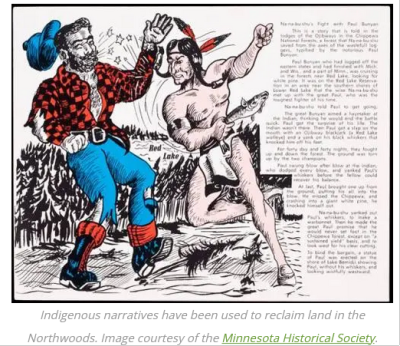
Though Paul Bunyan narratives dominate the landscape of the Northwoods, if we look closely we can see the ways Native people resist the legendary exploits. Indeed, a lesser-known Ojibwe oral story reminds us that the Anishinaabe people, their culture, and their histories will always prevail over dispossession and logging. In the story, Nanabozho, an Ojibwe trickster or cultural figure, confronts Paul Bunyan, who had already logged off most of the northeastern states before making his way to Minnesota. Nanabozho tells Paul to leave, to not log any more timber. A fight ensues, and […] Nanabozho swings a Red Lake walleye at Paul, knocking him off his feet. As Paul stumbles, Nanabozho pulls at Paul’s whiskers, making him promise to leave the area. This is why, today, Paul Bunyan does not have a beard and why he is facing west at the statue on Lake Bemidji, as he prepares to leave the region. This is also why we have the Chippewa National Forest, because Nanabozho and his Ojibwe kinsmen saved it from being logged. It is this contemporary narrative that highlights the complexity of Ojibwe storytelling […].
--
Images, captions, and text by: Kasey Keeler and Ryan Hellenbrand. “Paul Bunyan and Settler Nostalgia in the Northwoods.” Edge Effects. 2 December 2021. At: edgeeffects dot net/paul-bunyan-narratives/