Reading beyond colonial archives on the image of Bombay 'slums,' the racialization of urban labor, state disavowal, and histories of housing precarity: A look at Sheetahl Chhabria's scholarship

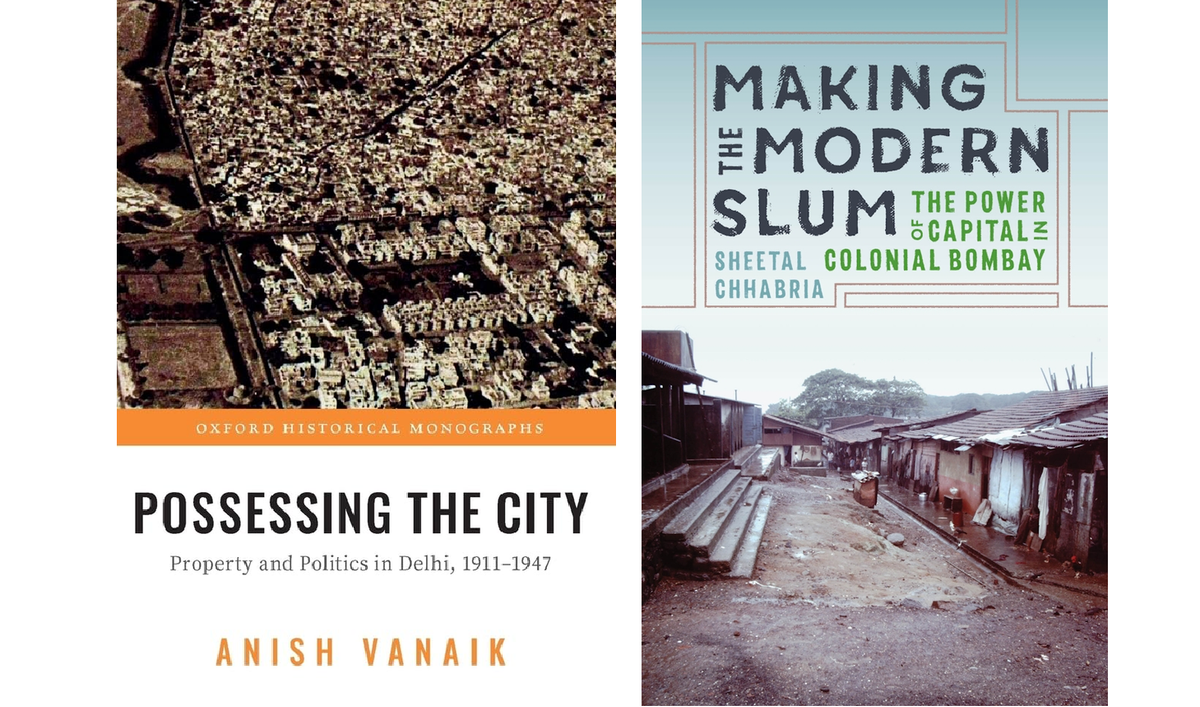
(Chhabria’s interview originally analyzed in a post elsewhere on 9 April 2023. Review of Chhabria’s book originally analyzed in a post elsewhere on 1 May 2023.)
I thought it’d be nice to consider Sheetal Chhabria’s own words alongside other scholars discussing her work. Anish Vanaik proposes that a similar process occurred in early twentieth-century Delhi; Vanaik also brings into the conversation Yahia Shawkat’s work on a comparable process in fin de siecle Egypt. In each case, racialization of labor entails racialization of space; state interest in maintaining exploitable pools of reserve labor saw the deployment of housing programs—even ostensibly subsidized/welfarist programs—as part of the reinforcement of these conditions of precarity/vulnerability.
—
Excerpt 1:
My [work] [...] traces the history of the emergence of the “slum” as a category of stigmatization in colonial Bombay, and locates it in broader histories of colonialism [...] in South Asia. [...] [E]verything counts, not just colonial archives. [...] These archival sources, like the rest of them, do not tell us the past, but mediate a reality for us. What does such an image tell us about how poverty relief changed over time in the subcontinent? In fact, by the late nineteenth century, a debate emerges among colonial officials as to whether the municipality should be doing poor relief at all, and wondering what to do about famine victims. If you took the British colonial archives and maps at face value, you would be missing a great deal. They should be read as documents meant to legitimize a regime. If one is not critical about archives, one falls into the tropes of those who wrote these archives. [...] Aside from Maharashtra state archives and Bombay municipal records, I also used native language biographies of the city. I found this tiny little book, something akin to a Lonely Planet guide from the time, for people who wanted to visit Bombay. By the early twentieth century, the city had become a character. The city--this abstract idea--was becoming what you were coming to visit, rather than its people. [...] In the 1860s, there is a Marathi biography of the city which actually deploys the tropes of an older colonial anthropology of Bombay from 1835. [...] I was [...] interested in the tension between on the one hand those colonial and native elites who wanted to turn the city into a place for revenue collection and commerce, and on the other the large majority of workers and migrants that shaped Bombay differently.
The question of tropes around urban development is always fodder in my mind, as I ask myself why certain representations of space become both so powerful and so contested in colonial India. The concern with the city in India is a relatively new one, as Gyan Prakash argued in a 2002 article on the “urban turn” in South Asian social sciences. The East India Company and the British Crown settled India primarily as an agrarian colony, with people stationed all across India to collect revenue. For long it was thought India was de-urbanized and peasantized, so the urban perspective was in the background. Tropes surrounding the tensions between the urban and the rural are at the heart of modernism broadly, and at the heart of India’s nationalist project. What we call “city space” is always associated with modernity, whereas all the rest is traditional. If you showed a map of Bombay to an urban planner, they would tell you certain parts of Bombay are more urban than others, and such qualifications would map onto caste separation. Low-caste areas would be seen as “not-fully-urban”, not city-like. [...] [T]he racialization of labor functions at the same time as the racialization of space. The internally-differentiated city comes to index a specific racialization of labor, in order to make it invisible.
Text above are the words of Sheetal Chhabria. As told to Ayan Meer. A transcript published as “The Archive Box #3: Building Colonial Capitalism in Bombay,” Global Urban History (11 December 2020). At: https :// globalurbanhistory. com/2020/12/11/ the-archive-box-3- building-colonial-capitalism-in-bombay/ [Emphasis mine.]
—
Sheetal Chhabria sets her finger on the core of a shared problem that her book Making the Modern Slum: The Power of Capital in Colonial Bombay, Yahia Shawkat’s Egypt’s Housing Crisis: Shaping the Urban Space and my own Possessing the City: Property and Politics in Delhi 1911-1947 are outlining. The settings and periods are diverse and the particular histories diverge. But, in each of our work, we point to both the commodification of shelter and the paradoxical histories of efforts to oppose or mitigate that commodification. […] The stubbornness with which mass housing initiatives are reinserted into commodity circuits is a key lesson in all three works. This despite a related phenomenon that Chhabria points to the sheer variety of ways in which housing has been used by the state to ‘manage populations’. Chhabria and Shawkat both refer, for instance, to moments in which housing has been utilized as a tool to ensure the immobilization of working populations. Much like in a prison, to use housing as a way to prevent or restrict the mobility of working people. Part of the reason for this is that Chhabria’s work on Bombay culminates at a point of unique labor mobility: the migration away from the city of much of Bombay’s mill labor force in the wake of the late nineteenth century plague epidemic. […] But it was also a project of housing in which luring workers back to the city and holding them there was an essential component. The Bombay Improvement Trust (BIT), whose trajectory from inception to failure Chhabria meticulously chronicles, bears the marks of exactly such an origin point. The BIT was in the final reckoning a mix of welfarism, state-subsidy for financial speculation, attempts to signal a more sanitary city and immobilising labour […]. In Shawkat’s Egypt too, both in the late nineteenth century and in the present, the ‘izba recurs as a form of housing designed to immobilize labor – converting peasants more fully into workers. […] The slum must also […] be an active source of a reserve army of labor. […] Here the establishment of a Delhi Improvement Trust (in 1937, nearly 40 years after the BIT) was initiated by a piece of bad press. […] The DIT’s major success was in […] (something that Chhabria points out happened in Bombay too) participating in a round of speculative development in the Delhi countryside. […] These and myriad other pathways have tended to return housing – even housing built at subsidized rates for the city’s working poor – to circuits of accumulation and profit.
Text above by: Anish Vanaik, “Housing and Commodification: Lessons from the Global South,” Borderlines [Series: “Shelter as Capital”] (18 February 2021). [Emphasis mine.]