Responding to messages: Histories of Arizona water diversion, Tohono O'odham demonstrations at the border fence, Quitobaquito, and the Yaqui catfish
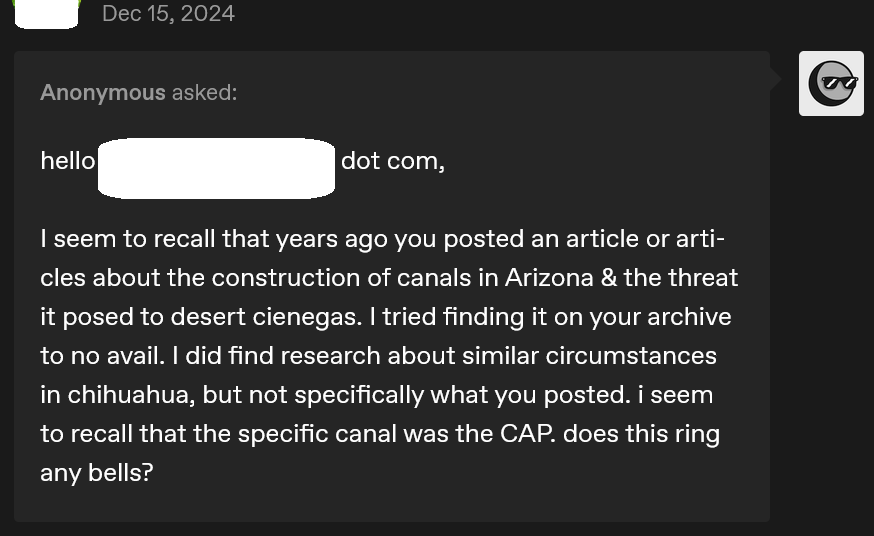
(Originally posted elsewhere on 15 December 2024.)
Thank you for tolerating me for such a long time. Glad you're here. And thank you for remembering the posts (from August 2020) about Cuatro Cienegas in the Chihuahuan Desert.
---
Thinking of Arizona specifically, what you described sounds similar to an August 2022 post about ephemeral intermittent streams of the Agua Fria and canals to service Prescott/Phoenix? (Briefly describes progression from early water diversion to grow alfalfa for cattle; then the damming of Agua Fria to make reservoir in 1930s; then the construction of 16 copper mines. Cites an article from Rachel Howard at Edge Effects: "The history of the Agua Fria can be read not so much as a warning but rather a symbol of what happens to small bodies of water in Arizona. This is the state of the five Cs: cotton, copper, cattle, citrus, and climate.")
---
From August 2020, might be thinking of this post about the unique endemic Yaqui catfish, an icon of the desert; post described the drying of cienegas (and how the fish is functionally extinct in the US) due to progression of cattle rangeland, farms, and canal diversion? (About how despite popular conception of the desert as dry, "prior to European colonization, the region supported rich waterways and aquatic communities." Post described how, by the 1880s, to service agriculture, "meandering cienegas" were strongly channelized and became deep-etched arroyos. And by 1960s, the pumping of water had meant most cienegas were gone. And by 2016 it was estimated that maybe only 30 of the fish remained in Arizona, a fish sometimes described as the "only catfish native to US west of the Rockies." Which also brings to mind, for me, the 2016 edition of Inland Fishes of the Greater Southwest: Chronicles of a Vanishing Biota from University of Arizona Press.)
---
Also sounds similar to this post from July 2020? That one was about cienegas in Arizona, specifically the corridor of riparian habitat (cottonwood, mesquite, etc.) along the San Pedro. Post made criticism of Arizona agencies which managed surface water and groundwater separately despite their physical/ecological interconnectivity. Post made mention of Arizona eryngo (Eryngium sparganophyllum), which only survives at three-ish sites specifically at cienegas within borders of Arizona and one site in New Mexico; couple of years after that post, the US federal government formally recognized it as endangered.
---
But in 2020, I also made a series of several posts about Quitobaquito Springs (at Arizona-Mexico border, in the Sonoran Desert) and Indigenous efforts to protect it? (The springs are a rare freshwater ecosystem at Organ Pipe Cactus area. US border wall construction was extracting and pumping vast amounts of water every day. In 2020, major demonstrations were held by Akimel O'odha, Tohono O'odham, and Hia-Ced O'odham. Brings to mind how, in the same area in 2019, Indigenous people brought more widespread attention to how a major global surveillance tech company collaborated with US border security agencies to field-test new a surveillance "command and control center" on Tohono O'odham communities, like a laboratory; the "virtual wall" functions with multiple towers which continuously surveil personal devices, sound, physical movement, etc. In those posts, I also mentioned that the springs at Quitobaquito are also pretty much the only home within US borders to the endangered Sonoyta mud turtle and endangered Sonoyta pupfish. The entire subspecies/lineage of the turtle only lives in maybe 5 sites total.)
---
Somewhat related, also made many posts from 2019 to 2023 about Indigenous protection of Oak Flat Chi-chil Bildagoteel in Arizona?
Regarding more recent irrigation and water loss in Arizona, I've posted about Natalie Koch's work in Arid Empire on the impact of diverting water for alfalfa farms and how current Arizona agencies facilitate the "colonial technologies" and market "the desert as a narrative resource"; she also describes how, in 1940s/1950s, the US State Department had a hand in encouraging international petroleum investors to invest in hundreds of thousands of cattle for dairy farms, a network which still influences much water diversion today. Aside from the Sonoyta mud turtle, also brings to mind threatened amphibians in Arizona related to cienegas, like Sonoran tiger salamander (likes permanent or standing water, estimated to survive in about 50 ponds in Cochise and Santa Cruz counties) and Chiricahua leopard frog (also likes the standing water, which is often diverted for agriculture or overtaken by non-native bullfrogs, estimated to survive in maybe 80 to 100 ponds). (Vaguely related but fun: There were a couple of long effort-posts I did about historical distribution range of American crocodiles in mangroves and coastal marshes on far southern edge of the Sonoran Desert general ecoregion before lower Yaqui river was depleted by agriculture.)
---
Shout-out to Cuatro Cienegas in the Chihuahuan Desert.
An oasis. A "bacterial lost world." About 300 pools. More than 90% dried-up in historic record; agricultural canals drain tens of millions of gallons of water a year. Home to 38-ish endemic animal species. Not one, not two, but three endemic species of turtles: A slider, a softshell (I love softshells), and the planet's only "aquatic" species of box turtle (I also love box turtles). Home to some of planet's only terrestrial or freshwater populations of stromatolites (bacterial mats composing structures reminiscent of Precambrian era; usually found in deep-sea hydrothermal vents, but here have been isolated from the sea for millions of years). Also home to some of planet's highest diversity of Archaea (taxonomic order of lifeforms potentially "older than bacteria"?).