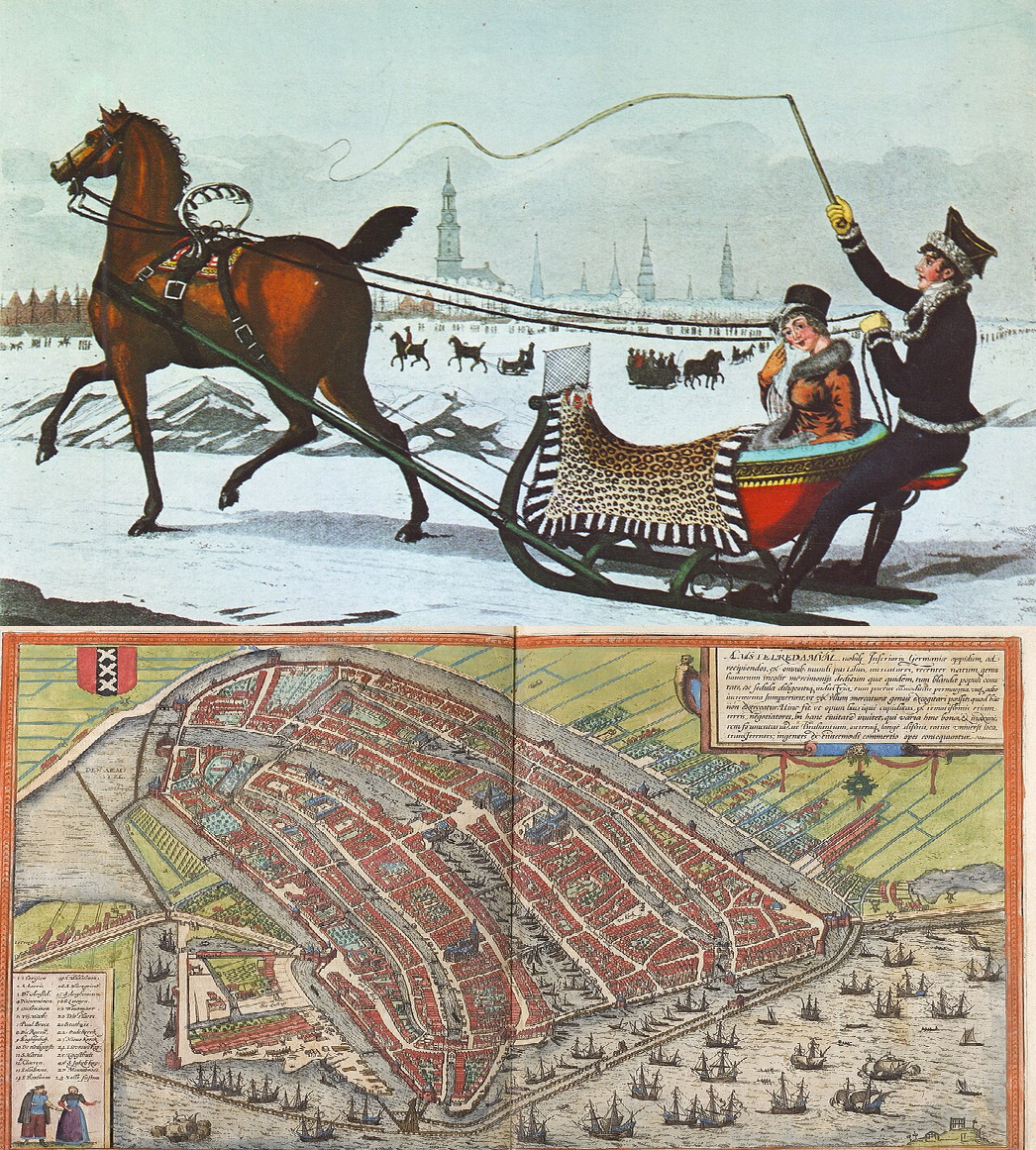
Santa's sleigh, the 'colonization of the urban night,' vehicularization, and 'multiple modernities': Amsterdam's streets and pedestrians in an early expression of industrialization

Work acquaintance, ostensibly as a joke about me and my interests, asked if I had any educational reading recommendations about “Santa’s sleigh”
So, to pass the time, thought we’d have a dialogue about the history of urban vehicularization, pedestrian encounters with vehicles, and control of space and mobility, through the “vehicle” (pun intended) of a case study of carriages and sleighs in eighteenth-century Amsterdam.
---
And none of this is to be taken quite seriously, I’m just saying words recreationally. (Early-modern metropole of Europe not my wheelhouse. Please defer to other proper specialists in this area who, I’m sure, could clinically dismantle the bullshit that follows—which is, again, mere “thoughts I had at work.”)
For all excerpts and arguments here, by the way, see: Bob Pierik. “Coaches, Sleighs, and Speed in the Street: “Vehicularization” in Early Modern Amsterdam.” Journal of Urban History, Volume 50, Issue 4. First published online 2 September 2022. All of this research was done by Pierik.
But Amsterdam is important in the history of urban space. It was the site of early speed limit regulations for vehicles: In 1681, a bylaw limited vehicle speed to walking pace (stapvoets), and a 1696 deposition describes the servants of a sheriff stopping a driver for driving too fast. By the 1770s, the sleigh-man’s guild had 285 sleigh-men active year-round, not counting unregistered personal sleighs, or those who used sleighs over snow in winter.
The (partially colonialism-fueled, partially and quite literally peat-fueled) expansion of the city’s infrastructure (in the context of peat use, Dutch management of maritime trade, and East India Company profits/shenanigans) allowed sudden, dramatic architectural expansion, though there was uneven adoption of new transportation methods of wheeled vehicles in newly-built edges of the urban area (where textile factories were situated) while maintaining the architecture of the dense streets of the medieval city core, so that sleighs and carriages existed side-by-side in a way that was distinct from the streets of Paris and London.
In 1790, visiting German scientist Georg Forster described Amsterdam as such: “The whole day long, a continuous thunderous roaring dominates. The manifold carriages of mayors, councilors, state officials, directors of the East India Company, physicians and the lavishly rich, the unremitting transport of goods [...] obstruct the way of passage and cause a constant yelling and rumbling [...].”
But historian/scholar Bob Pierik (in an article that opens with Forster’s lamentation) describes how Amsterdam was an early site of “vehicularization” and related street regulations, and he finds this notable and worth considering because it anticipated and predated the more famous and more widely discussed urban regulations and policing of properly-industrialized nineteenth-century London, which allows us to perhaps rethink the historiography and “teleological narrative” of modernity.
Since vehicles, pedestrians, and their attendant regulations were experimented with in the Dutch metropole decades before the mechanized transportation and “politics of paving” in Victorian Britain, there were what Pierik calls “multiple modernities” existing simultaneously in the streets of early modern Amsterdam (a “proper metropolis” at that time).
---
Evidently, “sleighs had been an important part of street life in Amsterdam long before coaches and chaises.” Indeed, Pierik invokes the observation of English author Samuel Ireland from 1789, describing a visit to Amsterdam: “[C]arriages with wheels, except for the use of the nobility and gentry, were not suffered here for many years […]. A sleigh, as the Dutch term it (the French a traineau or pot de chambre) is now in use: it is the body of a coach, without wheels […].”
And guess what? They dragged those sleighs over pavement. No wheels, but only “an oily cloth (a smeerlap) was used to smoothen the passage.”
A piece of rhyming graffiti, written on a wagon, and collected by Hieronymus Sweerts between 1683 and 1690, reads:
Who drives fast make a quick start
But easily loses their horse and cart
Careful and sen-
Sible is a good carriage man.
Along with sleighs for transporting goods and products, there were sleighs for personal transport: a toeslee (closed sleigh) and koetsslee (coach sleigh).
---
And what of the pedestrian? Early on, at least in the Netherlands, vehicles were perceived as dangerous to pedestrians, and it could apparently be seen as arrogant to flaunt aristocratic wealth by gallivanting around in an expensive personal carriage in the city center, and so regulations and public opinion seem to indicate that pedestrian right-of-way was prioritized. An Amsterdam bylaw from 1528 indicated that drivers of sleighs could not sit upon their vehicle but had to walk beside it, because:
“[D]riving caused great disorder, often mixed with malice, as people, specifically women and children, are at great danger of being driven over.”
An important city bylaw in 1634 banned the use of coaches within city walls. But the prohibition was gradually loosened, such that conflict between coach-drivers and pedestrians was frequently mentioned in depositions. But by the 1730s, something had changed. In Pierik’s words:
Pedestrians now shared space with vehicles and had a new responsibility to protect themselves […]. [T]he language used in Bicker’s chronicle is very telling: In 1734, exactly a century after the vehicle ban, he wrote of a coachman who “had the misfortune of driving over a poor woman who died shortly thereafter.” Here, rather than the “women and children first” rhetoric that we have seen in the sixteenth-century regulations on the sleigh-men in the previous section, the coachman was also presented as a victim, and the right of the coach’s presence on the streets remained undisputed. Similarly, in 1746, Bicker Raije wrote of a nine- or ten-year-old boy who was “negligently watching around him” moments before he was killed by a sleigh horse.
The trend continued, and in the nineteenth century, British authorities would notoriously enact sweeping policies to control mobility in and access to urban space, in ways that prioritized “economic” activity while reinforcing class hierarchies. In fact, Pierik sees this vehicularization of the early modern city as “at once a civilizing and a colonizing project” in the same vein as what Koslofsky described as “nocturnalization,” or the way in which, in London and Paris, “the elites of the court and the city colonized the urban night” with their affordance of transportation and a mobility not always shared with those lower in the hierarchies.
---
We are, of course, reminded of another aristocratic figure who, traveling through the night, engaged in this civilizing mission of nocturnalization, and who colonized public space with their vehicle. Someone who, like the early modern vehicle regulations of Amsterdam, is associated with Dutch tradition. Someone whose persona is closely connected to mobility, even hyper-mobility, drawn forth by their sleigh:
Santa Claus.
—
Anyway.
Bonus round notes (an appendix? an addendum?):
Contemplating this subject during last year’s “holiday season,” I was biking to retail wage-labor work through something like a commercial district on Black Friday (pains me to capitalize that, but I do so not to revere it, but instead to acknowledge the scale of its profanity). The kind of vehicle-prioritizing environment whereupon they blame you for your own negligence when you get run-over by a pickup truck with a "We the People" bumper decal, the kind whose drivers might like to aggressively roll coal on the perceived-effeminate pedestrian—like me.
Coal and peat, then, were on my mind.
Is part of Amsterdam’s urban/architectural density of the eighteenth century inescapably attributable to peat and its affordances (the cascading effects it had on canal shipments and originating exchange circuits with those living up the Rhine; like Dutch soon-to-be-mariner experts practicing methods and honing their trade locally). Did peat-use and the Canal Boom allow Amsterdam to take a liking to commercial transportation? Did peat industry bolster the metropolitan consortia and banking/lending people (who would go on to manage tropical investment)? Did peat-use among urban residents in both residential (cooking, heating, hobbies) and industrial (spirits, sugar, ceramics) contribute to architectural density of Amsterdam? (Domesticity and urban leisure/shopping: Another Christmas-themed reference?) What about sugar? While trying to avoid over-crediting maritime shipping with the Dutch Golden Age (also painful to capitalize, but done so to acknowledge the profanity), still worth (maybe?) acknowledging that Amsterdam by 1660 was the leading sugar-refinery capital of metropolitan Europe, hosting more than 50 of the 65-ish refineries in Holland. (They refined sugar from plantations in the Caribbean/Brazil, often brought to Amsterdam by Portuguese ships. Amsterdam made more money selling sugar—and, eventually, coffee—to “consumer frontiers” of Germans up the Rhine. It’s that context—the eventual shipment of Latin American-harvested coffee up the Rhine—which historian Tamira Combrink as “the hinterlands of slavery,” but that’s another tangent.)
In any case, does this corroborate Pierik’s proposal that, by the eighteenth century, Amsterdam was on track to “grow” in ways distinct from the “classic” model of industrialization in London (and to some extent, Paris)?
Again, not my wheelhouse! Please defer.
Anyway, here’s a curious tribute to peat and a turn-of-phrase comparing Dutch canals/rivers to the Nile, from 1874, featuring typical late-nineteenth-century nostalgia for classical antiquity:
Mr Richardson began by alluding to the general use of peat instead of coal in Holland—in hotels, in the kettle-warmers placed beside each party of tourists at breakfast-time; in churches, in the feet-warmers used by the ladies of the congregation; and in the kitchens of hotels and houses of the best class. [...] In these countries, as also in Holland, the people are compelled to use peat instead of coal, because of the scarcity of the latter; Mr Richardson referring to the fact that Holland is but the alluvial delta of the Rhine, of which it is the gift, as Egypt was said to be of the Nile.
From: Ralph Richardson, “Notes on the Dutch peat industry,” Transactions of the Edinburgh Geological Society, Vol. 2 (1874), pages 276-282.
(”Have you all checked-out this article?!” she asks, and it’s an article from the 1874 volume of Transactions of the Edingburgh Geological Society.)
Is cheap mobility of Dutch peat-fuel from its extraction source (via the canals), similar also to later British railways (shipping coal from northern England, shipping timber from interior South Asia, etc.)? Cute that British railways were not merely carrying coal for urban consumption, but the locomotives themselves were fueled by coal.
Joke pending: Some kind of pun about Christmas and coal.
Something like: “Santa putting peat in your stocking”?