Necropolitics and scripting empire: The great locust swarm (1874), the California children's war on squirrels (1918), and the lessons of early-20th-century world-conquering board games

There’s necropolitcs.
And then there’s necropolitcs.
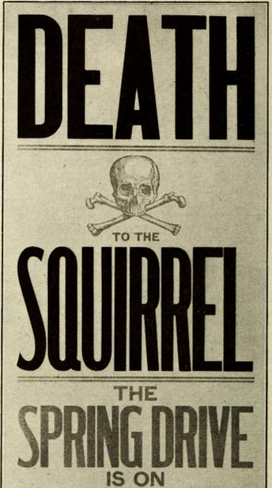
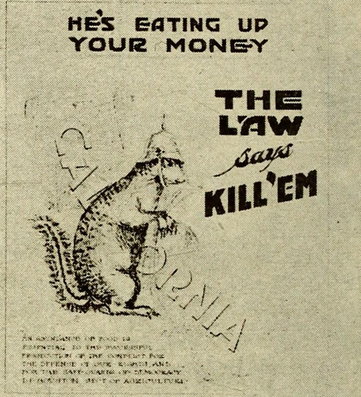
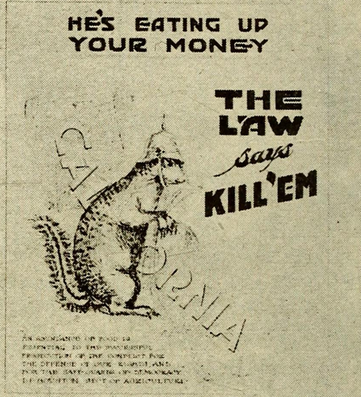
(Pages 176 and180, respectively, from: The Monthly Bulleting of the California State Commission of Horticulture, vol. VII, nos. 11-12, November-December 1918. URL: https://archive.org/details/californiaground00cali/page/n4/mode/1up)
What’s up with that? How about an antecedent:
For roughly ten days in July 1874, millions and millions (estimates have posited 12.5 trillion) of airborne Rocky Mountain locusts (Melanoplus spretus) swarmed the skies across (potentially) 198,000 square miles of the temperate Great Plains. Print media from the most densely populated areas affected are best represented from Kansas, Nebraska, Iowa, and western Minnesota. Reports claimed that these congregating grasshoppers (and the bodies of those which had died) had amassed in such quantity that they allegedly stopped a Union Pacific train at Stevenson station near Kearney, Nebraska. When chickens and turkeys consumed grasshopper bodies, historian Alexandra Wagner relays, “the digested insects tainted meat and eggs with reddish-brown oil.” Agricultural may have, in the statistics cited by Wagner, affected 74 percent of the total value of US farm products in 1874. Thousands (according to federal observers sent to survey the disaster) were at risk of starving in the following winter. This was also in the immediate aftermath of the Panic of 1873 and resulting Long Depression.
Wagner’s study addressed the influence of shifting paradigms of the “un/deserving poor,” poverty, and disaster relief; masculine representation and nationalist appeals in the marketing of frontier settlement in the aftermath; the curious timing of the recent Chicago Fire of 1871 and its influence on the rhetoric of solicitations for aid; and the early consolidation of a trans-border cooperative ethos among administrators of Plains states in the US who, in hopes of mitigating future similar disasters, convened conferences with each other and with Canadian provincial authorities. All worth checking out. However, it’s the “grasshopper army” that comes to mind in this context. See: Alexandra M. Wagner, “Grasshoppered: America’s Response to the 1874 Rocky Mountain Locust Invasion,” Nebraska History 89 (2008), pp. 154-167.
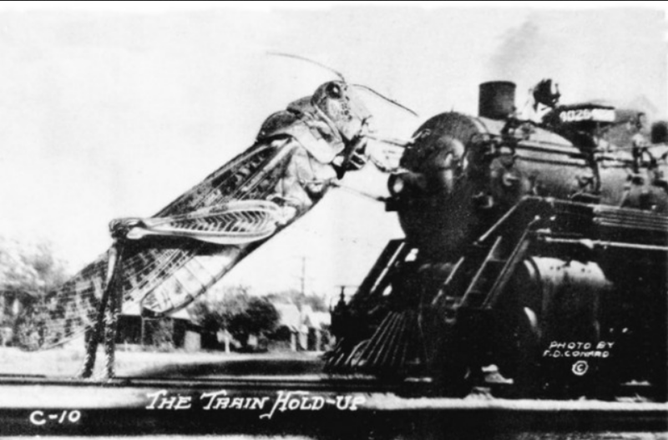
(“The Train Hold-Up.” Postcard from the 1870s.)
In 1877, Governor Penington of Dakota Territory declared May 4th a day of “humiliation, fasting, and prayer” to fight the bugs by ordering fields burned; he also ordered banks/schools/businesses to close to allow participation (because of an unexpected early-season grasshopper egg-laying hatch when a warm spring created local microhabitat for the bugs, suggesting wide/significant social consequences wrought from local/isolated quirks of ecology).
April 26th was declared a similar day of “fasting and prayer” by Governor Pilsbury of Minnesota. (By the way, he was an heir of the agriculturalist pseudo-nobility—the Pilsbury family—from which we now get corporate Pilsbury dessert products.)
That same year, the Nebraska Legislature issued a regulation encouraging a “grasshopper army” to fight the “public enemy” (the locusts), mandating that all men ages 16-60 perform two days’ manual labor killing insects or else face $10 non-compliance fine.
Did this army secure victory?
Maybe. After all, the Rocky Mountain locust was entirely extinct less than thirty years later. From 12.5 trillion to zero. (See Wyoming-based ecologist Jeffrey Lockwood’s recovery of partially-preserved locust bodies from Wind River Range glaciers and his research on locust extinction.)
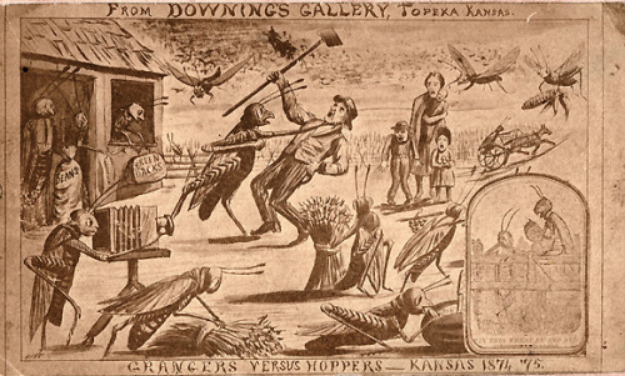
From historian Rohan Deb Roy’s analysis of anti-termite sentiments in British natural history literature demonizing South Asian arthropods in the 1870s to the legacy of the US Army Corps of Engineers’ anti-mosquito campaigns in the Caribbean in the first decades of the twentieth century, insects were a regular target of ire in an era marked jointly by ascendant tropical medicine research and the simultaneous proliferation of industrial-scale monoculture crops in the global tropics installed by colonial benefactors.
The conscription of the citizen-subject into an impromptu army to eradicate animal villains would be repeated again in the US. But distinguishing Nebraska’s grasshopper-slayers from California’s squirrel-killers, the California case presents an escalation: A vertebrate mammal was targeted for elimination.
The safeguarding of “natural wealth” against ground squirrels in 1918 took place amidst a wider cultural climate of discourses about contagion and invasion converging in California at that time.
Landscape management in California, from its inception as bureaucratic practice under the auspices of the US, had its eye on extraction potential. The 1848 gold rush and subsequent forging of what geographer Gray Brechin called the “imperial city” of San Francisco is a clear example. Following the earthquake of 1906 which devastated San Francisco, the remaking of urban space allowed opportunities for administrators to implement public health reforms from scratch, targeting pests of a smaller kind: viruses and bacteria. By about 1910, the consolidation of industrial agriculture in the Central Valley was—as perceived by industrialists—under potential threat of contamination by the importation of blights, fungi, and insect pests inadvertently transported across the Pacific by the vessels carrying Asian cultivars. With the launching of the Mexican Revolution in 1910, anxieties of contamination from beyond California borders abounded.
Examining the association of early conservationists with the blossoming eugenicist movement of early-twentieth century California, historian Alexandra Minna Stern identifies themes of invasion and pestilence amidst the direct relationship between aficionados of natural history and promoters of race science:
[T]he Immigration Section turned its attention to the "Mexican problem" when [...] Holmes and the Sacramento realtor Charles M. Goethe began to press for a [racial] quota [...]. A zoologist by training, Holmes taught eugenics at the University of California, produced a family pedigree inventory of Berkeley undergraduates, and espoused the idea of monetary incentive for white female students [...] to produce more children. In an article titled "Perils of the Mexican Invasion," Holmes assailed Mexicans as mentally [defective], and wildly procreative carriers of plague [...]. Goethe, who established the Eugenics Society of Northern California (ESNC), enabled Stephen Mather, the inaugural director of the National Park Service, to launch the interpretive parks program in Yosemite in 1920 and gave more than $2 million to the Save-the-Redwoods League for memorial groves [...].
Stern also reminds us of the simultaneous invocation of nature-affinity and “inherent” criminality in the worldview of “founder of modern American policing” August Vollmer, the first chief of police of the city of Berkeley and the founder of UC Berkeley’s School of Criminology:
He was also keen on intelligence testing, which he thought could both accurately identify feebleminded and delinquent adolescents [...]. When he was elected to the park board in 1934, Vollmer brought his ideas about hereditary potentialities to bear [...]. These concerns [...] underpinned the construction of Tilden Park. So too did Vollmer's scientific and biological approaches to criminality [...]. Vollmer declared that [...] [t]he provision of nature areas [...] would stimulate health and diminish crime: "Delinquency thrives where there is no supervised recreation."
Well, those potentially “delinquent” kids were in luck, I guess. What better recreation than joining the volunteer squirrel army?
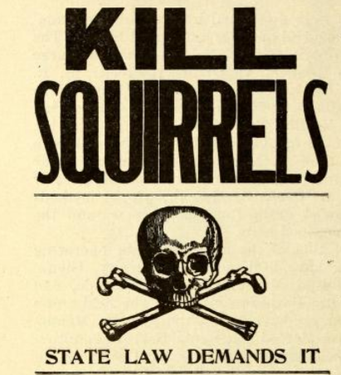
(Page 188 from: from: The Monthly Bulleting of the California State Commission of Horticulture, vol. VII, nos. 11-12, November-December 1918. URL: https://archive.org/details/californiaground00cali/page/n4/mode/1up)
As far as I can tell (admittedly, I’m not the best source here!), the most high-profile recounting of that story was submitted to Atlas Obscura by Dave Gilson, a Bay Area-writer and once a deputy editor at Mother Jones.
The following excerpts are from: Dave Gilson, “In 1918, California Drafted Children Into a War On Squirrels,” Atlas Obscura, 29 November 2016.
Gilson acknowledges the apparent scale 1918 drafting of children into this campaign:
“We have enemies here at home more destructive, perhaps, than some of the enemies our boys are fighting in the trenches,” state horticulture commissioner George H. Hecke warned in an impassioned call-up for “School Soldiers.” This children’s crusade was part of Squirrel Week, a seven-day frenzy […]. California set aside $40,000 from its emergency wartime funds for the campaign, which included an anti-squirrel publicity blitz: the state printed up 34,000 posters and distributed 500,000 leaflets. […] The pamphlet included a recipe for strychnine-laced grain as well as suggestions for other extermination methods, such as shooting, drowning, and poison gas. […] California’s war on squirrels was framed as an extension of United States’ declaration of war on Germany a year earlier. Part of this was practical: Future president Herbert Hoover, then the United States Food Administrator, offered his “hearty approval” […]. By the time Squirrel Week ended on May 4, children across the state had turned in 104,509 tails, though this was thought to represent a fraction of the total casualties.
The figure of the non-USian Other was vilified:
In the corners of the “Kill the Squirrels” cartoon, two members of the squirrel army stood at attention, wearing Pickelhauben -- the distinctive spiked helmets of the German army. Another Squirrel Week poster showed a Teutonic squirrel family wearing spiked helmets [...]. The father squirrel sported an oddly upturned mustache -- just like Kaiser Wilhelm’s.
Though it’s the rhetoric of violence, militarism, and extermination which really affects me here:
An article about Squirrel Week in the Lompoc Journal took the martial theme and ran with it, hailing the “growing army” amassing “casualties” in “initial engagements” against the enemy. “All the killing devices of modern warfare will be used in the effort to annihilate the squirrel army, including gas,” it continued. “Don’t wait to be drafted.” […] The campaign also enlisted the help of Four-Minute Men -- volunteers who delivered short speeches to rally public support for the war effort. Anti-squirrel talking points were issued so they might convince farmers and ranchers to go out and kill the “little ally of the [K]aiser”: The BEST squirrel is the dead squirrel. [...] He preys on our crops in countless hordes. He fills the ranks of the killed in true military fashion. [...] Why hesitate? We can get ‘em. How? Poison ‘em, gas ‘em, drown ‘em, shoot ‘em, trap ‘em, submarine ‘em. […] Are you not willing to give your whole-hearted support to this state-wide movement to KILL THE SQUIRREL?
The way Gilson recounts the events, this normalization, among children, of killing has staying power:
Even after the contest ended, the Commission of Horticulture reported that kids’ enthusiasm for killing squirrels continued for “an indefinite period.” During an anti-squirrel campaign in Lassen County later in the year, one girl brought in 3,780 tails; a boy brought in 3,770.
An appendix (?). A companion piece (?).
When I was about eleven years old, the city where I lived was gentrifying my neighborhood. There was an “empty lot” which was actually more like remnant prairie. Prickly-pear, rattlesnakes, toads, meadowlarks. Soon to be replaced with pesticide-lade, manicured lawns. . It was being turned into cookie-cutter prefashioned homes. Of all the creatures, ground squirrels were most conspicuous. The technical species was Richardson’s ground squirrels. But people called them “whistle-pigs.” From their lawn chairs, while sometimes laughing, people would fire BB guns at the creatures. Mere entertainment.
Casual violence. Like skipping stones or playing a board game.
I’d recently been contemplating this thing from the Budapest Municipal Photography Company archive:
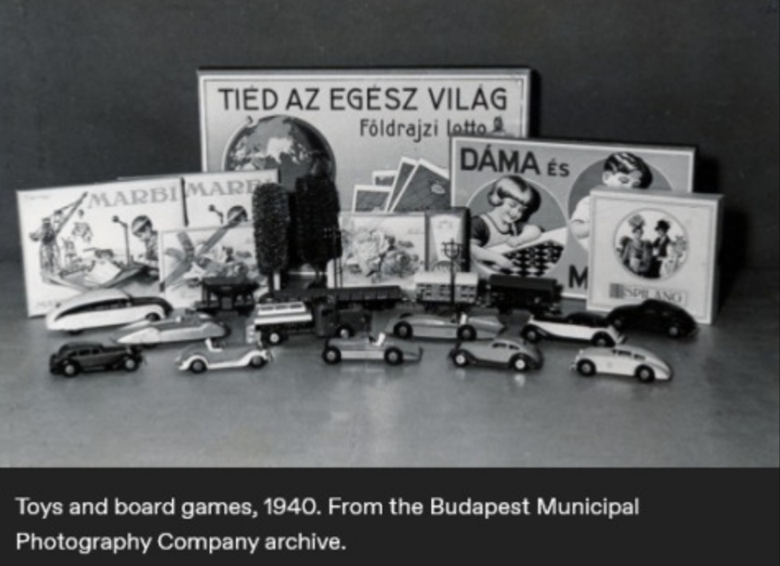
The caption (applied by an acquaintance who located it in the archive) reads: “Toys and board games, 1940.” And I think that the text on the gameboard box in the back says something like “the whole world is yours” (maybe).
And I was struck, because I’d also recently gone looking through other archives looking for geography-themed material marketed for children or as leisure activity in the late nineteenth and early twentieth-centuries (in the US/Europe). I was drawn to two other pieces that I wanted to consider in tandem:
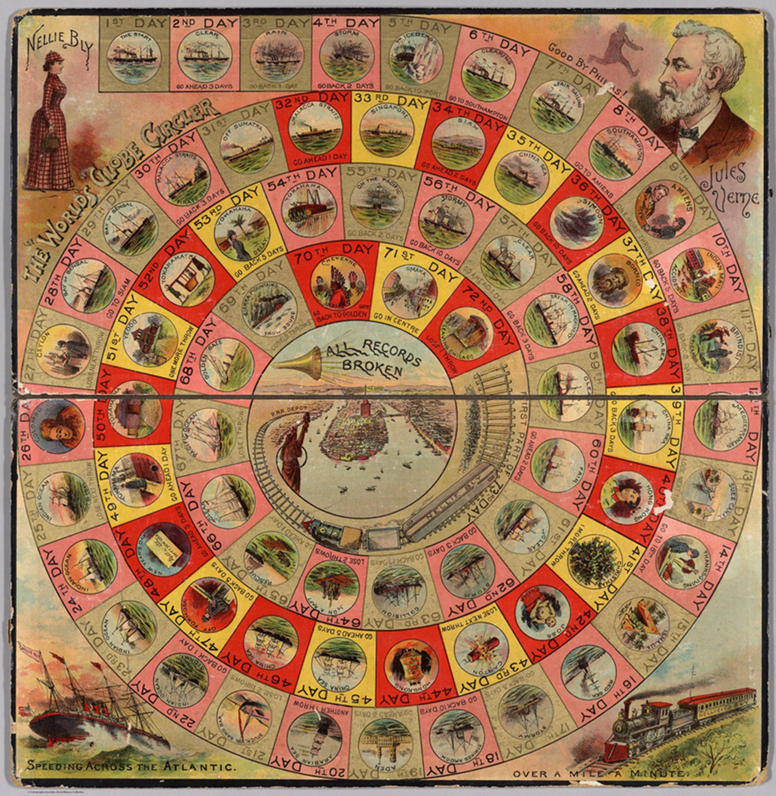
“World’s globe circler” is an English-language lithographed game board produced in New York in 1890. (The height is 41 centimeters; width is 40 centimeters.) The game board memorializes the real-world travels—between 1899 and 1890—of journalist Nellie Bly, who was attempting to emulate the journey of the character Phileas Fogg in Jules Verne’s Around the World in Eighty Dyas (1872). Here, a representation of Jules Verne can be seen on the board.
The second gameboard I’d been thinking about:
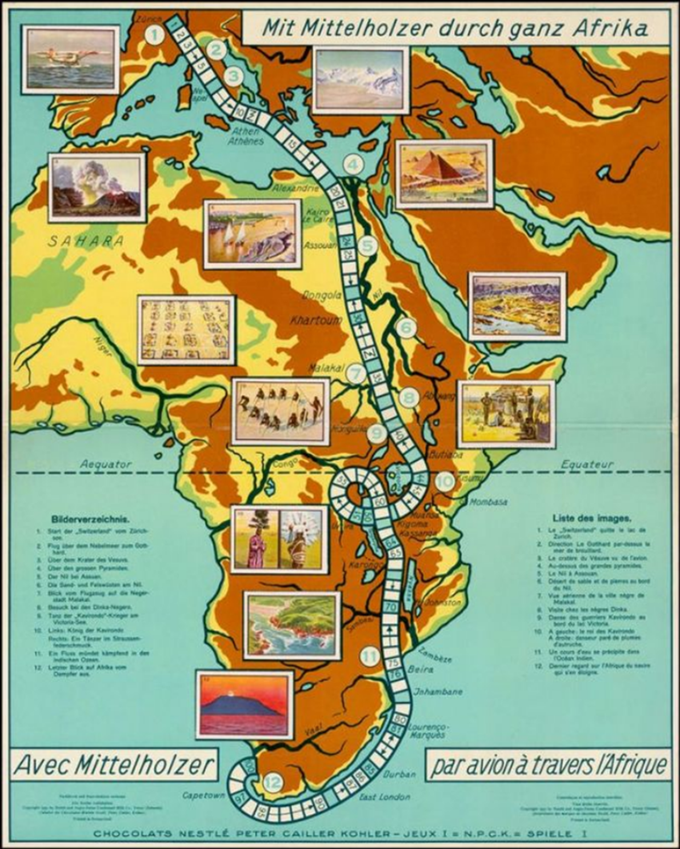
Mit Mittelholzer durch ganz Afrika. Avec Mittelholzer par avio a travers (Walter Mittelholzer’s flight over Africa) is a game board produced in Switzerland in 1931. Dimensions are 20 by 16 inches. (Take a look at the de facto sponsorship or tie-in for Nestle printed at the bottom of the board. Consider the role that Nestle’s corporation would come to play in cacao plantations in the following decades.)
While the US of the 1890s and the Swiss-German world(s) of the Weimar era are certainly constitutive of very different spatial and cultural settings, there’s potentially stuff in common here.
(Switzerland, in 1896, infamously hosted a “human zoo” to display living African peoples as curiosities and entertainment for the metropolitan public. In Geneva that year, the Swiss Second National Exhibition put two hundred Senegalese on display at the “Village noir” exhibit, where they inhabited a “mock village” in the central square, Plaine de Plainpalais. This might be important context for a Swiss game board dramatizing surveying and “adventuring” in Africa.)
Each uses the format of a “fun” game, ostensibly enticing to children. Each arguably mediates for those children an awareness of geography and the global scope of their nation-state’s operations.
Titles I’ve seen (though not read) referring to the German context:
- Patricia Anne Simpson, The Play World: Toys, Texts, and the Transatlantic German Childhood (2020)
- Jeffrey Bowersox, "Exotic Education: Writing Empire for German Boys and Girls, 1884-1914,” in German Colonialism and National Identity, edited by Perraudin and Zimmerer, 2017)
- David Ciarlo, "Mass-Marketing the Empire: Colonial Fantasies and Advertising Visions,” in German Colonialism in a Global Age, edited by Naranch and Eley (2014).
- David Ciarlo, Advertising Empire: Race and Visual Culture in Imperial Germany (2011).
- Heike Hoffman, “Educating Modernism: A Trade-Specific Portrait of the German Toy Industry in the Developing Mass-Market Society,” PhD dissertation at Tubingen (2000).
I’ve not the energy to inadequately paraphrase her, so I’ll just excerpt in full the words of Mahshid Mayar (scholar of transnational American studies, “archival silences,” and histories of childhood and children’s perception of race/empire). Here, in an interview with the LA Review of Books, she’s referring to her text Citizens and Rulers of the World: The American Child and the Cartographic Pedagogies of Empire (2022).
Growing up at the turn of the 20th century, for many American children, also meant learning to view the world through the lens of "home geography." [...] [T]hey inevitably responded to the transnational whims of an empire that had stretched its dominion across the globe [recent forays into Panama, Cuba, Hawai'i, the Philippines] [...]. [W]hite, well-to-do, literate American children [...] learned how to identify and imagine “homes” on the map of the world. [...] [T]he cognitive maps children developed, to which we have access through the scant archival records they left behind (i.e., geographical puzzles they designed and printed in juvenile periodicals) [...] mixed nativism and the logic of colonization with playful, appropriative scalar confusion, and an intimate, often unquestioned sense of belonging to the global expanse of an empire [...]. Dissected maps - that is, maps mounted on cardboard or wood and then cut into smaller pieces that children were to put back together - are a generative example of the ways imperial pedagogy [...] found its place outside formal education, in children's lives outside the classroom. [...] [W]ell before having been adopted as playthings in the United States, dissected maps had been designed to entertain and teach the children of King George III about the global spatial affairs of the British Empire. […] [J]uvenile periodicals of the time printed child-made geographical puzzles [...]. [I]t was their assumption that "(un)charted," non-American spaces (both inside and outside the national borders) sought legibility as potential homes, [...] and that, if they did not do so, they were bound to recede into ruin/"savagery," meaning that it would become the colonizers' responsibility/burden to "restore" them [...]. [E]mpires learn from and owe to childhood in their attempts at survival and growth over generations [...]. [These] "multigenerational power constellations" [...] survived, by making accessible pedagogical scripts that children of the white and wealthy could learn from and appropriate as times changed [...].
[Words of Mashid Mayar, as transcribed in an interview conducted, transcribed, and published by M. Buna. "Children's Maps of the American Empire: A Conversation with Mashid Mayar,” LA Review of Books, 11 July 2022.]
Two others from her:
Mahshid Mayar, "From Tools to Toys: American Dissected Maps and Geographic Knowledge at the Turn of the Twentieth Century,” in Knowledge Landscapes North America, edited by Kloeckner et al. (2016).
Mahshid Mayar, "What on Earth! Slated Globes, School Geography and Imperial Pedagogy,” European Journal of American Studies, vol.16, no. 3, (2020).
Scripts:
Perceiving the world as playground and possession.
Adopting language of invasion and eradication.
Killing squirrels.
-
Children watch, and children learn, and children practice.
Things perpetuate.