Responding to messages: Resources on 'police horses' and histories of land/racial bordering

(Originally posted elsewhere on 19 March 2025.)
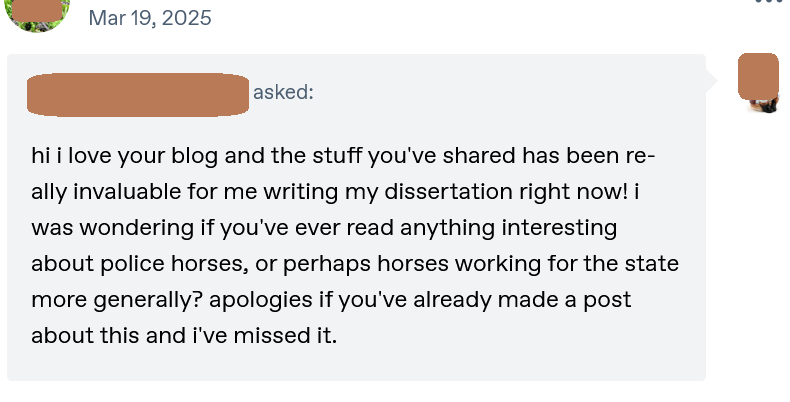
Nice. Don't know if your dissertation is specifically about horse histories; if so, then I'd imagine you already know much more than I do. So I don't know how much help I can be.
I've read about the significance of horses in Mughal statecraft and among the image/representation of Mughal aristocracy, and I posted about the history of police horses in Australia (back in June 2023), but it was brief; it just excerpts from Stephen Gapps and Mina Murray, in their "From colonial cavalry to mounted police: a short history of the Australian police horse" (The Conversation, 28 July 2021; "Horse Patrol" aka "Mounted Police" formally established 1825 after Wiradjuri war, used to round-up escaped laborers and attack Aboriginal communities as crucial force in colonial admin in 1830s culminating in Waterloo Creek Massacre.)
I've made some references to US participation in British campaigns of Boer War. (Apparently there was a micro-industry of the New Orleans port shipping 110,000 horses and 81,000 mules on 166 voyages via 65 British steamships for a cost of like hundreds of thousands USD per month for three years to help Britain.)
Similarly, I've seen titles in (but not read) the Canadian lit. Steve Hewitt and others write about Canadian mounted police and their role in national power in the Great Plains; twentieth-century counter-subversion; monitoring labor strikes and Indigenous/student dissent, etc.
"The Masculine Mountie: The Royal Canadian Mounted Police as a Male Institution, 1914-1939" (Hewitt, Journal of the Canadian Historical Association, 1996)
Riding to the Rescue: The Transformation of the RCMP in Alberta and Saskatchewan, 1914-1939 (Hewitt, 2006)
"Fashioning farmers: ideology, agricultural knowledge and the Manitoba farm movement, 1890-1925" (Hewitt, Journal of Canadian Studies, 1997)
"Canadianizing the West: The North-West Mounted Police as Agents of the National Policy, 1873-1905" (Mcleod, The Prairie West: Historical Readings, edited by Francis and Palmer, 1992)
---
Guessing you've already considered this, but a relevant thing I've read might be Breeds of Empire: The 'Invention' of the Horse in Southeast Asia and Southern Africa 1500-1950 (Greg Bankoff and Sandra Swart, 2007), about "the 'invention' of specific breeds of horse in the context of imperial design and colonial trade routes" and "the historiographical and methodological problems with writing a more species or horse-centric history." There was an earlier influential paper about imperial use of horses by Swart, ""The World the Horses Made": A South African Case Study of Writing Animals into Social History" (International Review of Social History 55:2, 2010).
Last year I read Bellweather Histories: Animals, Humans, and US Environments in Crisis (edited by Susan Nance and Jennifer Marks, 2023), and there was an interesting chapter on horses by Marks: "Chicago's 1872 Equine Influenza Epizootic and the Evolution of Urban Transit Technology."
---
Have you seen Jagjeet Lally's "Empires and Equines: The Horse in Art and Exchange in South Asia, ca. 1600-1850" (Comparative Studies of South Asia, Africa and the Middle East, 35:1, 2015)? It covers Mughal state power and aristocratic prestige as tied to horses, but also refers to the later utility of horseback mobility in East India Company and British power consolidation.
I used to be in a Central Asia-specific program-type thing and there was a long list of academic writing, most if it not in English, about horses as essential for statecraft in Mongol, Persian, Mughal, Chinese, and Ottoman contexts. So I know that there's a huge amount of writing on the subject, but I did not retain much of it. Jagjeet Lally's bibliography here is helpful. This also brings to mind Alan Mikhail's work The Animal in Ottoman Egypt (2013) and Under Osman's Tree: The Ottoman Empire, Egypt, and Environmental History (2017). Though horses aren't the main focus, they're essentially about "animal labor/capital."
---
I think I've seen that you've interacted with my old posts about Sujit Sivasundaram, Rohan Deb Roy, and Jonathan Saha on "interspecies empire"? Saha's most recent stuff includes writing in:
Biocultural Empire: New Histories of Imperial Lifeworlds (2024); Colonial Dimensions of the Global Wildlife Trade (2024); "A Historiography of Great Animal Massacres" (2024); "whiteness, masculinity, and ambivalent British Justice"; imperial use of elephants and "animal agency, undead capital, and imperial science" (2017); Subverting Empire: Deviance and Disorder in the British Colonial World (2015); imperial use of cattle and other livestock in "animals and the politics of colonial sensitibilites" (2015). Sivasundaram covers a lot of that (animality, criminality, imperial imaginaries) but also oceanic thinking.
---
Also thinking of:
The Horse in the City: Living Machines in the Nineteenth Century (Clay McShane and Joel A. Tarr, 2011)
And The Herds Shot Round the World: Native Breeds and the British Empire, 1800-1900 (Rebecca JH Woods, 2017). Though its not really about horses (mostly about sheep and cattle for dairy/meat).
---
But I know there are little niches:
(1) British frontier policing in Australia ("mounted patrols" in campaigns against Aboriginal peoples and keeping them on rangeland labor sites). (2) British metropolitan and urban settings (police horses in industrializing London, patrolling rural periphery during enclosure law era). (3) The settlement of the Great Plains of the US (especially origins of Rangers, the Fence Wars, and policing West Texas). (4) The Spanish colonization of Mexico and especially the Rio Grande Valley (horses in maintaining state power on the northern/desert frontiers; Spanish/Mexican states and Comanche/Apache mobility in southern Great Plains). (5) Argentina's state-building in the Chaco. (6) And then all of that material about Mughal, Mongol, Ottoman horses.
Though I'm not really familiar with most of that. In trying to formulate thoughts about "carceral archipelagoes" and "frontiers," I've previously seen titles about the utility of telegraphs, railyards, and police for US power consolidation.
But when horses/cattle get involved, much of that literature seems to be directly produced by "police department museums," "police science" journals, or former police-superintendents-turned-pseudo-historians in their retirement years who study their own noble profession as a novel curiosity.
Additionally, horses are a bit of a unique case/research thing within animal studies, too, because much of the lit is adjacent to equestrianism or studies of social/anthropological aspects of agriculture.
But I imagine you know better than me if this is true. So please let me know if I've got the wrong impression! It's my impression that, more recently, the advent of critical animal studies, multispecies ethnography, and critical geography has meant there's a lot of new stuff to check out.