Racialization, "imperialist nostalgia," displacement, and rewriting the past at Zor al-Zarqa marshlands: Bentley on colonial zoology and a 'rhetorical historiography of the last Palestinian crocodile'

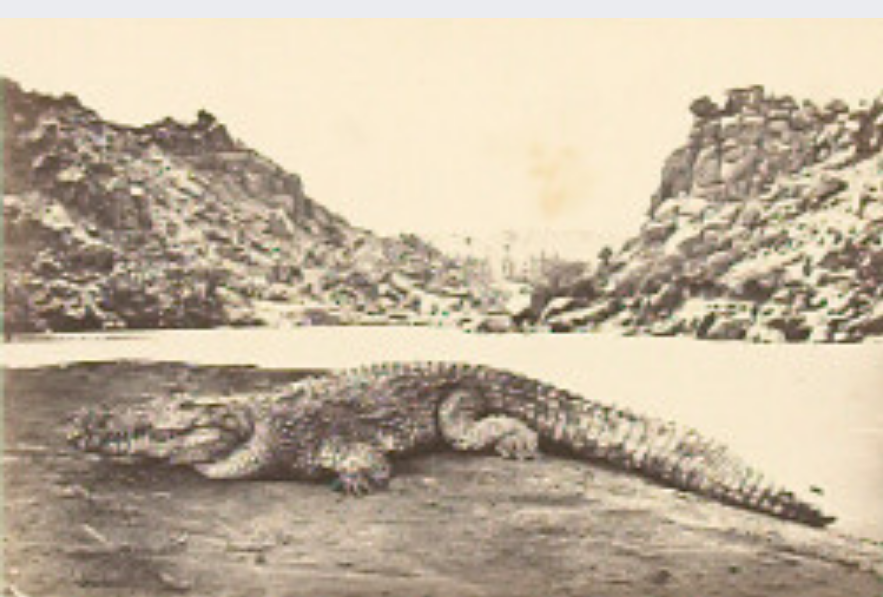
(Originally posted elsewhere on 5 September 2022.)
Surprise: I'm reading about crocodiles and empire again.
This time, a really interesting/substantial new piece from Elizabeth Bentley on the British/German/French role in the extinction, representation, and misremembering of Nile crocodiles in Palestine.
--
Image in the header, by the way, from: Francis Frith, "'Crocodile on a Sand-Bank,' in the book Egypt and Palestine, 2 vols., by Francis Frith (London: James S. Virtue, 1858-1859); volume II of II," (ca. 1858), a photography on albumen silver print, held at Fine Arts Museums of San Francisco, accession number: 1999.81.2.68
--
Bentley proposes that the "last" of the now-extinct Nile crocodile population of Palestine was "a dynamic rhetorical figure rather than a single specimen."
Turn-of-the-century naturalists, as elsewhere on the globe, were conducting "salvage ethnographies"--and, in this case, salvage zoologies (?). Aware of the dwindling population of crocodiles at Zor al-Zarqa in Late Ottoman Palestine, European naturalists/zoologists harvested what would often be publicized as the "last living crocodile" from the region, to be harbored at zoos or in collections in metropolitan Europe. Nonetheless, the crocodile remained extant for a bit.
Bentley acknowledges European fixation (at that time) on lastness ("last of a race," "last of a species," etc.), scarcity (capital!), and decline/past/civilziation (famous morbidity of Late Victorian Britain and broader European "imperialist nostalgia" amidst the newly-uncovered sites of Sumer and Egypt, in which Palestine's association with the Roman port of Crocodilopolis added extra weight to Palestine's association with crocodiles; thus, as inheritors or whatever of Rome, Europe could stake a claim in the "story" of the Levant).
More revelations, though, come from Bentley's attention to the testimonies of contemporary Palestinian historians to recompose the history of often-elided Ghawarna people. Bentley describes the significance of once fertile marshlands--also the crocodiles home--to the Ghwara who made a living weaving mats from the marsh's reeds. In her telling, the Ghwarna are associated with "darkness"--that is, darkness of skin, given their affiliation with Palestinians of Sudanese descent. Thus, in the imaginaries of surveyors of the British Mandate, the Ghwarna were hapless subjects.
Bentley takes issue with how the contemporary Israeli-run Biblical Zoo houses Nile crocodiles adjacent to interpretive signs which describe ..........
--
Excerpt:
[I]n colonial zoological literatures between 1870 and 1935. This was the historic period of colonial zoologists’ speculation about […] the whereabouts of the last Palestinian crocodile. […] [T]he Palestinian crocodile extinction story is intertwined with violent histories of colonial resource extraction, racialized labor exploitation, and indigenous human dispossession. […]
Clarence the crocodile drifts about lazily in the thick summer heat […] at the […] Zoological Gardens in West Jerusalem […]. Nile crocodiles once lived in Palestine’s Mediterranean coastal marshlands. The poster narrates […]: “In 1905, the last crocodile was hunted in Israel by residents of [the Palestinian village] Jisar-A-Zarka.” […] [T]he market for late Ottoman Palestine’s small and dwindling crocodile population was overwhelmingly driven by colonialists […]. [T]he […] zoo poster implies that Palestinians were responsible for Nile crocodiles’ regional extinction. This historical narrative hinges on the last crocodile’s symbolic singularity […]. Several “last Palestinian crocodiles” – that is, crocodiles hunted when the local population was at the brink of extinction – remain to this day in British, German, and Israeli collections. The last Palestinian crocodile, therefore, is a dynamic rhetorical figure rather than a singular specimen. […]
—
[We can] contextualize […] the colonial scientific archive with Palestinian-authored scholarship from this historic period, as well as […] interviews with local [Palestinian] historians […] By tracing the last Palestinian crocodile’s rhetorical circulation to 1935 – when an [Israeli] zoologist declared that Palestinian crocodiles were finally extinct – [we can] connect the story of Palestinian crocodile extinction with the British Mandate and Palestine Jewish Colonization Association (PJCA)-led drainage and destruction of the crocodile’s former habitat and the dispossession of the Ghawarna who lived on that land. […] [I]t was only after the wetlands were drained that the PJCA transferred the Ghawarna community to Jisr al-Zarqa, newly created on a fraction of the Ghawarna’s […] lands. […]
—
The freshwater Nahr al-Zarqa, known for its clear blue waters, was used for drinking and agriculture. […] The marshlands themselves were home to two communities of Bedouin origin, ‘Arab Kabbara and ‘Arab al-Ghawarna […]. ‘Arab al-Ghawarna roughly translates to “people of the lowlands” or “marshes.” For reasons of social status intertwined with their marshland dwelling-place, the name carries a fraught and at times stigmatized history. The Ghawarna who lived in the Zor al-Zarqa/Kabbara marshlands were primarily members of the ‘Ammash and Jurban families. As recounted to me by the local historian Mohamad Hamdan and the environmental and community activist Saidah alAli – who live in Jisr al-Zarqa […] – the Ghawarna earned a living […] weaving mats from the marsh’s abundant supple, springy reeds. […]
Palestinians of Sudanese descent were also affiliated with the Ghawarna during this period. […] Their […] “darkness” […] was the subject of repeated, disproportionate fascination in the writings of colonial researchers who came to hunt crocodiles and document marshland flora and fauna. […]
—
The relationship between imperial science, natural resource extraction, and territorial expansionism during the late Ottoman and British Mandate periods is well-documented. […] Why did Palestinian crocodiles – especially the last crocodile – attract so much attention from colonialists? What did they find so intriguing about this small, localized, and rapidly dwindling (if not entirely extinct) population? […]
Lastness […]. Colonial zoologists’ fixation on the last Palestinian crocodile was in part driven by an enduring European fascination with “lastness” as a spatial-temporal construct. This fascination exemplifies the convergence of evolutionary science and imperial sensibilities […]. [I]t converged with the myth of “the last of the race” and an enduring fascination with the “rise and fall” of civilizations. […] [T]hese sentiments […] were often cloaked in an air of “imperialist nostalgia.” […]
Scarcity […]. The interlocking relationship between imperial science, capitalist exploitation, and racist dehumanization is apparent in an 1887 PEQ article by the Templer German-American researcher Gottlieb Schumacher. Schumacher did not merely represent the Ghawarna as existing outside the circuits of capital. To him, they were capital. […]
Place […]. Palestinian crocodiles’ popularity among Europeans was heightened by place-based historical associations. The crocodiles were associated by name with several archeological and geographic sites near their habitat which were connected to Hellenistic and medieval Crusader histories in Palestine. These sites included the ruins of the Greco-Roman port city Crocodilopolis and the nearby river Nahr alZarqa, which during the Greco-Roman period was allegedly known as Crocodeilon. The ruins and river attracted a broad spectrum of nineteenth- and twentieth-century Europeans […]. Through their excavation and representation of Palestinian crocodiles’ placebased historical associations, colonialists perpetuated a Eurocentric interpretation of Palestine’s material history.
The crocodile served as a reptilian conduit for rewriting – and claiming ownership over – Palestine’s past, thereby de-Arabizing the history of the coastal marshlands. […]
—
Nearly a century has passed since Bodenheimer proclaimed the Palestinian crocodile’s extinction, obscuring the violent processes of Palestinian dispossession and ecological destruction.
—
All text above by: Elizabeth Bentley, “Between Extinction and Dispossession: A Rhetorical Historiography of the Last Palestinian Crocodile (1870-1935),” Jerusalem Quarterly, Issue 88 (Winter 2021). Published by Institute for Palestine Studies. DOI: doi. org /10.70190 /jq.188.pg