Responding to messages: On the French cartographic (and taxonomic) imagination when grappling with 'the sluts of Modernity'

<3
Thank you!
Considering Baudelaire, there was more material in the same chapter (which I did not include in the excerpts) on his era's literary depictions of Montmarte/women and its influence in 1890s representations of class boundaries/sexuality, which I've attached below under the "keep reading" (where I also mention invocation of race and pathologization/medical sciences in these representations, and how the 1890s French encyclopedias and taxonomies of "female types" were responding to earlier Baudelaire-era texts and also go out of their way to emphasize disguises/costumes as the woman's specialty/weapon--something to do with makeup/vanity/fashion--for its ability to mask class background, and this description of "masking" potential destabilizing subversiveness might also represent or be proxy for similar French anxiety about the "modern" turn-of-the-century urban landscape itself). You might be interested?
My tags on that post:

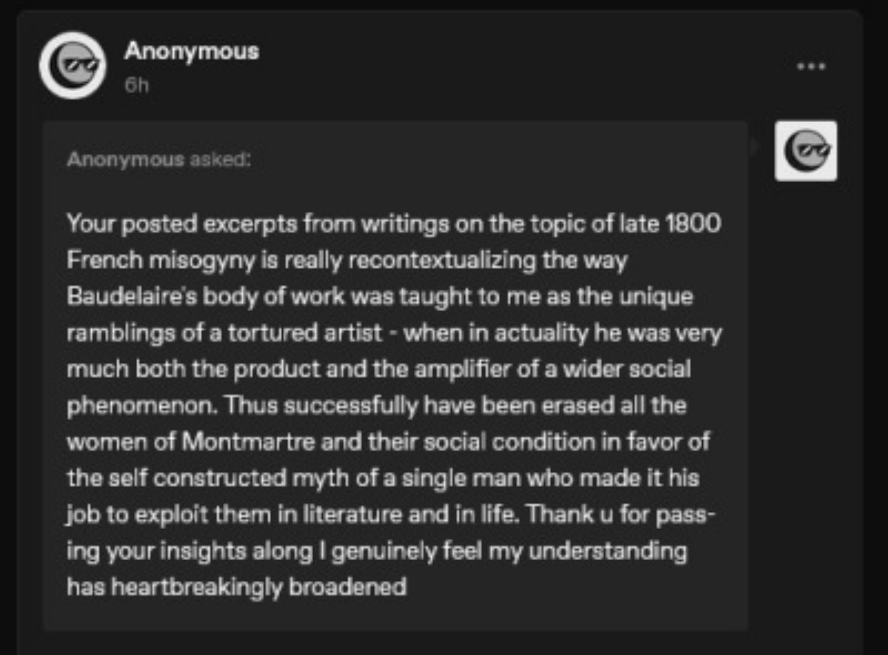
Wanted to gesture toward something about urban geography and the French imagination. Initially was just going to stay silent, but a few days after posting, encountered this similarly-themed post:
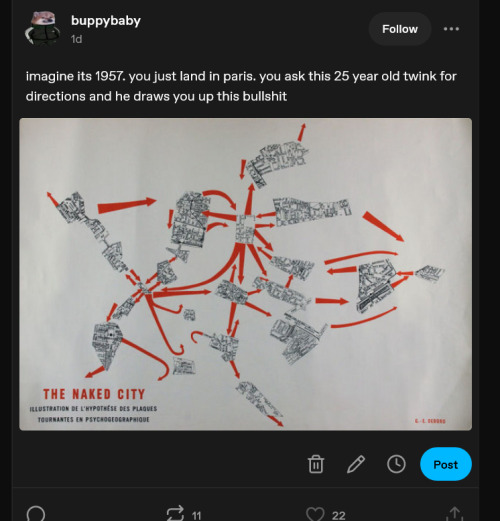
And now still dwelling on it.
Because twentieth-century psychogeography stuff and the literal spatial mapping of invisible "vibes" remind me of portions of the same chapter in the book I was quoting, where maps of Paris as a "city of women"/"nucleus of (erotic) modernity" thing seem to suggest fixation on cartographic-mindedness and uncanniness of urban space.
Neat, then, that stuff like de Certeau's Walking the City (the Concept-City, the "haunting" of the city through "ellipses" in shadowy space, hegemonic institutions contrasted with informal pedestrian movement "tactics" as a form of "speech") also eventually come from French context.
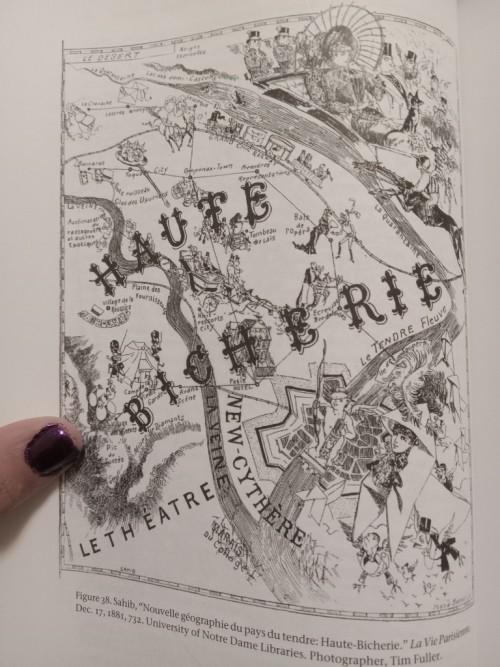
From Menon's book, maps of Paris as city of women (1881-ish, from La Vie Parisienne) which show similar directionality/flow of vibes between districts:
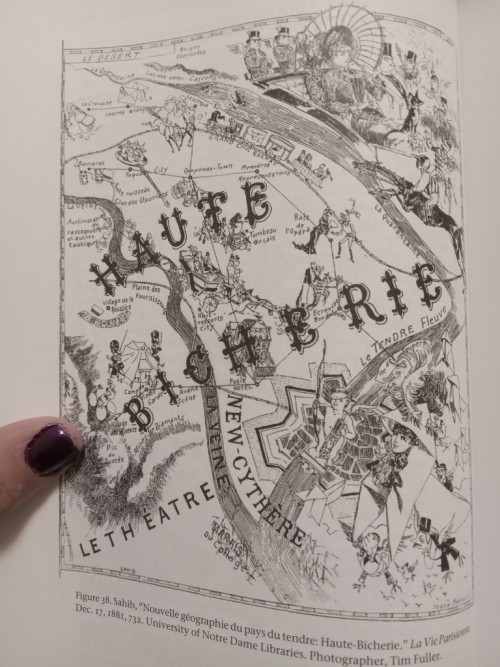
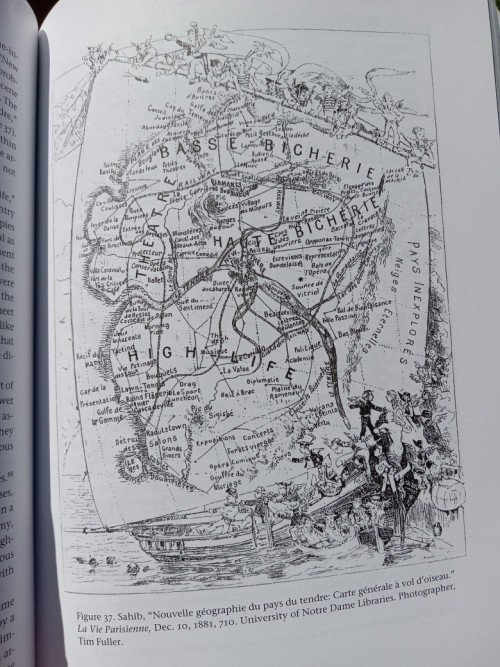
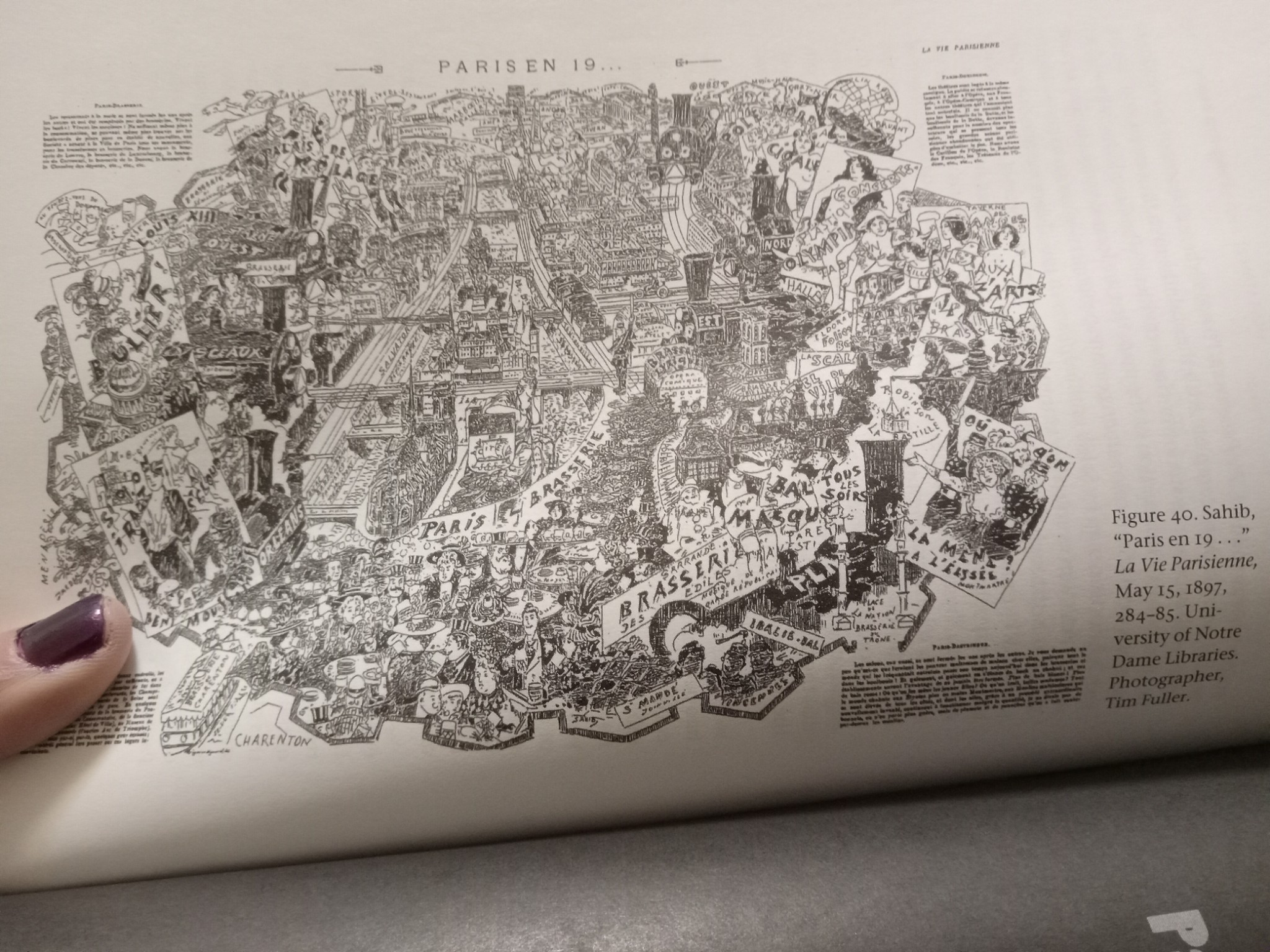
(On these maps, the cocotte--folded-paper model of a bird, a "chick"--is a symbol for Montmarte entertainment/sex work.)
On "haunting": I've been mulling Menon's description of French anxiety about women/urban geographies, and the accusation that both adopt disguises.
Temporal context of Baudelaire's work (1840s-1860s) is interesting, and I like that you mention him in connection to depictions and flurry of public discussion of women (1880s-1890s). Because one thing Menon does in that book on femme fatale imagery (largely about Montmarte), when she's explaining the "encyclopedias" of "female types" in the 1880s-1890s, is show how their authors were directly/explicitly responding to similar texts from the 1840s-1860s. She proposes that, in the 1890s, Montmarte was a site of ambiguity and a sort of fantastical destination for middle-class Parisians (aspiring to upward mobility), where anxieties about women's physical/social mobility were epitomized in the French national imaginary. She also suggests that literary/artistic imagery of cocottes/sex workers/femme fatales tried to digest this attraction/revulsion.
Below, I'm summarizing Menon's argument, and not necessarily vouching for it. French context not my specialty!
I'm just saying words recreationally.
What changed in the 1840s, and achieved some kind of fruition/added weight by the 1890s? Big part is the Second Republic and the nation-state's political self-understanding. The discourses of 1840s liberte percolate and get given more popular prominence by the "radical" political stuff of the 1890s. (Menon mentions 1871 as important, as defeat in the Franco-Prussian War provoked French anxiety about depopulation/malnourishment/decline.)
"Modernity" ushers in a recasting of urban landscape. (Can we partially locate this in the 1840s, too? Peak of "first" British industrialization.) Proximity of upper classes with lower classes is alarming. The "new" city might also be dismissed for its alleged artificiality, symptomatic of modernity--and a mask for destabilizing subversiveness? With classes in such close social (and spatial) proximity, how do you tell them apart?
Here, Menon suggests that "costumes" are critical. While Montmarte, by the 1880s, would come to be well-known as the the theatre and cabaret district, the authors who appointed themselves taxonomists of women repeatedly emphasized "costume" (beyond the theatre) as the woman's specialty. Sex workers thus are framed as doubly duplicitous: Posturing as wealthier class or duping men out of money, both performed through the donning of disguises, which women (makeup, vanity, haute couture fashion, or whatever) are presumed to be so practiced/talented at.
So in the way that the physical/geographic space of Paris's urban landscape can mask illness/duplicity/political destablization, then the women of Paris could also utilize costumes to also mask the same threats (ambiguous class/racial background obscured by donning misleadingly-high-fashion dress, confusingly-androgynous bicycling pants, or the literal costumes of cabaret performers).
I'd add:
In the 1880s/1890s, these encyclopedias/taxonomies that hope to catalogue women happen in tandem with the ascent of (other) new sciences enamored with classification systems: anthropometry (body measurement classifications aided by photography), criminology/psychology (pathologization, "personality typing"), and the closely-linked simultaneously-ascendant public health and tropical medicine/disease control.
The association of lower-class women with pathology (psychologically with duplicitity/waywardness, and physically with sex workers/"venereal disease" et al.) is well-known, and the maintenance of an "orderly" and "modern" city (read: nation, read even deeper: race) then requires the regulation especially of sex work and allegedly adjacent professions (Montmarte's entertainers, servers, etc.). We might also extend this anxiety and compulsion for pathology/taxonomy to workers, service industry types, other women broadly, Algerian-born and West African-born Parsisians, etc.
They're perceived as interlopers--sources of infection?--in the modernizing French-and-must-only-remain-French nation and its psyche.
Anyway.
Couldn't include all the good stuff (including fad of bicycling) because I was already typing by hand while reading from a physical book and ran out of energy. (Like psychogeography and de Certeau, another connection to twentieth-century French imagination? Bicycle touring as a hobby was big at turn of the twentieth century, with transit routes and new layover stations/hotels for that purpose contributing to fashioning of urban space.)
From Menon:
---
During the Romantic period, the prostitute was a sympathetic figure who fell in love, rejected her former life, and then typically punished herself [...]. La dame aux camelias (1848), by Alexandre Dumas fils, may have been the last successful novel modeled on this prototype. Later in the century, this particular manifestation was no longer credible. In contrast, the prostitute in the literature and art of the Second Republic was a figure of conspicuous consumption on the modern boulevard, "a brilliantly artificial construction" whose "spectacular theatricality appealed to the misogynous artists at mid-century because it obscured the libidinal animal they imagined to be lurk under her synthetic surface." [...]
Bernheimer explained the literary function of the prostitute [at that time] [...]. Balzac provided a transitional presentation of prostitution in Splendeurs et miseres des courtisanes of 1845-47. [...] Zola tore away the masks constructed by earlier artists and writers; and Huysmans determined that "female sexuality = prostitution = castration = syphilis = the organic world." [...] Mauclair declared that [...] [a]fter years of debauchery, the courtesan still has rage for the first man who took away her dream of a sentimental, idyllic love. This leaves her, according to Mauclair, "[a profund anarchist, since she can see man in all his primitive, animal-like state]" [...]. [S]he disdain the public who loathes her. She is an egalitarian because desire makes all men equal. [...]
Pol de Saint-Merry's popular 1898 text entitled Pecheresses examined the origins and significance of contemporary prostitution. In his opinion, novels taught a woman to play a game in which she appeared to protect her virture but eventually, and inevitably, succumbed to vice. He estimated that [...] [m]any prostitutes were recruited among rural women, who moved to the city and eventually became part of the "masse des pecheresses vulgaires" [mass of commonplace sluts]. Paul Bourget, in his Physiologie de l'amour moderne (1890), described a downward spiral that began with a woman's becoming a man's mistress. From here, it was six months to the Latin Quarter, one year to a brasserie, five or six to the Folies-Bergere or what he called an "Eden," and finally to a brothel. [...]
Elsewhere, Saint-Merry discussed the difficulty of distinguishing between the pecheresse and the femme du monde, a task made more complicated by the increasing numbers of cafe singers and actresses. [...] In an article for Gil Blas Illustre in 1897, Catulle Mendes wrote of woman's appearance and her ability to transform herself through makeup. He claimed that as a source of ecstasy, or an excuse for crime, nothing compared to the power of a woman. In order to manipulate men, women learned the art of donning guises [...]. With practice, any woman could take on a variety of personas.
For his "Femmes automatiques," for La Vie Parisienne (1892), Ferdinand Bac drew a variety of women behind velvet ropes, as if they were exhibits in a museum [...]. Male customers are required to pay coins to animate these automatons, and the subtitle reads, "You get what you pay for." A number of the women shown are types to be found in Montmarte [...].
Octave Uzanne, in his Parisiennes de ce temps of 1894 (discussed [earlier] for its use of references to Paris as Eden), examined women from different social spheres: workers, prostitutes, actresses, and middle-class housewives. [...] In his introduction, Uzanne identified his reason [...], connecting his project directly to the multivolume Les Francais peints par eux-memes, of 1840-44 [...]. Uzanne recognized that French society had changed, due to politics, industrialization, and scientific advances. [...] A sense of instantaneous was critical to his definition of female types, and in fact, he compared it to photography: "[So we happily set in train a parade of the principal types of modern women, restricting the analysis [...] to a sort of quick sketch [...], or what the present passion for photography calls in its jargon--a snap'" [...].
A chapter [...] is devoted to the concept that certain types of women could be found in certain geographic regions of Paris. [...] By touring from the Place de la Nation to Vincennes, a flaneur could discover "[the most fascinating imaginable parade of females, from the bottom to the top of the city's social hierarchy ... The amazon, the bicyclist, ... the reader, ...the androgynous type with her lesbian mannerisms, strange garb and frigid looks ..., the health fanatics ..., the very ladylike Englishwoman ...]".
Georges Montorgueil, a member of the Montmarte community and the author of several books [...], undertook what was perhaps the most enyclopedic examination of female types. [...] The last two types in the book are la bicycliste and la perverse, which are linked in a significant way [...]. This was due especially to the cyclist's pantslike costume [...].
At the lowest level flourished "[the femme ..., the street-walker who bleeds the bourgeois as surely as her male friend, her pimp, knocks him down [...]." She had no comforts [...]. Her realm was the street and the police frequently pursued her. [...]
In the 1880s, La Vie Parisienne ran a series of fantastic topographical illustrations, by the artist known as Sahib, that addressed the ambiguity of love in Paris by literally mapping the shifting territory of the prostitute.
The article of December 10, 1881, initiating the series, [...] proclaimed Paris to be a "New Cythera." Cythera was the island where Venus came ashore following her improbable birth. Watteau conceived of the island in the eighteenth century as the scene for aristocratic erotic fantasies [...]. The composition of the first map, entitled "Nouvelle geographie du pays du tendre," [...] clearly refers to Watteau's masterpiece [...]. Its proposition is that the upper-middle classes are marking their power within society by writing themselves into a fantasy previously intended only for the aristocracy. [...].
A third map describes the theater province, [...] and a fourth, "Haute-Bicherie" [...] overlapped by a portion of "Theatre," situates various levels of prostitution. The close proximity of the theater district and the haute bicherie confirmed that many women arrived at prostitution through theatrical professions. [...]
The map shows that there are many ways to reach the "little hotel," via a game of baccarat or even the circus. [...] This island contains symbols that make the connection with prostitution clear. A folded piece of paper appears several times [...] and also encloses the figure of a young woman. This is a symbol for a cocotte, a fictional type of woman [...]
The earliest printed publication that used this term was a satirical pamphlet entitled Les Cocottes!!!!! (1864), which covered a wide range of meanings [...]. Edouard Siebecker, in Physionomies parisiennes: Cocottes et petits creves (1867), confirmed that it was not easy to pigeonhole a cocotte: "[She is of many sorts, and it is no easy matter to assign her a background]" [...]. Charles Virmaitre proposed a more comprehensive terminology in his Paris-Galant (1890). There he classified cocottes according to their place of work--the rameneuse, who saw customers at home; the grue, who started out in the theater; and the allumeuse, who procured clients in alleys. [...]
On the outskirts of Paris, and not subject to strict regulation [...], Montmarte had become a destination for the middle classes looking for excitement [...]. Montmarte was at the center of a change in value systems, in which clearly defined spheres of existence were eroding. [...] Artists and writers responded through the production of types, including the fille d'Eve, the cocotte, and the femme fatale, which attempted to restore order [...]. The maps [...] provide a visual key to popular imagery, satire, and new ways of seeing Paris in the years leading up to the Universal Exposition of 1900.
---
Text from: Elizabeth K. Menon, Evil by Design: The Creation and Marketing of the Femme Fatale (University of Illinois Press, 2006).