Rhinoceros near the eastern Mediterranean?: Megafauna and Holocene extinctions (part 1 of 2)

(Originally posted elsewhere on 7 November 2022.)
Great question.
This post will outline context stuff. My follow-up post will answer more directly. Preview: There were white rhinos in North Africa relatively close, though they will now likely be extinct this century.
But to situate this:
We can guess that the Near East was more densely wooded during the Holocene (through the Bronze Age?) from ecological/palaeoenvironmental resesarch and from attestations of cedar harvest recorded from, say, Assyrians.
Sounds like you already know that the Fertile Crescent and Anatolia were home to elephants, tigers, lions, cheetahs, leopards, ostriches, and other superlative celebrities in the Bronze Age and ancient world(s).
Tigers, lions, cheetah, caracal, and at least 2 subspecies of leopard were all still alive in Levant, Anatolia, Mesopotamia, Kurdish land, the Caucasus, and Persia within the last 150 years.
Then, we also know that the Syrian ostrich (Struthio camelus syriacus) was historically present in Palestine/Syria during the nineteenth century. (During the medieval era, they probably still lived on the Arabian peninsula and western Persia. Gifts of ostriches were given to the imperial Han Chinese court by Parthians, and to Chinese courts by Western Turks in the 600s. Artistic depictions of ostriches still show up in Tang-era China, so ostriches were either still present in Bactria/Sogdiana, or they were present in Persia and shipped along the Silk Road.)
Crocodiles lived along the coastline of the eastern Mediterranean in Palestine into the 20th century. (Whether they were Crocodylus niloticus or Crocodylus suchus is hard to tell. Both species are still alive in Africa and both species were present in Egypt.)
Earlier in prehistory, we of course know about the wacky cave goats of Crete and the dwarf hippos of Mediterranean islands.
We also know that the Asian elephant was more widespread, and present in Anatolia and the Middle East during the Holocene.
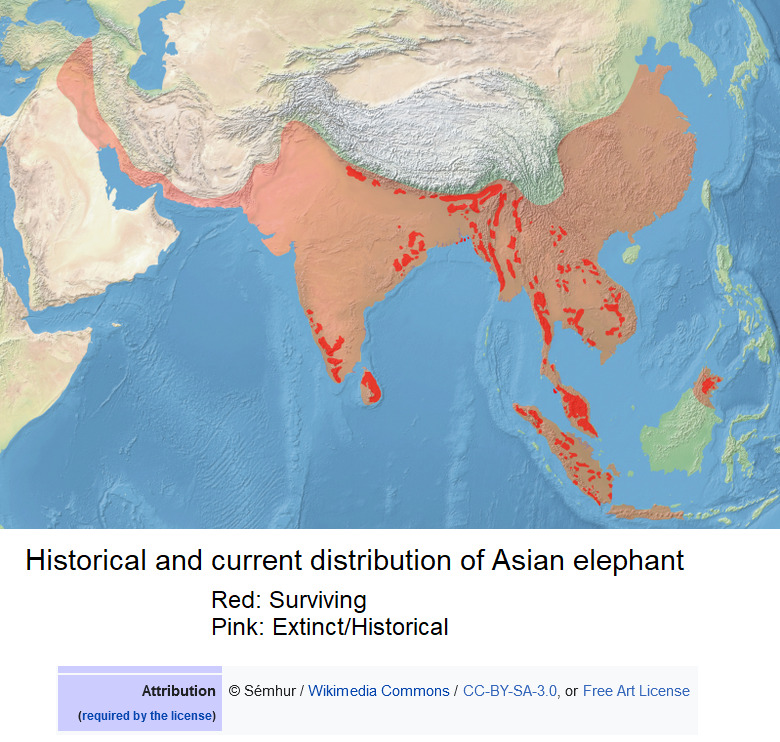
You might have guessed that the elephants known to Greeks and Romans would be the African elephant, given the strong connection between the Hellenistic Mediterranean cultures and Libya/Egypt. However, it seems that the Asian elephant that was better known in the eastern Mediterranean. There appears to have been a morph or subspecies of Asian elephant that lived along the Persian Gulf’s northern shore (the "Syrian elephant"). Asian elephant remains from the Holocene have been found in Anatolia and Kurdish lands. In the eastern Mediterranean, Assyrian kings boasted of trapping elephants for sport as recently as 3000 years ago. Also, consistent trade and cultural exchange from Persia meant that the Mediterranean peoples had an awareness of Indian/South Asian relationships with elephants.
Regarding forests:
The fame of cedar trees in Phoenicia (eastern Mediterranean) would explain why Phoenicians could become so well known for boat-building (ships require wood). More widespread forests would also explain why Caspian tigers could be present in what is now modern-day Iraq and Kurdish land.
Translations of ancient Near Eastern texts discuss woodlands. You’ve probably seen me share this excerpt before:
While some texts simply allude to environmental degradation, such as the Sumerian gardener Shukallituda’s experimentation with agroforestry in the wake of deforestation ... others contain explicit description of forest clearance, including the claim of Gudea of Lagash (2141-2122 BC), who “made a path” into the forest, “cut its cedars,” and sent cedar rafts floating “like giant snakes” down the Euphrates” [...]. Despite declining biological diversity and productivity, the annals of Ashurnasirpal II [king of Assyria from 883 to 859 BC] describe abundant wildlife and a substantial inventory of domesticated livestock. He claimed to have slain 450 lions, killed 390 wild bulls, decapitated 200 ostriches; caught thirty elephants in pitfalls; and captured alive fifty wild bulls, 140 ostriches, and twenty adult lions. In addition, he received five live elephants as tribute, and “organized herds of wild bulls, lions, ostriches, and male and female monkeys.” At a banquet on the occasion of the inauguration of the palace at Kalhu (biblical Calah), his 69,574 guests dined on 1200 head of cattle and 1000 calves; 11,000 sheep and 16,000 lambs; 500 stags; 500 gazelles; 1000 ducks; 1000 geese; 1000 mesuku birds, 1000 qaribu birds, 20,000 doves, and 10,000 other assorted small birds; 10,000 assorted fish; and 10,000 jerboas - along with enormous quanitites of beer and wine, milk, cheese, eggs, bread, fruit and vegetables, and a vast number of other offerings.[...] Hence, many Indigenous societies were disrupted, reconfigured, and dominated prior to formal colonial annexation. The costs of declining biological and cultural diversity are well documented, as are the costs of disturbance and domination in natural and social systems. A Sumerian epic tale, ‘Emmerkar and the Land of Aratta,’ describes an earlier state of peace and security, ending with man’s fall from grace. Descent into chaos is described in the epic, ‘Lamentation over the Destruction of Sumer and Ur.’ In Western Asia, patterns of [ecological] disturbance and [social] domination emerge with the complex interplay of ascendant Egyptian, Caucasian, Semitic, Indo-European, and Dravidian aristocracies in the fifth millennium BC – patterns that cascade through history.
Source: Jeffrey A. Gritzner, “Environment, Culture, and the American Presence in Western Asia: An Exploratory Essay,” (2010). [Emphasis mine.]
But rhinos?
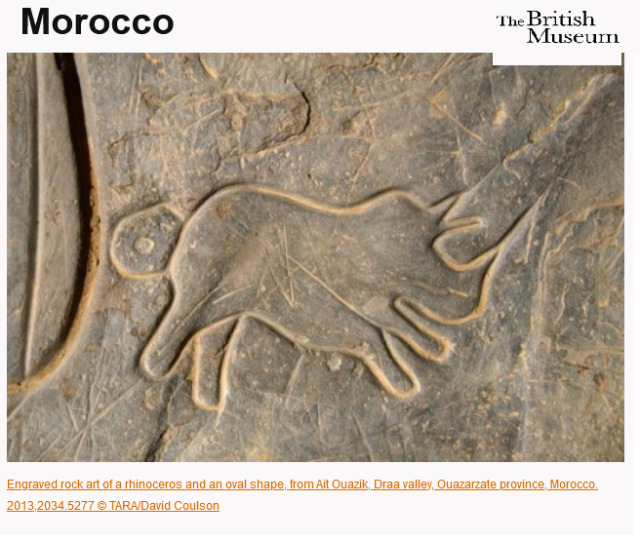
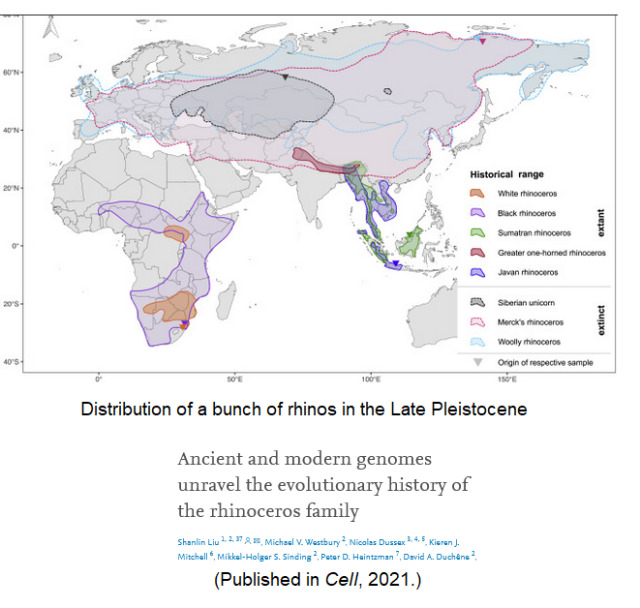
Stephanorhinus kirchbergensis and Stephanorhinus hemitoechus are known to have survived in Late Pleistocene Europe. But it’s apparently hard to gauge their proximity to or density near the Near East. This rhino situation differs from the other disappearing megafauna, because the same species the other missing/extinct creatures (Syrian elephant, Caspian tiger, Asiatic lion, Syrian ostrich) still have living relatives within the same genus. But there are no surviving Stephanorhinus creatures.
While the extant Asian elephant was once distributed outside of South Asia and into the west and the Middle East, as far as we can tell the extant Indian rhinoceros only lived as far west as the Indus and/or Bactria.
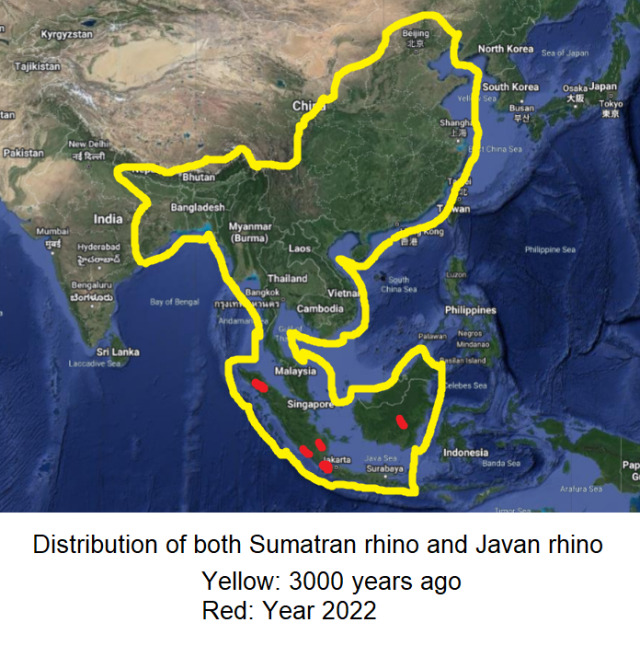
However, both the Javan rhinoceros and Sumatran rhinoceros -- both of which survive as endangered species today -- lived across China much later in history. During the Bronze Age, both rhino species lived as far north as Beijing and the Yellow River. Like the Asian elephant, the rhinos were pushed farther and farther south as urban areas and dam/river infrastructures were developed. Rhinos survived in the north near the Yangtze and modern-day Shanghai around 100 BC during the ascent of the Han dynasty. By 600 AD, rhinos appear to have still been present at least farther north than Guangzhou/Hong Kong.
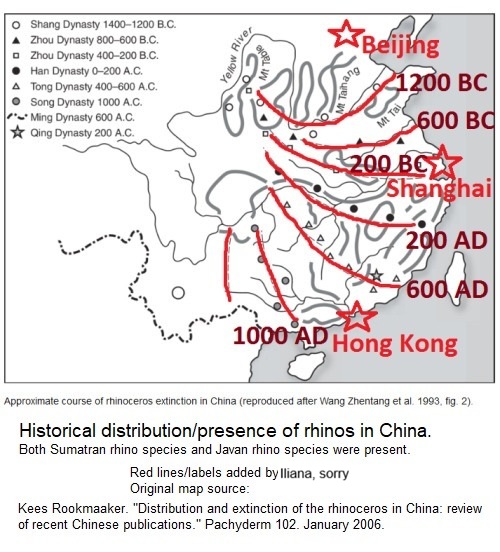
Identifying a similar gradual “pushing-out” of another megafauna icon, historian Mark Elvin famously titled his environmental history of China as The Retreat of the Elephants.
Isn’t this impressive? It’s the distribution range contraction of both the Sumatran rhino and Javan rhino over the past 3000 years. The Javan rhino, once ranging across the continent, only survives in one tiny population on a single island. (Map by me.)
The white rhinos of Africa may have undergone a similar retreat as the “Green Sahara” faded.
See the following post!