Rhinoceros near the Mediterranean?: Megafauna and Holocene extinctions (part 2 of 2)
The 'last' white rhinos and the 'Green Sahara'
(Originally posted elsewhere on 13 November 2022.)
Here, I want to talk about rhinos in North Africa.
The extinct Ceratotherium mauritanicum (in the same genus as white rhinos) and the still-living Ceratotherium cottoni (the “northern white rhino” or “Nile rhino”) were both alive in Morocco and Algeria during the Holocene. And the northern white rhino probably survived in the Sahara for longer. Holocene rock art across the Sahara depicts rhinos. Some petroglyphs, perhaps as young as 7,000 years old, depict rhinos in Morocco, Libya, and Egypt.
Short answer: There were white rhinos, possibly two different species of white rhinos, living in North Africa and near the Mediterranean coast in the Holocene long after the construction of Gobekli Tepe. Within a matter of a couple of decades, they may no longer exist on the planet.
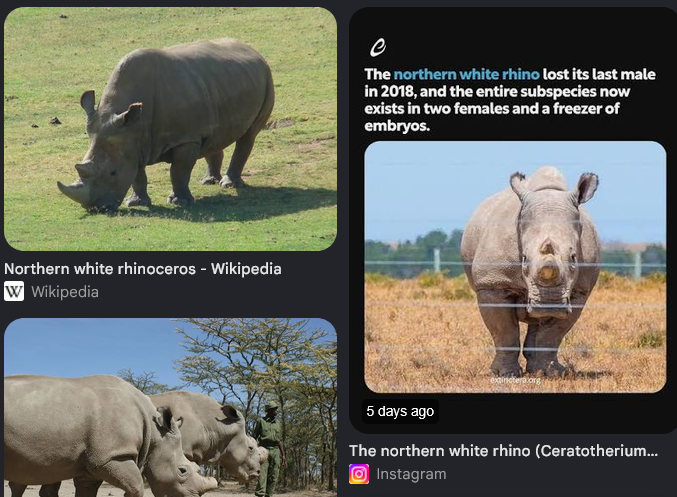
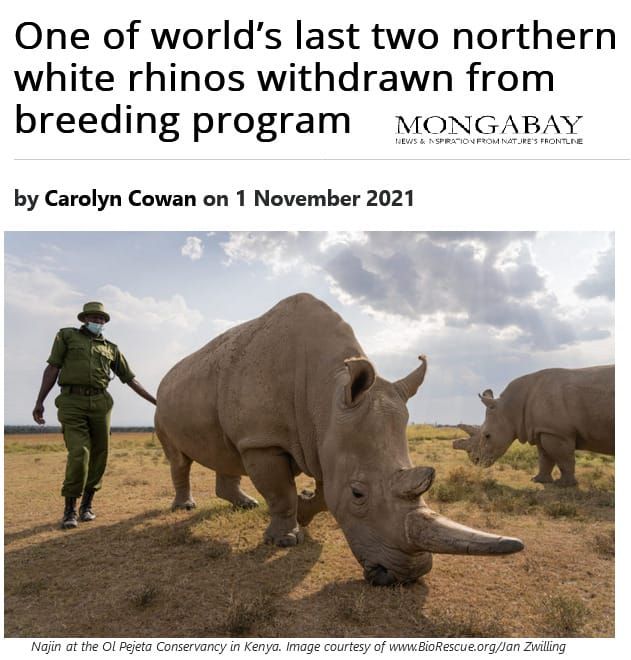
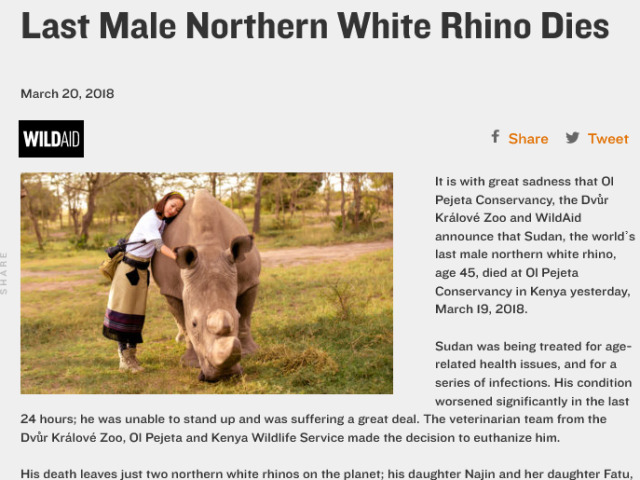
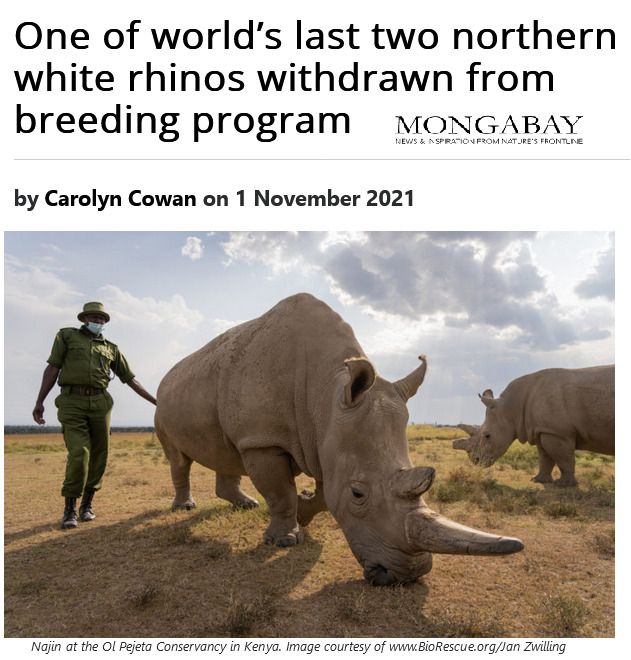
As of 2022, there are only two remaining northern white rhinos left alive. This species will be extinct, vanished, very soon, within our lifetimes.
And it turns out that this so-called northern white rhino, Ceratotherium cottoni, seems to have inhabited Egypt, Libya, Algeria, and the Mediterranean coast of North Africa during the early Holocene.

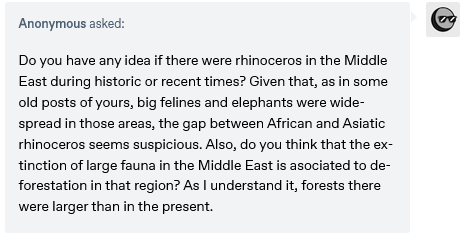
In media campaigns and textbooks, this creature has long been a prominent example of a “critically endangered species.”
The “northern white rhino” is also called the “Nile rhino”. This creature a unique subspecies, Ceratotherium simum cottoni. However some researchers instead consider it to be a unique species of its own, Ceratotherium cottoni. In 2018, “Sudan,” the last male of the species, passed away. The two remaining northern white rhinos, Fatu and the older Najin, are both over the age of 20. In October 2021, Najin was “retired,” or determined to be ineligible for breeding.
---
We have no evidence that Stephanorhinus survived into the Holocene, or any later than 14,000 years ago.
But at least one—maybe two—species of Ceratotherium persisted in North Africa in the Holocene (including one until the more recent past).
Even the still-living black rhino may have lived farther north into Egypt before the ascent of the Old Kingdom.
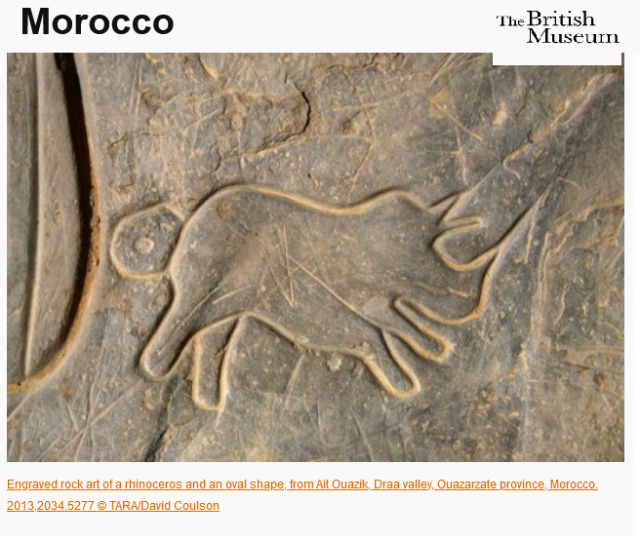
Ancient rock art of a rhino in the Draa valley of Morocco:
Considering the “Green Sahara” of the middle Holocene was much wetter and featured savanna landscapes, the still-living black rhinoceros may also have had a wider distribution, at least up until the time that the Sahara began to dry again which coincidentally aligns with the time of earliest dynastic Egypt. White rhinos (both the extinct C. mauritanicum and the living white rhinos) seem better adapted to dryland environments, like those of the Sahara and North Africa. And black rhinos seem more associated with seasonal woodland and more-vegetated landscapes. But the “Green Sahara” may have suitable to some black rhinos.
However, rhinos remain conspicuously absent from Egyptian depictions of the lower Nile. Therefore, I doubt rhinos persisted anywhere near the Fertile Crescent after 3000 BC.
Here’s the “Green Sahara” landscape, featuring “Lake Mega-Chad” and large areas of vegetated savanna and wetland:
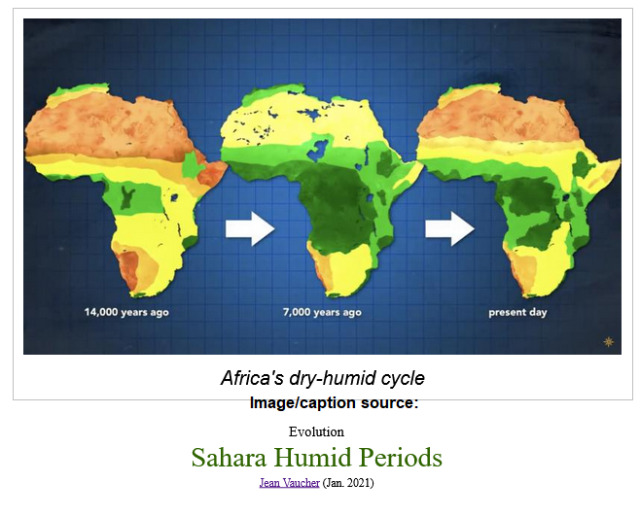
So here’s the geographical gap we’re talking about.
And this might appear conspicuous, given that within human history, other large mammals like elephants lived in both Africa and Asia and also in the Fertile Crescent between them; lions and cheetahs and leopards lived in both Africa and Asia and also in the Fertile Crescent between them.
Distribution map of the 6 living species/subspecies of rhinoceros (made with working-class GIS, MS Paint, lol):
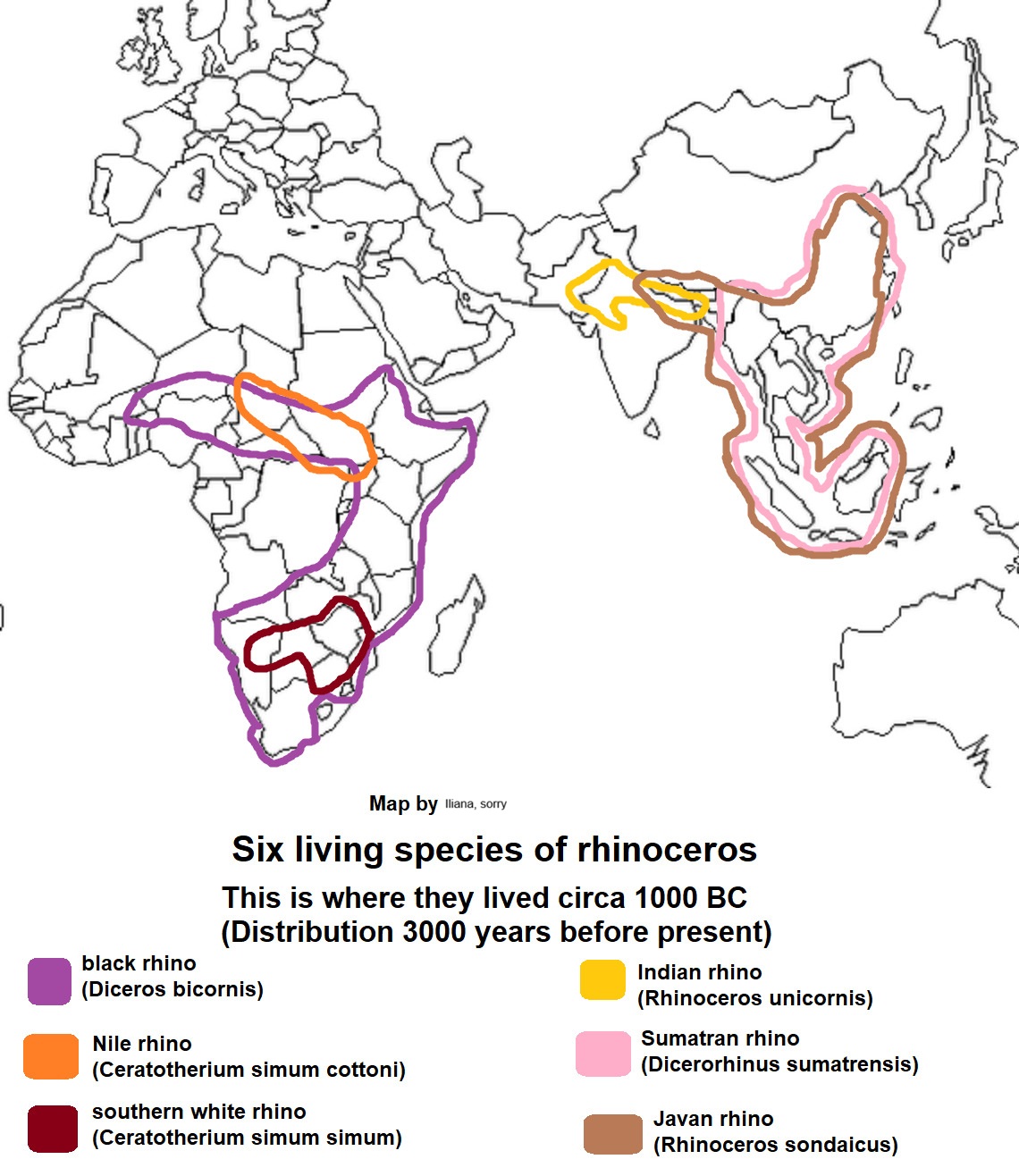
That’s what rhino distribution looks like “in history.” Today, rhinos are extinct across like 99% of all of that distribution range, though.
Anyway, here’s what the Late Pleistocene in North Africa looks like.
Note that I haven’t included the woolly rhino, the Siberian unicorn, or Stephanorhinus mercki, all three of which lived farther north in Europe, Central Asia, and northern East Asia.
ote that at 12,000 years ago, the northern white rhino’s distribution is wider than it is today.
Even the straightforward W!ikipedia article about Ceratotherium mauritanicum explicitly proposes that the rhino was still alive during the “earliest Holocene” and disappeared “by the Mesolithic.” Now, even when following-up with academic sources, I have questions about how the distinction between two species is being made. Here’s what we know:
- Ceratotherium mauritanicum was definitely alive during the Late Pleistocene, and maybe later, and was definitely present in Morocco.
- The closely-related Ceratotherium cottoni, the still-living “northern white rhinoceros,” was also living in Morocco and northern Algeria during the Late Pleistocene, alongside C. mauritanicum.
- Rhinos are depicted in ancient artwork/petroglyphs from the early Holocene in Morocco.
My question is: If C. mauritanicum and C. cottoni (a still-living species) were so closely-related and living in the same place, can we really know which species of rhino is depicted in the ancient rock art?
Furthermore, it’s still possible, also, that the still-living black rhinoceros ranged further northward in the “Green Sahara” during the early Holocene. It has been suggested that some rock art in Egypt, east of the Nile, depicts the black rhino, but I don’t know where this oft-repeated claim comes from?
So finally, here’s a guess at the presence of rhinos by the time of pre-dynastic Egypt:
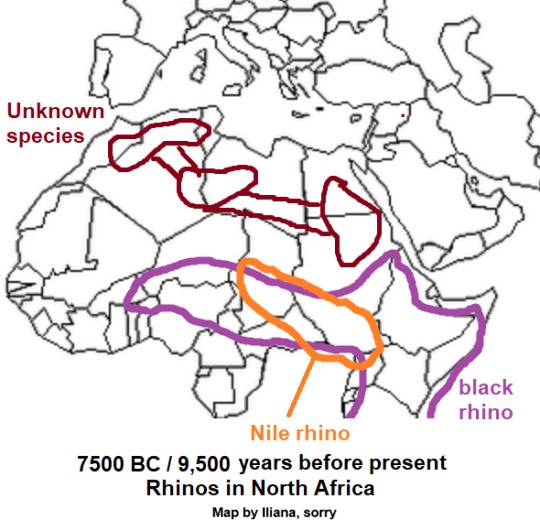
Anyway, if you want to do some research, these are sites with artwork depicting rhinoceros from pre-dynastic and/or early dynastic Egypt, the early Mesolithic, “Bubalus” style locations, or the early Holocene generally (from maybe 8000 years before present, or younger):
L’Assif N’Talaisane in the High Atlas of Morocco; Yagour in the High Atlas of Morocco; Messak-Tadrart area of Libya; Aramat area of Libya; Gilf Kebir in Egypt
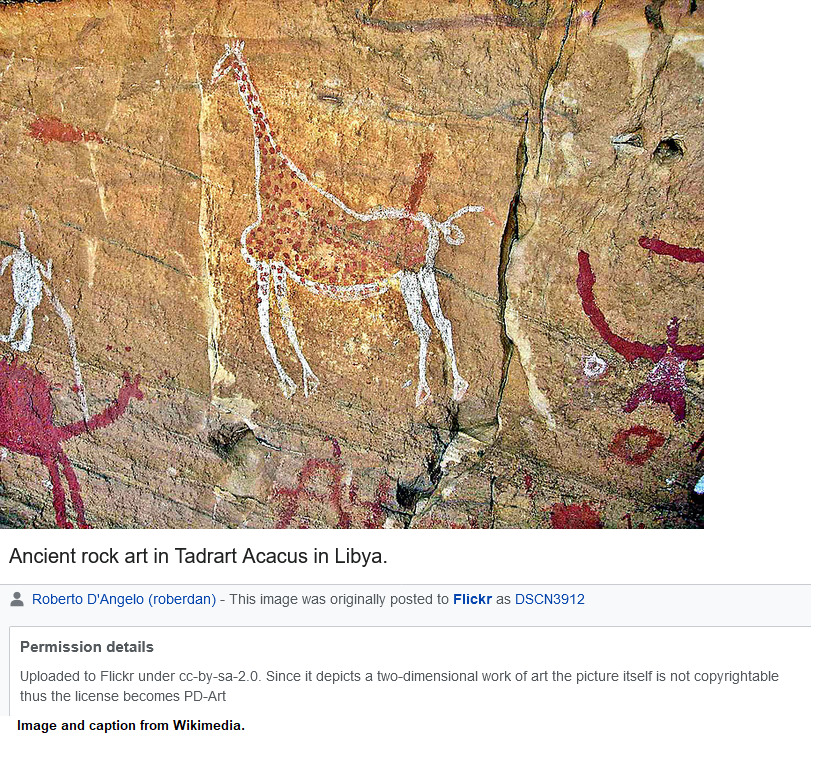
Elephants are even more common in early Holocene art from the Sahara. A lot of these sites also have petroglyphs of giraffes, too, including the “Giraffe Caves” at Gebel Uwaynat at the Egypt-Sudan frontier.
A giraffe in ancient rock art in Libya:
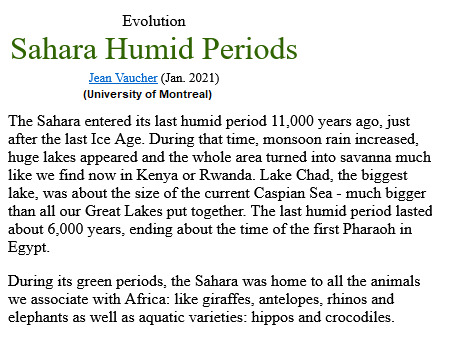
Even without rhino presence, here’s the milieu of creatures known to be present in the eastern Mediterranean in the Holocene:
Asian elephant (in Assyria); African elephant (in Nubia, Kush, Punt and possibly also in Algeria until Carthage); aurochs; hippopotamus (in Nile delta); gazelles; Arabian oryx; Asiatic lion (widespread, including Greece and Balkans until 500 BC and Mesopotamia until twentieth century); Caspian tiger (in eastern Anatolia, the Caucasus, Hyrcania, Kwarazmia, in some places until the mid-twentieth-century); Arabian leopard and Persian leopard (both still present); caracal; cheetah (widespread though probably intermittent, still alive in Persia); Syrian ostrich (now extinct); sacred crocodile (in Nile delta, coastal Palestine, and isolated oases in Tunisia and Morocco).
---
Anyway. After the construction of Gobekli Tepe, after the decline of (most! don’t forget Wrangell Island!) woolly mammoths, after the end of the Pleistocene, as “civilizations” emerged in Egypt and Mesopotamia, was there a rhinoceros that lived naturally in the eastern Mediterranean?
Difficult to say. But white rhinos were kind of nearby.
And of that entire lineage of North African white rhinos, only two individuals survive on the planet today.
Update from 2026: