Serendipity of a 'revolutionary' German termite infestation: Hamburg's place in racism in tropical medicine, the clearing of poor districts, Namibian genocide, and insects as 'thousands of tiny Bakunins'
Incredible sequence of events to me. Would love to see these discussed together.
Basically: Termite redemption. Poetic justice enacted by insects. A little story about insect reverse-imperialism in Hamburg. Thought they ought to be considered side-by-side.
SET-UP
Excerpt 1:
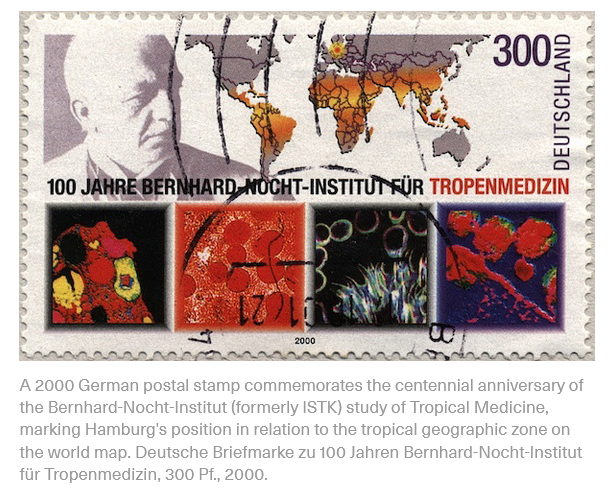
On May 28, 1914, the Institut für Schiffs-und Tropenkrankheiten (Institute for Maritime and Tropical Diseases, ISTK) in Hamburg began operations in a complex of new brick buildings […]. The ISTK […] mission: […] support the Hamburg Port […]; and to support endeavors of the German Empire overseas. First established in 1900 by Bernhard Nocht, […] the ISTK originally operated out of an existing building […]. [A] residential area for harbor workers was demolished to make way for the warehouses. […] [O]ver 20,000 people were pushed out of their homes […]. In turn, these [...] areas of the city [...] were the worst hit by the Hamburg cholera epidemic of 1892, the most devastating in Europe that year. The 1892 cholera epidemic [...] articulated the growing inability of the Hamburg Senate, comprising the city’s elite, to manage class relationships [...] [in such] a city that was explicitly run by and for the merchant class [...]. In Hamburg, the response to such an ugly disease of the masses was the […] isolated immigrants on an island, and separated the sick according to racial identity. In partnership with the German Empire, Hamburg established new hygiene institutions in the city, including the Port Medical Service (a progenitor of the ISTK). [...] [T]he discourse of [creating the school for tropical medicine] centered around city building and nation building, brick by brick, mark by mark […]. [T]he program of the building and its interior were part of the German Empire and Tropical Medicine’s much larger interest in controlling the health and wealth of its nation and colonies. [...] The field of Tropical Medicine had been established in Germany by the very same journal Nocht published his overview of the ISTK. The [journal] […] was first published in 1897, the same year that the German Empire claimed Kiaochow (northeast China) and about two years after it claimed Southwest Africa (Namibia), Cameroon, Togo, East Africa (Tanzania, Burundi, Rwanda), New Guinea (today the northern part of Papua New Guinea), and the Marshall Islands […]. The inaugural journal [...] marked a paradigm shift [...]. In his opening letter, the editor stated that the aim of Tropical Medicine is to “provide the white race with a home in the tropics.” [...] Despite belonging to two different disciplines [medicine and architecture], both Nocht and Schumacher’s publications articulate an understanding of health [...] that is linked to concepts of identity separating white upper-class German Europeans from others. [In] Hamburg [...] recent growth of the shipping industry and overt engagement of the German Empire in colonialism brought even more distant global connections to its port. […] [T]he “tropics” seemed to act as a foil for the European identity […]. What it meant to be sick or healthy was taken up by both medicine and architecture - [...] neither in a vacuum […].
Text by: Carrie Bly. "Mediums of Medicine: The Institute for Maritime and Tropical Diseases in Hamburg". Sick Architecture series published by e-flux Architecture. November 2020. [Emphasis mine.]
--
PUNCHLINE
Excerpt 2:
We are talking about the termite, whose conquest of a northern German city also shook certainties about which animal belongs where. [...] It was probably shortly after the German Empire had carried out a campaign of racist collective punishment against the Herero and Nama peoples in the colony of German southwest Africa (today Namibia) in the early twentieth century that the colonizers were colonized by termites. The “destructive, wood-munching creatures” had likely made it to Hamburg with imported wood that was used for the cladding of the city’s new heating system. The termites would probably not have survived a single winter in the cold climate of northern Europe, but luckily for them, in 1921 the local electric company had begun to channel waste heat from the generation of electricity through a pipe system to government offices and homes. [...] In all probability, the termites were living in a thriving colony when they were discovered in 1937. [...] [T]he termites followed the duct grid and worked their way up to the trees of the Karolinenviertel district (“Karoviertel”) and the Justice Forum, where they still live to this day. While the Karoviertel was being overrun by a congenial army of creative types from above, becoming a trendy residential neighborhood with all the well-known problems of gentrification, simultaneously the venerable Justice Forum (consisting of the Higher Regional Court, and the Criminal Justice and Civil Justice buildings) was being attacked from below. One city official reports that the worst nightmare of all property owners became reality when civil servants discovered that termites had started to devour the state registry records - thousands of tiny Bakunins. It had been the strategic goal of [...] Bakunin-style [...] revolts of the 1800s to destroy as many local records of deed registries and bank liabilities as possible before normal class rule could be restored. Ironically, a contemporary anti-termite poison is being marketed by BASF under the brand name Termidor, which unintentionally draws a connection to Leon Trotsky’s coinage of the term “Thermidor” to refer to the counterrevolutionary phase of the bureaucratic restoration of power. […] [B]ut even after a series of countermeasures over the past ninety years […] [e]ven the removal of entire houses […] [o]ld tactics like the mass poisoning of entire districts […] and the introduction of all kinds of insecticides […] were common into the 1980s […]. When the termites arrived in Hamburg, the discourse around the insect had already morphed from admiration to disgust. The Belgian Nobel Prize winner […] vividly described this astounding social metabolism in his Life of the Termites (1926): “You see, this is prefect communism [derogatory], communism of the pharynx and intestines, driven by the collectivism of shit-eating. Nothing is lost in this dreary and thriving republic […].” The forestry scientist and zoologist Karl Escherich, a staunch National Socialist, picked up the thread in his inaugural address […] [at] the University of Munich in 1933. His speech, titled “Termite Delusion,” contrasted the supposedly good ant colony of the Third Reich with the diabolical termite system of [communists].
Text by: Fahim Amir. “Cloudy Swords”. e-flux Journal Issue #115. February 2021. [Emphasis mine.]