Short riff on circulations of aesthetics/visual culture: Eisenstein, Japan, and Berlin (and what was it like to see a Soviet auteur's naval mutiny film in a Weimar cinema right after the Kiel Mutiny?)

(Originally post elsewhere on 22 January 2026.)
Had to--and I’m sorry, I’m really, really exhausted--read Frederik Schodt’s influential (in US pop-history/media criticism circles) 1983 writing on Japanese manga, kind of like an "intro" to contemplate. But I tried treating it instead more critically, as an example of historiography and US/European reception of quote-unquote foreign media.
But was struck when Schodt referred to “Russian filmmaker Sergei Eisenstein,” kinda in mere passing like that (to be fair, Schodt was seemingly aiming for a broad audience--USian readers of the early 1980s--so can’t detract too many points, I guess, maybe.).
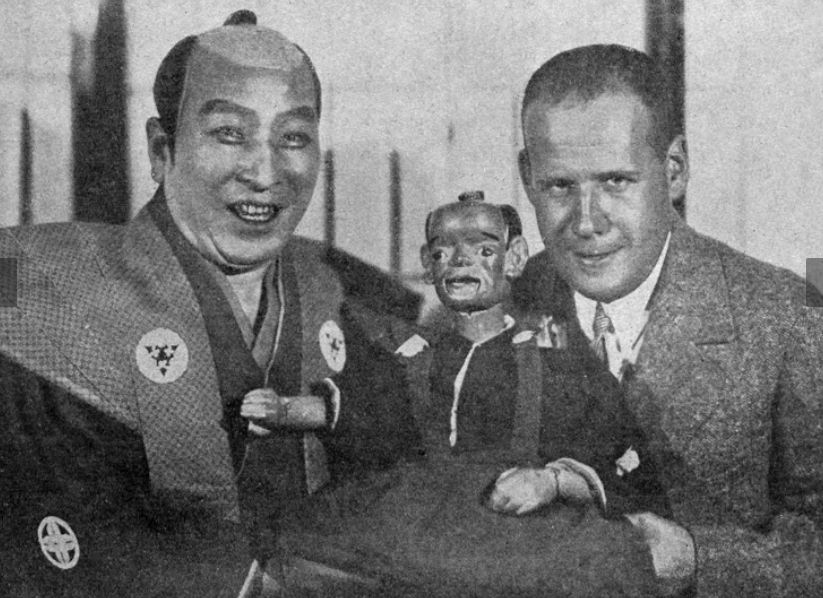
(The photo in the header of this post, by the way, shows Sergei Eisenstein meeting Japanese kabuki actor Sadanji Ichikawa in Moscow, 1928; photo later circulated in the May 1999 issue of Geijutsu Shincho.)
So when asked if I found anything particularly interesting (in the reading), I returned to Schodt’s mention of Eisenstein, who was quoted (by Schodt) regarding his (Eisentstein’s) early twentieth-century perception (Eisenstein wrote an essay in 1929) of Japanese ideogram/text and what he thought was the inherently “cinematic” nature of Japanese culture.
(Can we unpack the implications of this too??? Western filmmaker’s framing of fantastical/”inherent” Japan.)
(Wait, new discussion of unpack-able problematic implications: 1920s Soviet auteur counts as “Western”: yes or no or it depends?)
Anyway, thinking about temporality. Moment in time, particular place.
Eisenstein’s landmark Battleship Potemkin debuted in 1925, for which he traveled to a special Berlin premiere. The city host to Brecht, Fritz Lang, Marlene Dietrich. (the fictional) Dr. Cagliari, perhaps Siegfried himself, and analogous to Lang’s Metropolis.
1920s Berlin sometimes referred to as a “theatre” unto itself, with interplay/exchange between stage and film. So, a lot for Eisenstein to play with conceptually. "Father of montage cinema" Eisenstein and "father of montage theatre" Brecht in the same city. (What's with all the gendered/patriarchical default language?)
(His big famous film was about a mutiny of sailors against officers on the Russian ship Potemkin. I now wonder what it would’ve been like to see the movie with a Berlin audience at that time, as one of the major instigating forces in the 1918 German Revolution was the Kiel Mutiny affair of sailors rebelling against commanders, very fresh in minds at the time.)
Elsewhere, same text, Schodt’s like: Manga proliferates post-1945--for a lot of reasons. Now thinking about US occupation. Also thinking of Victorian London’s explosion of mass-market print magazines (can we now unpack the implications of my chauvinism, having dragged British culture into this?). Mass production, railroad circulation, wealth amplified by colonial plundering aside--and that’s a big aside--now thinking of aesthetic/visual communication in the British metropole at that time. 1850s-1880s: pulp stories, penny dreadfuls, adventure magazines, serialized stories, embellished travel accounts, sensationalist dailies. Very visual.
Same time as rise of other popular visual displays (exhibitions, expositions, professionalization of academic/scientific disciplines employing museum/public display).
idk something about visual cultures.
Aesthetics aesthetics aesthetics. So much visual information to process. Gonna close my eyes now.