Sinixt dispossession and a "caribou rainforest" (part 2 of 4): The 2019 legal case and state claims of "extinction"

(Originally posted elsewhere 3 July 2019, with updates August 2019 and January 2020.)
So, in 2019, the southern mountain caribou was formally declared (by US federal authorities) extinct within the Columbia Mountains/inland temperate rainforest region. But this wasn’t the only contest—possibly not even the most notable—over the term “extinct” in the region this same year.
The conflation of Indigenous peoples with animality, on the one hand, and the application of the paternalist/racist/depersonalized/objectifying term “extinction” to Indigenous peoples, on the other hand, are both heavily criticized (rightfully) rhetorical maneuvers of “classic” colonial epistemologies. Addressing caribou extinction and Sinixt dispossession in the same conversation is, here, done not to contribute to that gross tradition. Rather, it’s to acknowledge the entangled perception of possession/disposability with which colonial nation-states (Canada and the US) treat this region as a whole—land, human, and other-than-human alike. (After all, this is a land of timber extraction, ski resorts, and fossil fuel pipeline infrastructure. The period 2018-2020 has seen an advancing of Canadian federal projects intensifying this extraction.)
A British Columbia court ruling from May 2019 involving a Sinixt man essentially allowed that the Sinixt may now cross the international border for cultural practices. But the case also paved the way for another historically significant change: The Canadian government wrongfully declared the Sinixt people “extinct” in 1956, but the outcome of this case may have laid the legal groundwork for formal recognition of the Sinixt people once again.
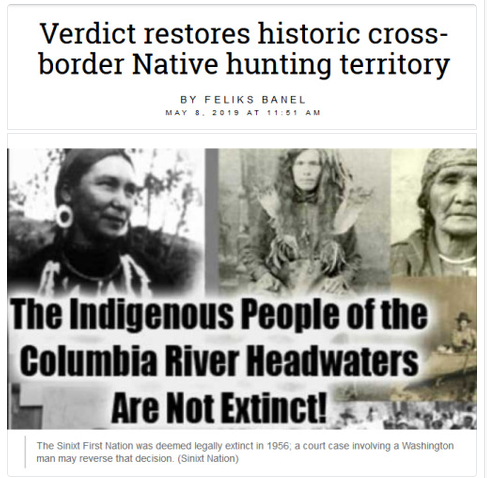
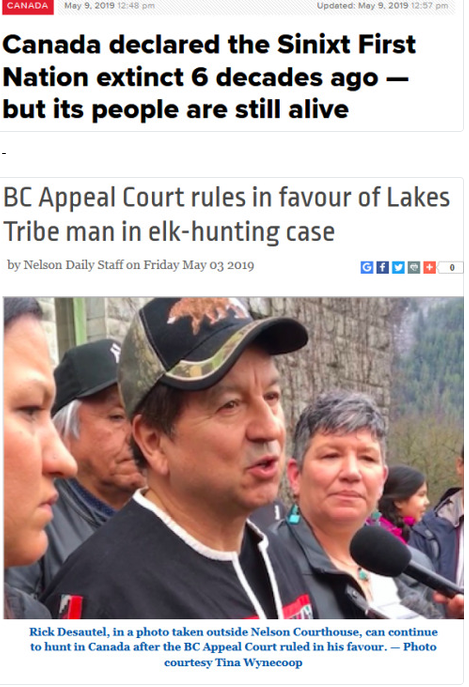
The Canadian government declared the Sinixt people “extinct” in 1956, despite the relatively large area of land inhabited by Sinixt people and despite Sinixt people living as registered members of US confederated tribes and living among other Canadian First Nations. [The Sinixt are often referred to in settler-colonial texts as the “Lakes tribe.”]
This legal situation began in October 2010, when Rick Desautel - a member of Lakes Tribe of the Colville Confederated Tribes, in northeastern Washington near Spokane - shot an elk near Castelgar in British Columbia. Since he was technically a US citizen, BC officials charged him with hunting without a license and hunting without being a resident. Desautel argues that the elk hunt was permissable because it occurred on traditional Sinixt land - a land which crosses the US-Canada border.
From a My Northwest article about the latest victory in the case, from May 2019:
That’s when the Colville Tribes decided to pursue a legal strategy to help reestablish the Sinixt in Canada and secure rights afforded recognized First Nations in that country. “So when the Tribal Council says, ‘We’ll go do this and we’ll start a court case,’ and they asked me if I wanted to be the test case, I said I would sure love to be the test case,” Desautel said. “My ancestry goes really deep into the Sinixt part of the country there.” […]
Since he had agreed to be a test case for the Colville Tribe to try and change the law via the courts in Canada, Desautel notified game authorities in British Columbia about what he had done. […]
The decision last week [May 2019] by the B.C. Court of Appeal to uphold this decision is another significant legal victory, and it means that what Rick Desautel did [crossing the international border to engage in cultural practices] isn’t considered illegal anymore. More importantly for other Sinixt people, it may also mean that the Sinixt First Nation (also known as the Arrow Lakes Band) – which was deemed extinct by the Canadian government in 1956 on dubious contentions that the Sinixt people had dispersed and moved away from their homelands – might be officially recognized again.
[End quote.]
Sinixt land before the twentieth century:
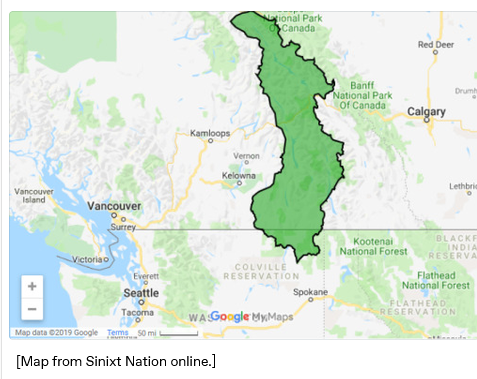
In December 2019, Bill Metcalfe of Nelson Star laid out the stakes:
The Supreme Court of Canada agreed this year [2019] to hear the provincial government’s appeal of a Sinixt hunting case that has been in the news for several years. The result will have major implications for the Sinixt and for aboriginal rights across the country. […] In response to each court defeat, the provincial government, which originally charged Desautel with hunting as a non-resident and without a licence, appealed to a higher court only to lose each time. If the Supreme Court of Canada court sides with the Sinixt, their extinct status could be overturned, according to their lawyer […]. [End quote.]