Sinixt dispossession and a "caribou rainforest" (part 3 of 4): The region and its name
When I was a teenager—fixated on the (to me) extraordinary presence of “coastal-type” rainforest so far inland and how its relative fertility contrasted with the “dryland” sagebrush steppe of much of the adjacent Columbia Plateau—the region received less attention as a cohesive unit, particularly in the US. “Inland temperate rainforest zone” was how I described it at that time; sometimes, “inland cedar-hemlock zone.” Within BC/Canadian scientific literature, “interior wet-belt” was also applied. For as unique as the region is/was, there hadn’t been a universally adopted formal title for the place.
So why is it referred to as the “Caribou Rainforest”?
Considering the presence of other superlative and unique creatures—grizzly bear, gray wolf, wolverine, fisher, lynx, moose, Kootenai River white sturgeon, giant salamanders, endemic slugs, massive cedars, ferns, mosses—several of which only live here, why caribou?
From recent visits, here’s a look (photos by me) at some typical habitat (Clearwater drainage of northern Idaho), where the smaller-but-no-less-superlative creatures (amphibians, molluscs, ferns, fungus) dwell:
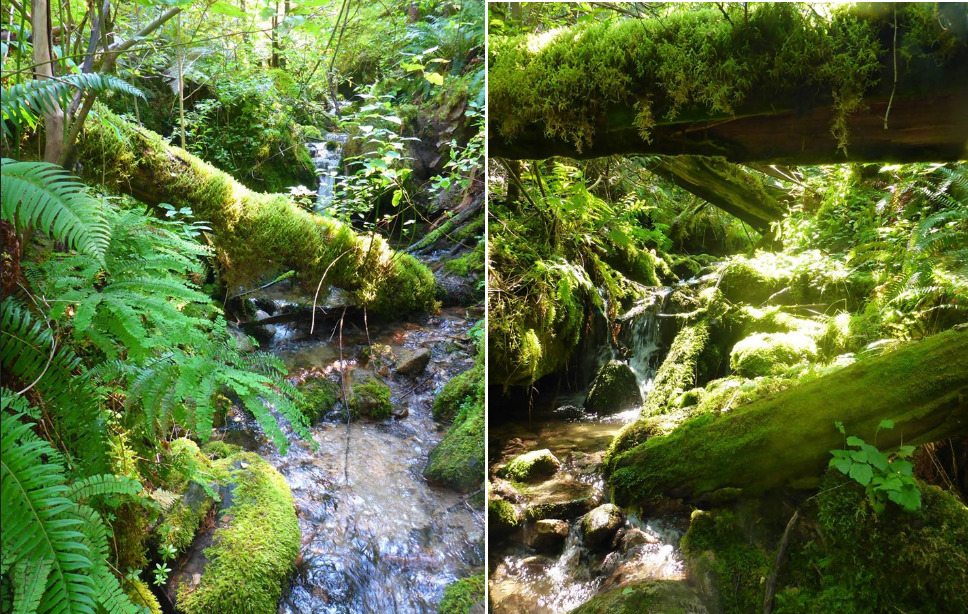
Superficially, the place may appear similar to the coastal rainforest of, say, (what is designated in political borders as) Washington or Oregon. But the presence of denser winter snows (and the presence of caribou) contribute to the inland region’s distinction.
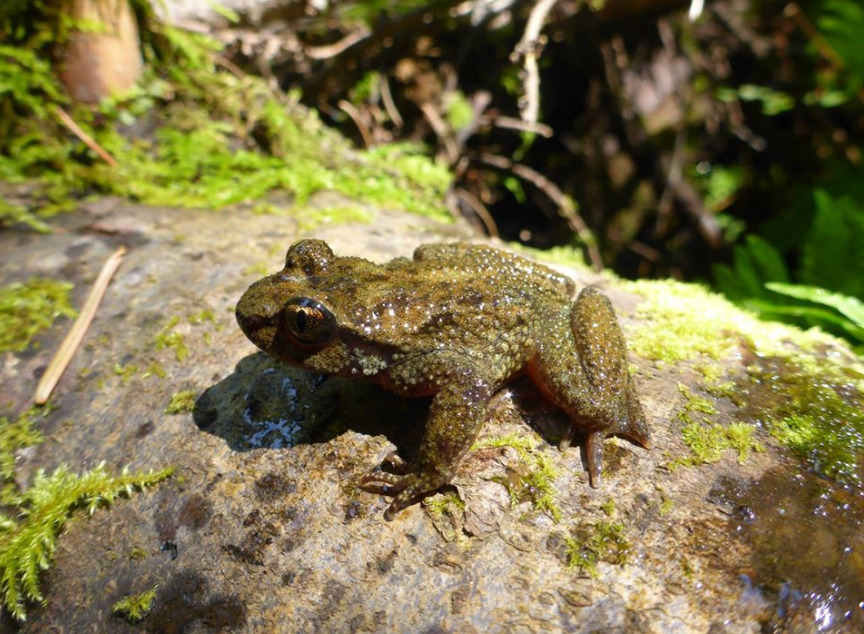
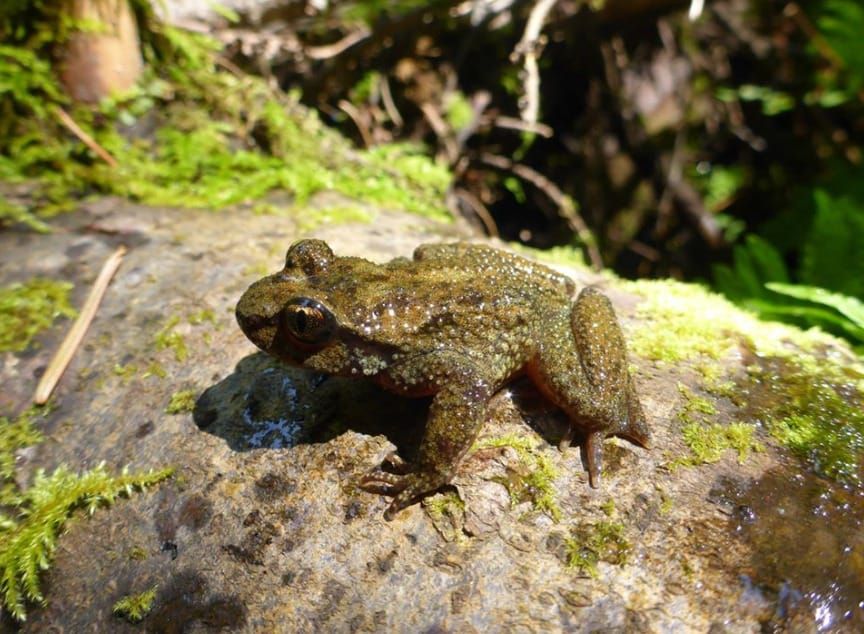
The frog (photo by me) is Ascaphus montanus (the “inland tailed frog” or “Rocky Mountain tailed frog”), and is endemic to the region (like the southern mountain caribou). The frogs are small, silent (no vocal cords, since mating-call singing wouldn’t be heard over the constant sound of rushing water), cold-tolerant, and highly-aquatic denizens of small mountain streams. Their tadpoles have suction-cup “sucker” mouths so that they can attach to rocks without getting carried away in the strong current of such fast-flowing streams. The “tail” in the name refers to the male’s organ (which facilitates internal fertilization, since sperm would also get washed away in the current), a rather unique feature among frogs.
In 2019, when the last of the southern mountain caribou were relocated outside of US borders, caribou were declared extinct within the contiguous US for the first time. The rainforest exists on traditional land of the Nez Perce, Qlispel, Pend O’Reille, and Sinixt peoples (the Sinixt being those were wrongfully declared “extinct” by the Canadian federal government decades ago, and who are now actively engaged in legal pursuit of recognition).
Basically, this is one place where a specific type of caribou not only inhabits mountain landscapes, but also depends on the presence of intact rainforest (for access to tree-hanging lichen in winter, facilitated by moist marine air uplifted against the western front of the Columbia Mountains).
Older maps (made using Microsoft Paint—the working-class GIS) because I wanted to give a shout out to the some of the rainforest’s iconic endemic amphibians (good indicators of the general distribution of the ecoregion itself).
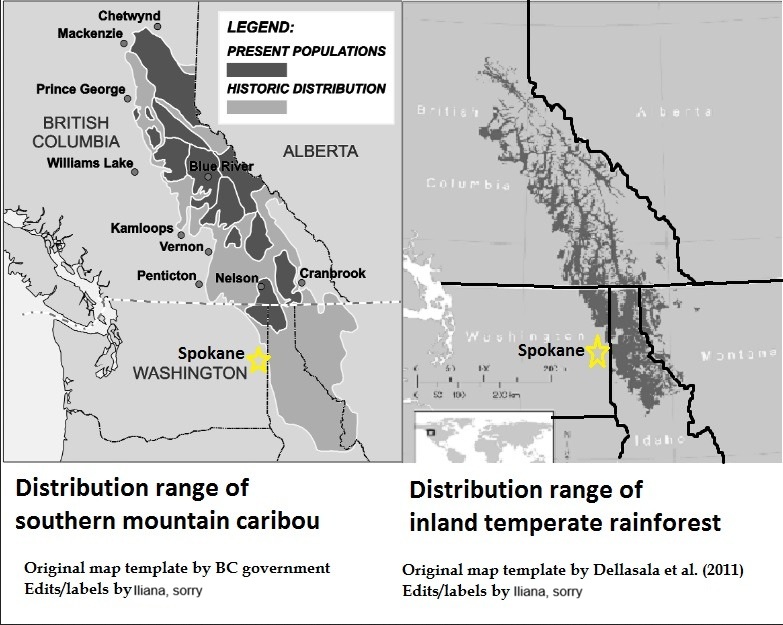
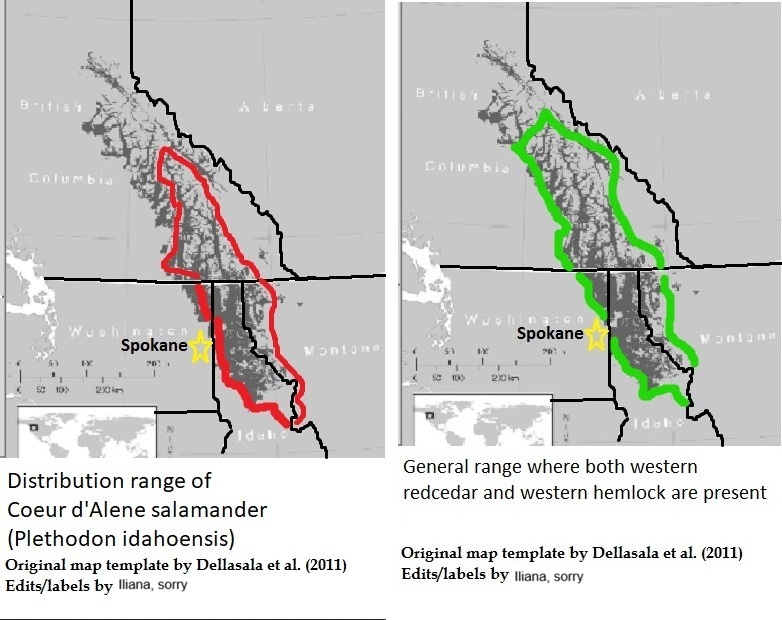
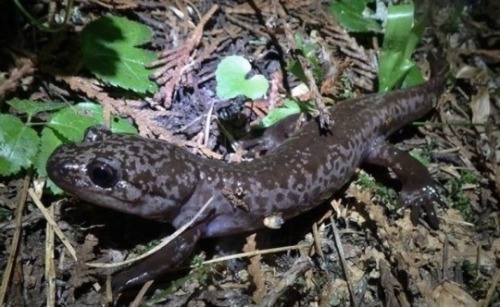
Another endemic species: Plethodon idahoensis (the “Coeur d’Alene salamander”), whose distribution range closely follows the limits of the inland temperate rainforest. Aside from seeps in talus slopes, these salamanders are usually subterranean for much of the year, and they apparently persist well in “waterfall spray zones,” where they hang out on the rock faces, doused in mist, next to the rainforest’s many small step-pool morphology waterfalls. I’ve also read that waterfall spray zones are important in the inland temperate rainforest specifically, because they provide adequate moisture for “oceanic species” of mosses and ground-dwelling plants.
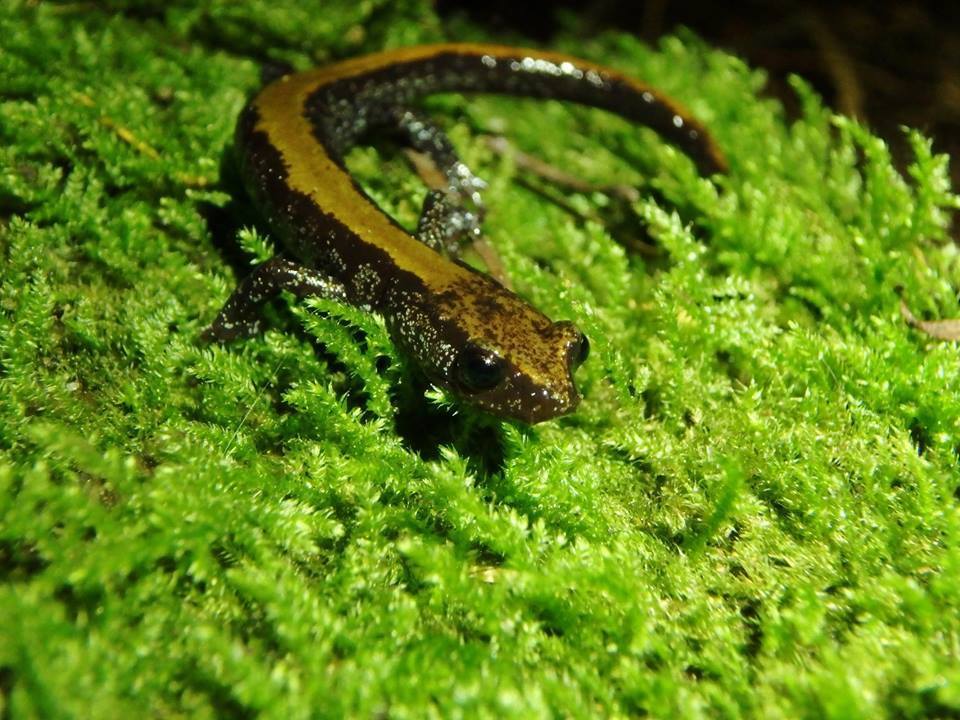
My favorite, of course (more on that at some other time!), is Dicamptodon aterrimus (the “Idaho giant salamander”), also endemic to the region but with a much more limited distribution. (Photo by me.)
Here, rainforest species more typical of the marine-influenced coast (amphibians, salmon, slugs, cedar, hemlock, ferns, mosses) mingle with species more typical of the Rockies and boreal forest (grizzly bear, gray wolf, wolverine, fisher, lynx, puma, moose, elk, caribou). Chinook salmon still migrate into the portions of the rainforest within US borders, and white sturgeon and other anadromous fish still live in the Canadian portion.
Many of the special endemic species of this rainforest are plants (like mosses and ferns), invertebrates (like molluscs and harvestmen), or amphibians (like giant salamanders and tailed frogs). So, maybe comparatively, the caribou is a “cuter” animal to use as a popular emblem. But also: There is a special relationship between lichen and caribou that seems very emblematic of how temperate rainforest involves many close relationships and exchanges between the sea and the land; rivers and forests; aquatic animals and terrestrial animals; etc.
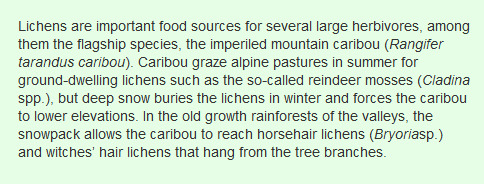
Since 2002, the Valhalla Wilderness Society has sponsored research on inland rainforest lichens […]. They have found that the inland temperate rainforests contain one of the richest tree lichen floras in the world – richer than BC’s coastal temperate rainforest. [The sponsored researchers] found more species of lichens in the Incomappleux Valley than tree, shrub, herb, grass and moss species combined. [Text and screenshot source: Valhalla Wilderness Society.]
Deep snow usually covers lichens growing on the ground, which would normally deprive caribou of access to wintertime food, so many caribou might usually avoid high elevations and deep snow of mountains in winter. However, the cedars and hemlock of the inland temperate rainforest have many lichens hanging from their branches, which are accessible as food for caribou throughout the winter.
In 2019, scholars Darwyn Coxon, Trevor Goward, and Jeffery Ross Wenrer published some updated maps illustrating the association/similarity with coastal rainforest.
They note:
Deep winter snow plays important roles in Inland Temperate Rainforests, preventing frost from penetrating into the ground and protecting shrubs, herbs and soil biota from extreme winter cold. Melt of the winter snowpack is vital for groundwater recharge, sustaining springs and seepage areas that support ancient cedar stands.
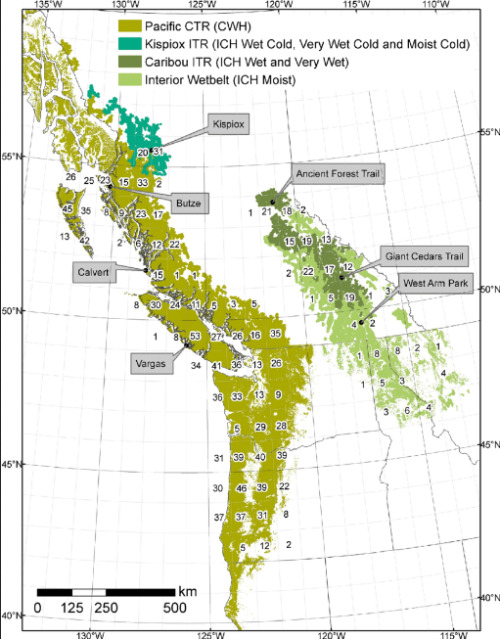
Map (and text excerpt) both from: Coxson, Goward, and Werner, “The Inland Temperate Rainforest and Interior Wetbelt Biomes of Western North America,” in Reference Module in Earth Systems and Environmental Sciences (Elsevier, 2019).
And what of the dwellers of the ground?
That’s where my attention is often drawn.
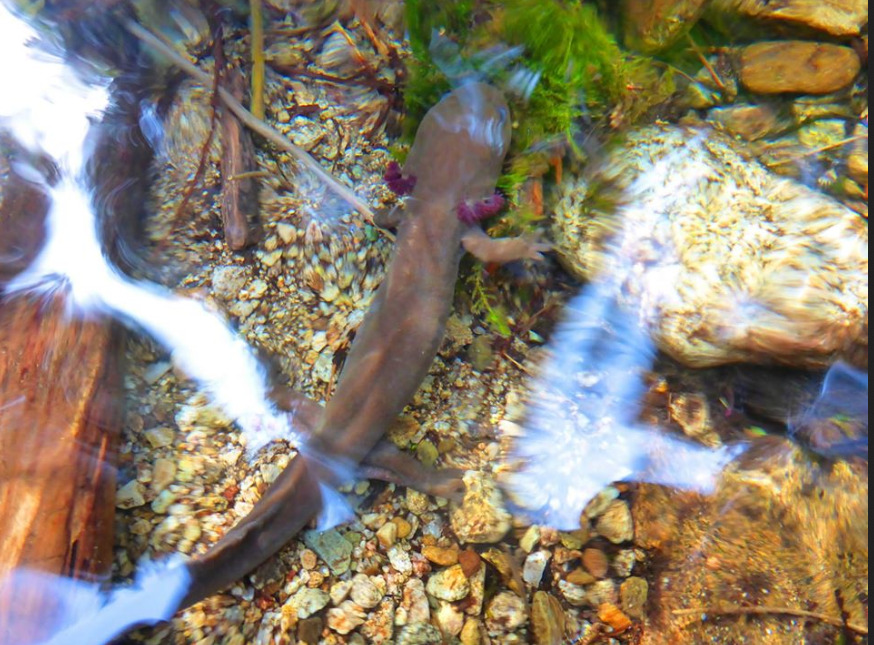
Here’s an aquatic larvae of the Idaho giant salamander (photo by me). Unlike most other salamanders, whose larvae live in still water like ponds or lakes or vernal pools, these salamander larvae live in the tumultuous and fast-flowing streams, where there are many little waterfalls and broken cedar logs creating nooks and crannies for hiding.
There are other “small” gems of the streamside and understory beneath the cedar branches.
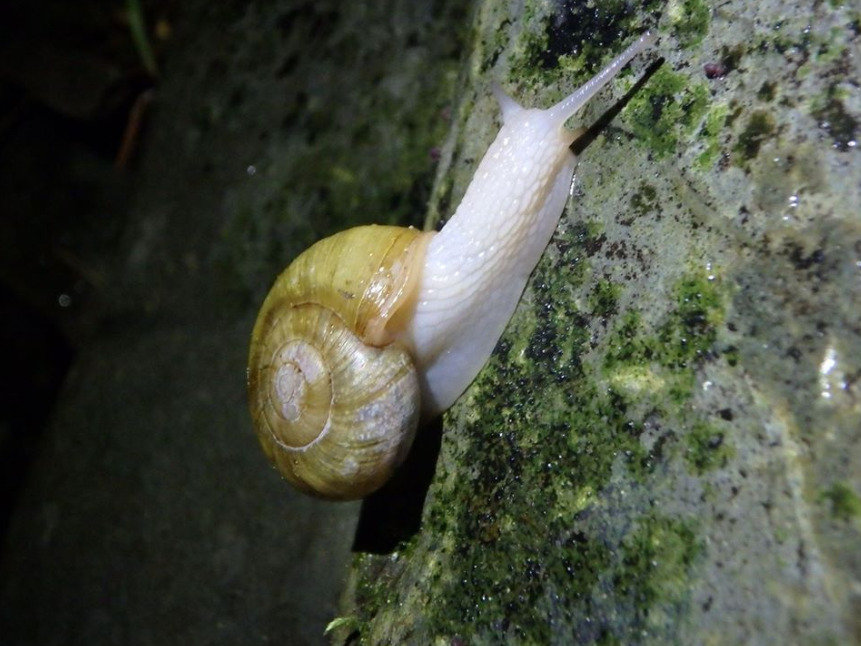
This slug struck me. Plenty of the molluscs of the region haven’t been thoroughly/formally described in detail.