Sinixt dispossession and a "caribou rainforest" (part 1 of 4): Extinction of mountain caribou in the contiguous US, timeline recap from 2018-2020
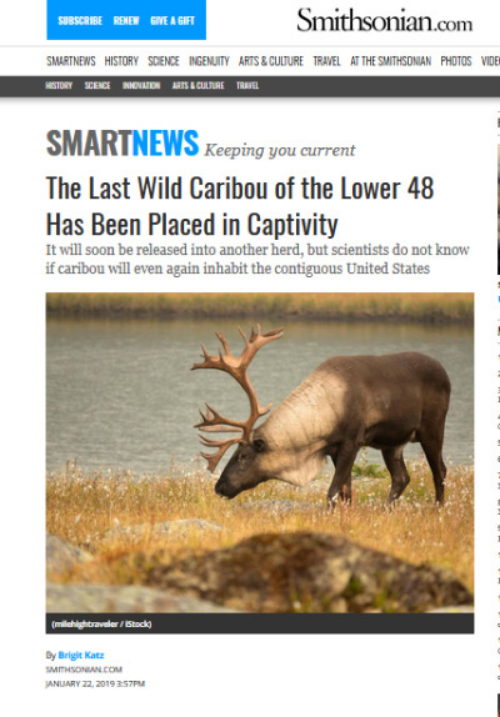
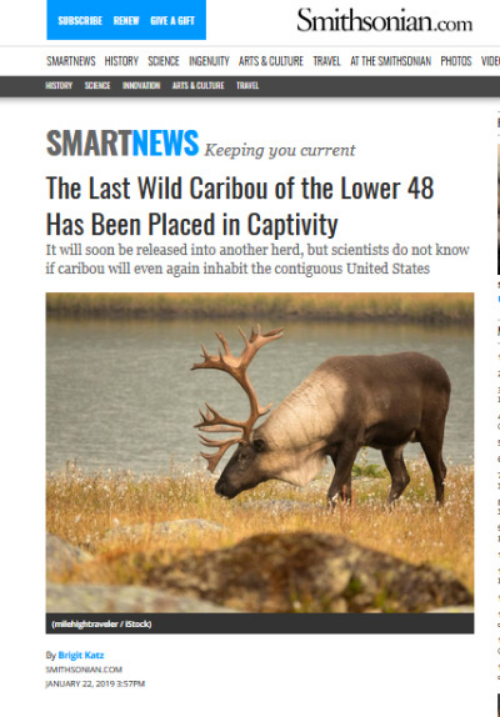
Originally posted elsewhere 30 January 2019:
A relict species of megafauna has barely held on to existence in the inland temperate rainforest region within borders of Washington, Idaho, and Montana. The “mountain caribou” or “southern mountain caribou” was the last native
"reindeer” to live in the Lower 48 of the United States right up until this winter. By the end of 2018, there were only three mountain caribou left in a small population known by biologists and land managers as the “South Selkirks herd.” This herd lived along the Canada-US border between Sandpoint (Idaho) and Nelson (British Columbia.
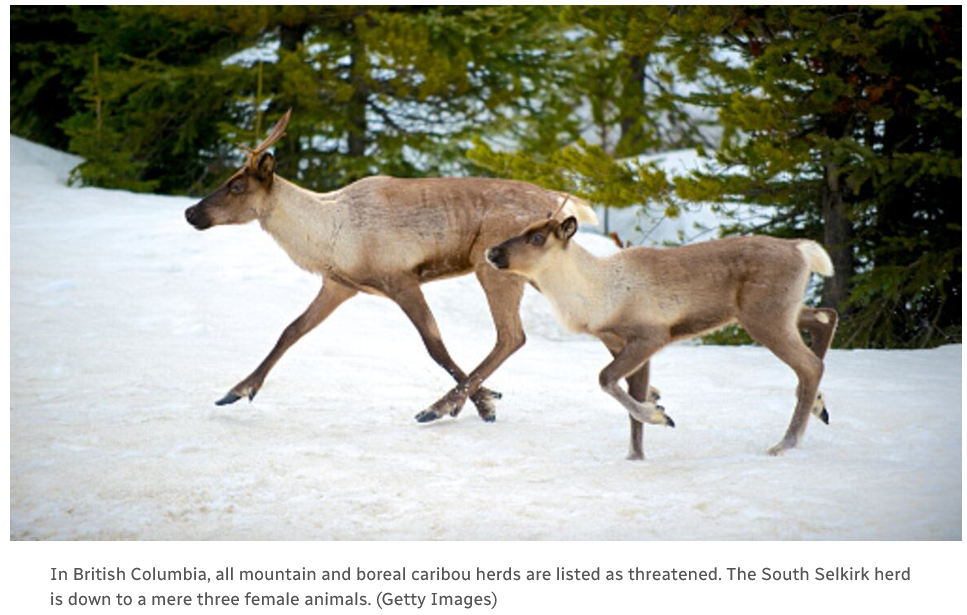
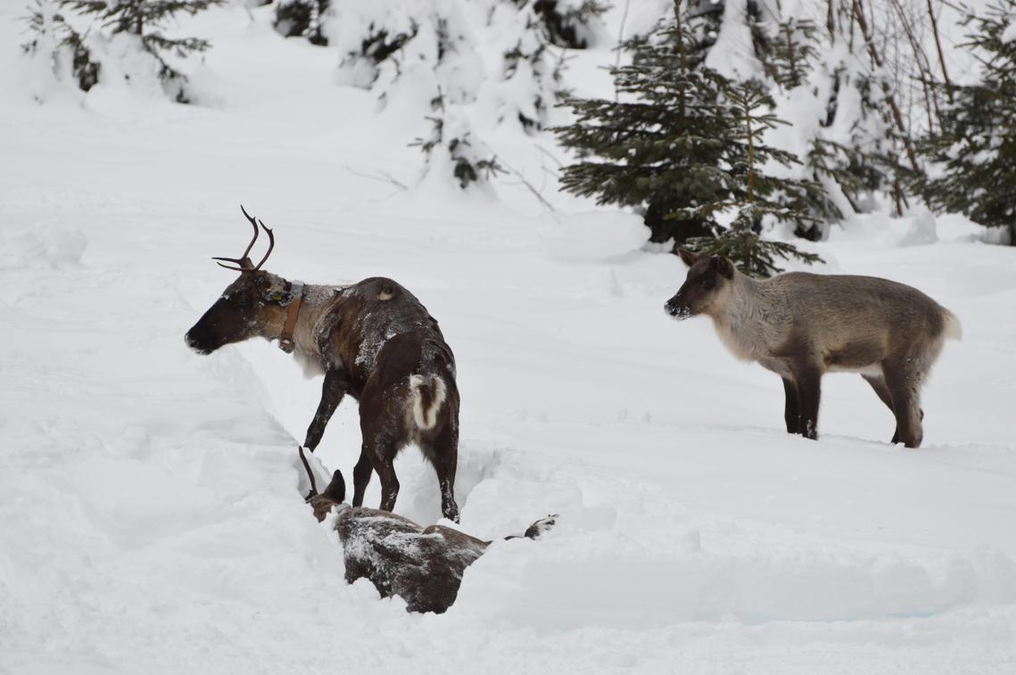
Here are a couple of individuals that were once a part of the South Selkirks herd (from CBC):
I’d used “working-class GIS” (Microsoft Paint, sorry!) to add layers to distribution maps to try to better frame what makes the southern mountain caribou rather unique (colored outlines and text caption added by me):
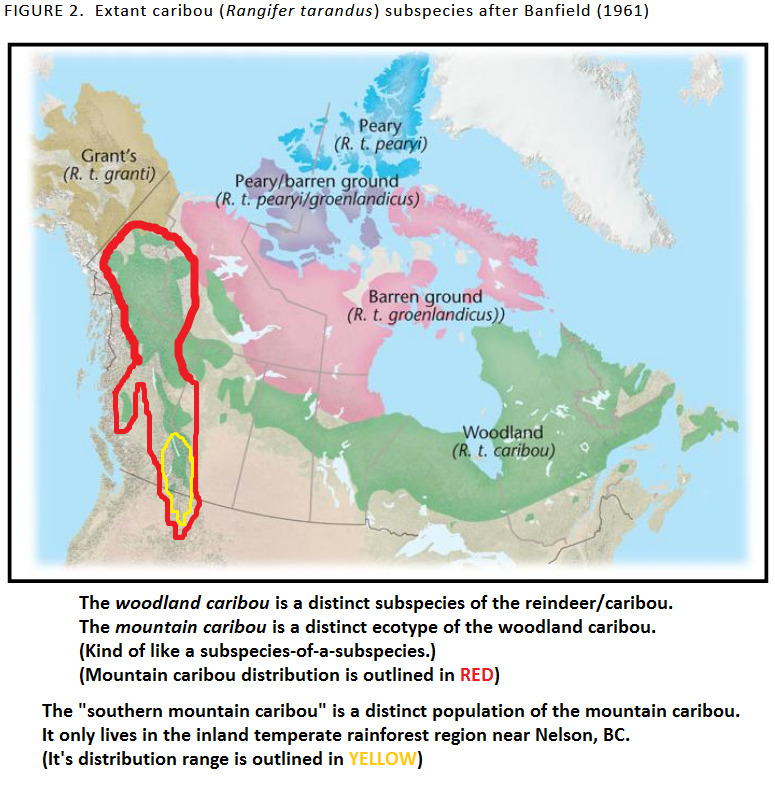
Here’s the historic distribution range of the southern mountain caribou before its extinction in the US, and a view of how closely the animal relies on temperate rainforest (original map source 1; and source 2; text captions added by me):
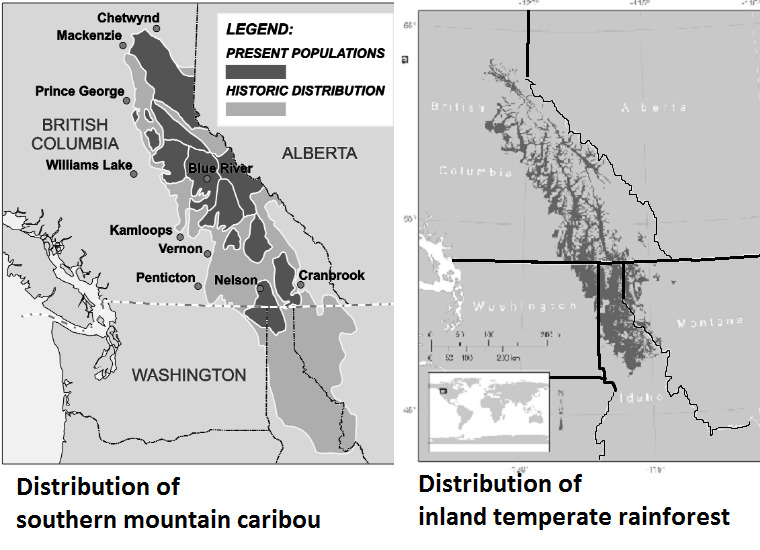
The southern mountain caribou is dependent on the fertile cedar-hemlock forest of the inland temperate rainforest, where they eat hanging mosses and lichens. As of January 2019, they have all been taken into captivity and will be relocated farther north in more reliable habitat in eastern British Columbia.
Here’s a look at one of the last US-dwelling individual caribou being transplanted and re-released. She was a part of the South Selkirks herd. BC provincial biologists found her hanging out near Creston; she was sedated 15 January 2019, and then released near Revelstroke—farther north in the interior rainforest region, in a space more mountainous and rugged than the Selkirks.
She’s pictured, here, laying down while recovering from sedation. The other two are also southern mountain caribou which were relocated, but they are transplants from the South Purcell herd which lives/lived along the US border near Cranbrook (BC) and Yaak (Montana), adjacent to the original location of the South Selkirks herd.
(The following text was an addition to this piece, written in October 2019.)
These headlines chart events in British Columbia and the US’s Pacific Northwest, beginning with the extinction of caribou in the contiguous United States in January; followed by the British Columbia provincial government’s approval of new clearcuts, corporate logging contracts, wolf-shooting proposals, and pipeline construction in critical caribou habitat; then, in October, the US federal government finally listed the caribou as formally endangered as local First Nations in BC prepare to propose their own caribou-management plans. (Most of these headlines come from Sarah Cox’s reporting for The Narwhal, one of the only outlets to have publicized this saga.)
January 2019: Caribou are extinct in the contiguous United States, as the last 3 members of the South Selkirks herd of southern mountain caribou are taken from Idaho and relocated to near Revelstroke in BC.
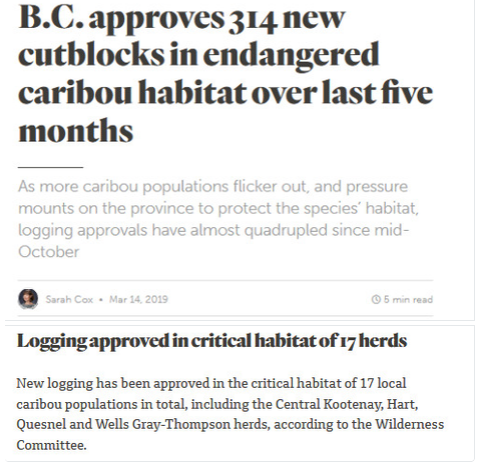
14 March 2019: “BC approves 314 new cutblocks in endangered caribou habitat over last five months.”
16 April 2019: “Caribou protection plan spawns racist backlash in northeast BC.”

26 April 2019: “Canadian Energy Pipeline Association to lobby BC government on endangered caribou plans.”

7 August 2019: “‘Deliberate extinction’: extensive clear-cuts, gas pipeline approved in endangered caribou habitat.”


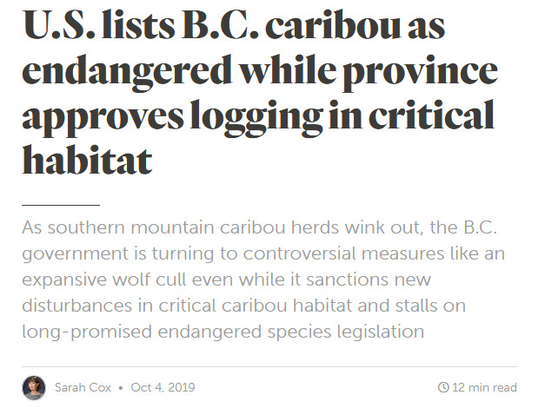
4 October 2019: “US lists BC caribou as endangered while province approves logging in critical habitat.”
6 October 2019: “First Nation in BC to devise own caribou herd-management plan, blames province for not doing enough.” (The Globe and Mail.)
The Tsilhqot’in National Government announced plans to draft their own herd-management plan for southern mountain caribou, as an alternative to the British Columbia provincial government’s continued allegiance to logging, development, and fossil fuel pipelines. This announcement comes a couple of days after the United States federal government announced, on 2 October 2019, that it would finally extend Endangered Species Act protections to most herds of southern mountain caribou.
--
Kalispel tribal authorities had been involved in some interesting caribou protection projects, one of which really highlights the importance of arboreal lichens for the survival of the highly endangered southern mountain caribou.
From early 2018, a press release from the Kalispel Department of Natural Resources:
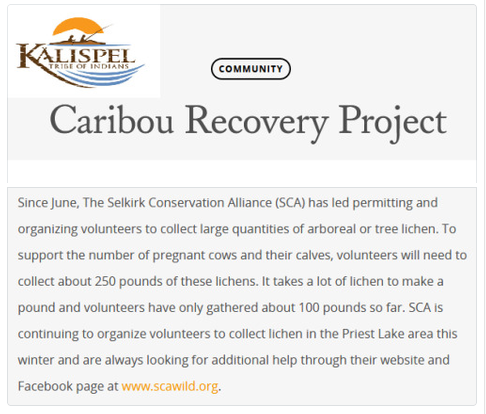
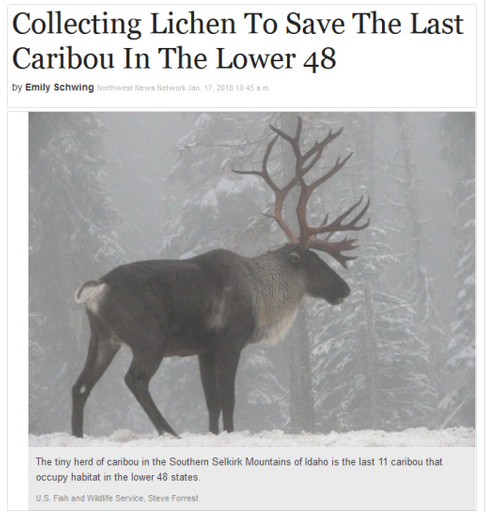
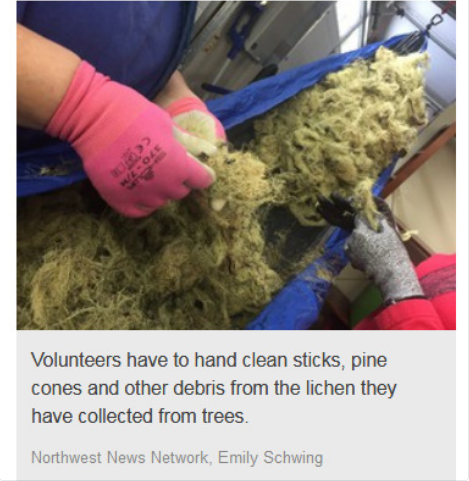
The lichen was being collected in order to feed southern mountain caribou during the spring of 2018, while they were being held in a “maternity pen” in the Kootenay region of British Columbia, since those caribou wouldn’t be able to leave the pen to forage for food. The pen was to protect the pregnant caribou and newborn calves from wolves, puma, and human interference. But the project was actually shelved due to extreme snow depth. This project took place right before the contiguous US’s last caribou herd disappeared, with caribou being declared extinct within the contiguous US in January 2019.
Why lichen?
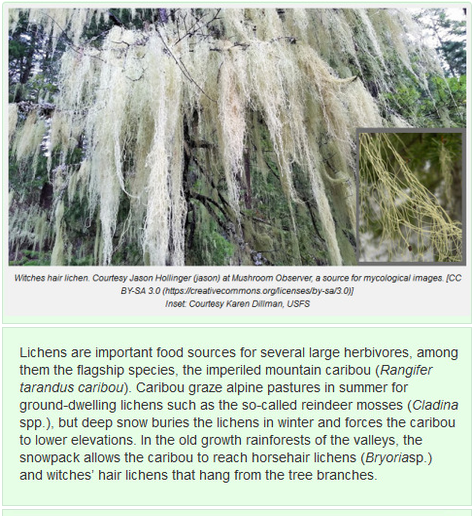
So, you know that image of Arctic caribou (including the aptly named subspecies “barren-ground caribou”), an image of the ungulate grazing on terrestrial lichens which blanket taiga soils in rich color? Caribou feed on lichen. “Oh, so it makes sense that the inland temperate rainforest region would host caribou, since temperate rainforest is associated with lush mosses, lichens, and ferns.” Not so fast: This interior wet-belt of forests differs from the more “classic” rainforest of the Pacific Northwest’s coastline. On the coast, marine air moderates winter climate, leading to milder winters and more rain—therefore, more exposed/accessible lichen yearround. However, the inland temperate rainforest region is much more prone to snow in winter, given influences of continental climate and the rugged slopes of the Columbia Mountains and Canadian Rockies. How do southern mountain caribou, then, access lichen? They often aim for hanging lichens, which drape cedar, hemlock, and fir branches even when snow is on the ground.
See Susan Woodward’s write-up for Radford University’s Terrestrial Biomes series:
So the Kalispel tribal project preserved lichen on behalf of the dwindling caribou:
Activists from other First Nations echo the Kalispel project.
In the (northern hemisphere) summer of 2019, the National Campus and Community Radio Association (NCRA) granted Sinixt activist and storyteller Marilyn James (and Kootenay Co-Op Radio) its annual Neskie Manuel Award for Aboriginal Affairs and Culture Programming to the audio episode “In the Shadow of Extinction.” A part of the Sinixt Stories: Ancestral Roots, Cultural Seeds program produced by Catherine Fisher (also a member of the Blood of Life Collective) for Kootenay Co-Op Radio, the episode features narration from James and fellow Sinixt knowledge-keeper Taress Alexis. James describes her relative Ambrose Adolph’s experiences with caribou during the 1930s and 1940s, as well as the more contemporary decline of southern mountain caribou in the inland temperate rainforest region—the Sinixt tum’xula7xw.
James, in the episode, laments:
As settlers began settling the area, like Ambrose said, open spaces were dissected by fences and fields. It becomes critical for the survival of migratory animals for settlers and people to make way for those travel corridors, but that was never considered… Now, the caribou are like the Sinixt, they’re just a shadow of the landscape - you don’t see them, and when you do see them it’s kind of a vision because they’re so rare. And it was such a natural aspect to this landscape in the past.
—
The Sinixt people themselves were confronted by Canadian nation-building disavowals, particularly in 2019. (See following posts.)